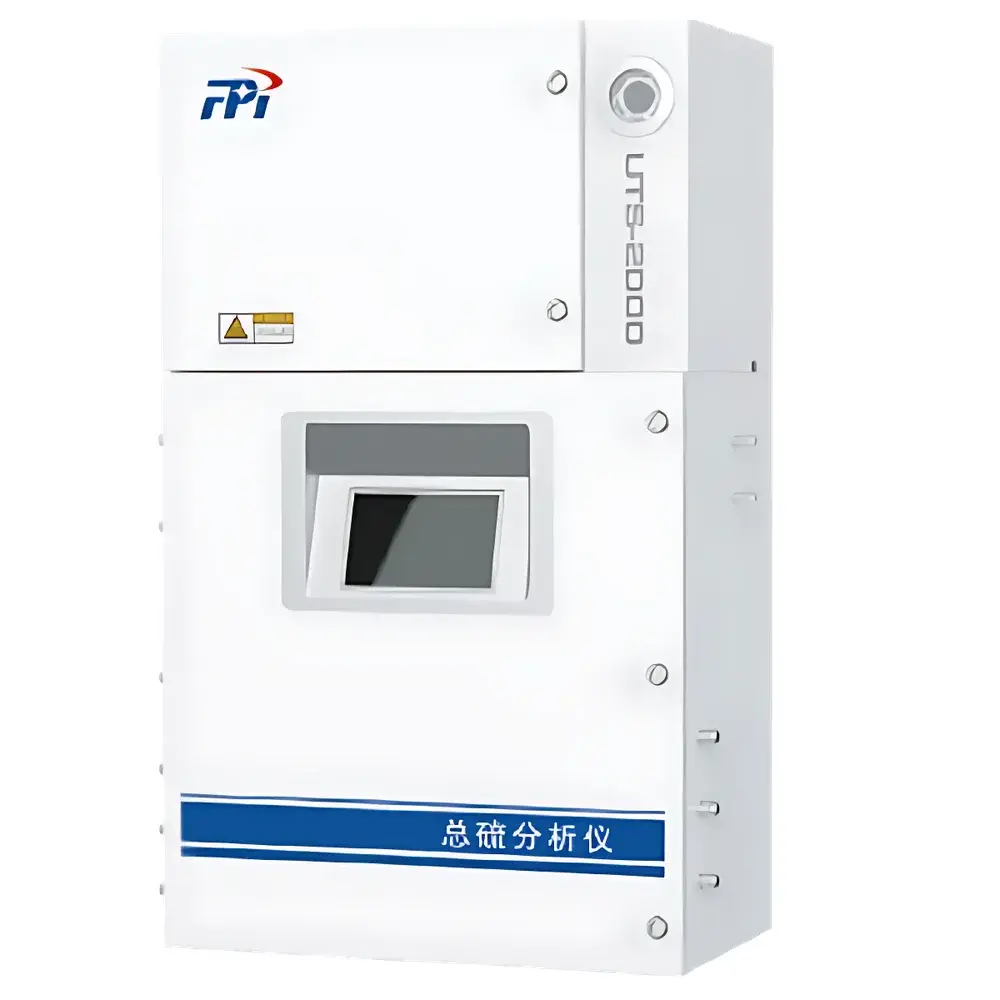
UTS-2000 UV Fluorescence Total Sulfur Analyzer by FPI (Hangzhou Focus Photonics)
| Brand | FPI (Focus Photonics) |
|---|---|
| Origin | Zhejiang, China |
| Manufacturer Type | Original Equipment Manufacturer (OEM) |
| Regional Classification | Domestic (China-made) |
| Model | UTS-2000 |
| Pricing | Upon Request |
Overview
The UTS-2000 UV Fluorescence Total Sulfur Analyzer is a high-performance, laboratory- and field-deployable analytical instrument engineered for the precise quantification of total sulfur content in gaseous and liquid hydrocarbon streams. It operates on the principle of ultraviolet fluorescence detection following high-temperature oxidative combustion—a method standardized in ASTM D5453, ISO 20846, and UOP 971. Sample introduction is followed by complete catalytic oxidation in an oxygen-rich quartz furnace at temperatures exceeding 1000 °C, ensuring quantitative conversion of all organic and inorganic sulfur species—including thiophenes, mercaptans, sulfides, disulfides, and elemental sulfur—into sulfur dioxide (SO₂). The generated SO₂ is carried by ultra-pure argon or helium into a reaction chamber, where it is excited by pulsed UV light (190–230 nm); subsequent fluorescence emission at 320–380 nm is detected by a low-noise photomultiplier tube (PMT). This photometric signal is linearly proportional to sulfur concentration over a dynamic range spanning sub-ppb to low-ppm levels, enabling trace-level compliance monitoring and process optimization.
Key Features
- Sub-second measurement cycle time—real-time output within ≤1.5 seconds after sample injection, supporting closed-loop process control and rapid compositional feedback
- 100% sulfur recovery efficiency across diverse matrices, validated against certified reference materials (CRMs) per ISO/IEC 17025 calibration protocols
- Compact footprint (W × D × H: 450 × 550 × 320 mm) and IP54-rated outdoor enclosure option, permitting direct installation adjacent to sampling points without requiring climate-controlled analyzer shelters
- Integrated thermal mass flow controller (MFC) and pressure-regulated combustion gas delivery system for stable stoichiometric oxidation conditions
- Quartz combustion tube with proprietary catalyst formulation resistant to halogen and metal poisoning, extending service life beyond 12 months under continuous operation
- Self-diagnostic firmware with real-time sensor health monitoring, automatic zero/span verification, and alarm-triggered event logging
Sample Compatibility & Compliance
The UTS-2000 accepts gaseous samples (natural gas, refinery fuel gas, syngas) and liquid-phase feeds (naphtha, diesel, LPG, biofuels, crude oil distillates) via heated sampling lines (up to 180 °C) and vaporization modules. All wetted components are constructed from sulfur-inert materials (e.g., fused silica, Hastelloy C-276, PTFE), minimizing adsorption losses and memory effects. The analyzer meets applicable requirements for hazardous area classification (Class I, Division 2, Groups B, C, D per NEC/CEC) when installed in outdoor cabinets. Data integrity complies with FDA 21 CFR Part 11 through audit-trail-enabled software, electronic signatures, and secure user-role access control. Routine performance qualification follows ASTM D7166 and ISO 8573-1 for compressed gas purity assurance.
Software & Data Management
FPI Analytix™ Suite v3.2 provides full instrument control, method configuration, calibration management, and trend analysis. The software supports automated multi-point calibration curves (linear, quadratic, or spline-fit), drift correction algorithms, and statistical process control (SPC) charting. Raw spectral data, PMT gain history, combustion temperature logs, and gas flow profiles are stored in vendor-neutral .CSV and .XML formats. Integration with DCS/SCADA systems is achieved via Modbus TCP/IP or OPC UA protocols; optional MQTT support enables cloud-based telemetry for predictive maintenance analytics. All audit trails—including operator actions, calibration events, and parameter modifications—are timestamped, immutable, and exportable for GLP/GMP regulatory review.
Applications
- Natural gas custody transfer and pipeline quality assurance (meeting GPA 2145, AGA Report No. 8)
- Catalyst protection monitoring in hydrotreating, reforming, and FCC units across petroleum refineries
- Coal gasification and biomass-derived syngas sulfur speciation pre-cleanup
- Metallurgical off-gas analysis in zinc/lead smelting and steelmaking processes
- Food-grade ethanol and edible oil refining—ensuring compliance with EU Regulation (EC) No. 1333/2008 sulfur limits
- Environmental emissions monitoring for EPA Method 15/16 compliance in flare gas and vent stream characterization
FAQ
What sulfur species does the UTS-2000 detect?
It measures total sulfur as SO₂-equivalent after complete oxidative conversion—covering all organosulfur compounds (e.g., thiols, sulfones, thiophenes) and inorganic forms (H₂S, SO₂, elemental S, sulfate aerosols).
Is carrier gas purity critical for accuracy?
Yes. Ultra-high-purity argon (≥99.999%) or helium (≥99.9995%) is required to prevent quenching of UV fluorescence and baseline noise; built-in gas purifiers are recommended for field deployment.
Can the UTS-2000 be integrated into existing DCS networks?
Yes—via native Modbus TCP/IP or OPC UA interfaces with configurable polling intervals (1–60 s) and alarm forwarding to plant-wide notification systems.
What maintenance intervals are recommended for routine operation?
Combustion tube inspection every 3 months; PMT gain recalibration quarterly; full system performance verification semiannually per ISO/IEC 17025 internal QA procedures.
Does the analyzer support remote diagnostics?
Yes—through secure SSH-enabled firmware access and embedded web server for live status viewing, log download, and firmware updates without onsite technician dispatch.
Related Products