
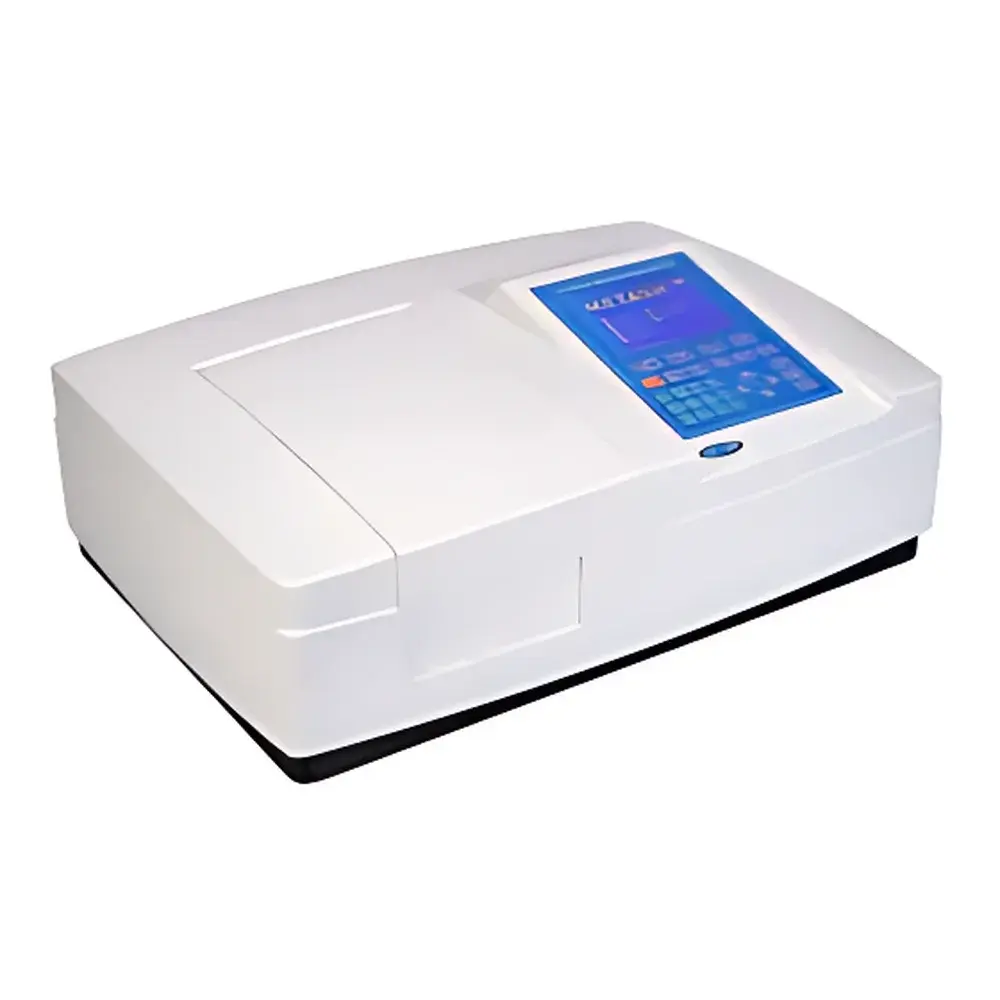
UV-8000 Dual-Beam Ultraviolet-Visible Spectrophotometer
| Brand | Jihepu (Jinan Hepu) |
|---|---|
| Origin | Shandong, China |
| Model | UV-8000 |
| Optical System | Dual-beam |
| Detector | Photodiode Array (PDA) |
| Wavelength Range | 190–1100 nm |
| Spectral Bandwidth | 1.8 nm |
| Wavelength Accuracy | ±0.1 nm (at D₂ line, 656.1 nm), ±0.3 nm (full range) |
| Stray Light | ≤0.05% T |
| Wavelength Repeatability | ≤0.1 nm |
| Photometric Accuracy | ±0.2% T |
| Photometric Repeatability | ≤0.1% T |
| Baseline Flatness | ±0.001 A |
| Drift | ±0.0004 A/h (at 500 nm) |
| Noise | ±0.0005 A/h |
| Photometric Range | 0–200% T, –4.0 to +4.0 A, 0–9999 C |
| Display | 320 × 240 pixel, 6-inch high-brightness LCD |
| Data Interface | USB |
| Power Supply | AC 220 V/50 Hz or 110 V/60 Hz |
| Dimensions | 625 × 430 × 210 mm |
| Weight | 28 kg |
Overview
The Jihepu UV-8000 Dual-Beam Ultraviolet-Visible Spectrophotometer is an analytical instrument engineered for precision absorbance and transmittance measurements across the ultraviolet, visible, and near-infrared spectral regions (190–1100 nm). It operates on the principle of dual-beam optical path compensation—splitting the incident light into sample and reference beams simultaneously—to eliminate errors caused by source intensity fluctuations, lamp aging, or electronic drift. This architecture ensures high photometric stability and long-term measurement reproducibility, making it suitable for routine QC/QA applications in pharmaceutical, environmental, biochemical, and academic laboratories. The system employs a high-stability deuterium lamp for UV emission and a tungsten-halogen lamp for visible/NIR output, both with extended operational lifetimes. Light dispersion is achieved via a precision grating monochromator, while detection utilizes a linear photodiode array (PDA) for rapid, noise-resilient signal acquisition without mechanical scanning.
Key Features
- Dual-beam optical design with real-time reference beam correction, minimizing baseline drift and enhancing measurement fidelity over extended acquisition periods.
- High-resolution monochromator with fixed 1.8 nm spectral bandwidth, optimized for balancing resolution and signal-to-noise ratio in compliance with ISO 9001 and ASTM E275-22 spectral performance guidelines.
- Robust mechanical architecture: optical components are mounted on a 16 mm thick machined aluminum baseplate, decoupled from chassis vibration and thermal expansion effects via suspended optical bench design.
- Advanced electronics featuring ARM-based embedded controller, 24-bit high-speed analog-to-digital conversion, and synchronized sine-bar wavelength drive mechanism ensuring ≤0.1 nm wavelength repeatability.
- 6-inch high-brightness LCD (320 × 240 pixels) with intuitive menu navigation; supports standalone operation for photometric, quantitative, kinetic, multi-wavelength, and nucleic acid/protein analysis modes.
- Comprehensive photometric validation suite—including baseline flatness (±0.001 A), stray light suppression (≤0.05% T at 220 nm), and photometric accuracy (±0.2% T)—aligned with USP and EP 2.2.25 requirements for spectrophotometric instrumentation.
Sample Compatibility & Compliance
The UV-8000 accommodates standard 10 mm rectangular quartz or glass cuvettes (pathlengths 1–100 mm optional via accessory holders), supporting liquid, suspension, and thin-film samples. Its optical configuration complies with international standards for spectrophotometric validation, including ISO/IEC 17025:2017 method verification protocols and GLP-relevant traceability frameworks. While not pre-certified for FDA 21 CFR Part 11, the instrument’s data integrity features—including time-stamped audit logs, user-access control tiers, and non-editable raw data export via USB—support implementation within regulated environments when integrated with validated laboratory information management systems (LIMS).
Software & Data Management
Bundled Jihepu SpectraScan software enables full PC-based instrument control, spectral acquisition, derivative analysis, peak identification, and custom calibration curve generation. Raw absorbance spectra are stored in ASCII-compatible formats (.csv, .txt) and native binary files with metadata headers (wavelength, date/time, operator ID, instrument serial number). Software supports batch processing, comparative overlay of up to 12 spectra, and export to Excel, Origin, or MATLAB for advanced statistical modeling. All data exports retain full traceability, and the software architecture permits integration with third-party platforms via COM/ActiveX interfaces—facilitating automated workflows in GMP-compliant manufacturing settings.
Applications
- Quantitative analysis of active pharmaceutical ingredients (APIs) per USP , including assay validation and dissolution testing.
- Enzyme kinetics and protein quantification using Bradford, Lowry, or BCA methods; DNA/RNA concentration and purity assessment (A₂₆₀/A₂₈₀ ratios).
- Environmental monitoring: nitrate, phosphate, and heavy metal ion determination via colorimetric assays (e.g., EPA Method 365.3).
- Quality control of dyes, pigments, and polymer additives through spectral fingerprinting and stability profiling under accelerated aging conditions.
- Educational use in undergraduate chemistry and biochemistry labs for Beer–Lambert law validation, equilibrium constant determination, and ligand-binding studies.
FAQ
What wavelength calibration standards are recommended for routine verification?
NIST-traceable holmium oxide and didymium filters are recommended for wavelength accuracy checks at 241.1, 279.4, 287.5, 333.7, 360.9, 418.5, 460.0, 484.5, 536.2, and 637.5 nm.
Does the UV-8000 support GLP-compliant audit trails?
Yes—the embedded firmware records all measurement events with timestamps, operator IDs, and parameter configurations; audit logs are exportable and immutable in raw format.
Can the instrument perform kinetic measurements over extended durations?
Yes—equipped with programmable time-scan mode (up to 9999 points), adjustable interval (0.01–9999 s), and auto-zero referencing between cycles to maintain baseline integrity.
Is the photodiode array detector cooled?
No—the PDA operates at ambient temperature; however, its low dark-current design and 24-bit digitization ensure sufficient dynamic range (A = –4.0 to +4.0) without thermoelectric cooling.
What maintenance is required for long-term optical stability?
Annual verification of lamp alignment and grating calibration is advised; desiccant replacement every 6 months prevents humidity-induced optical degradation in humid environments.
Related Products






