
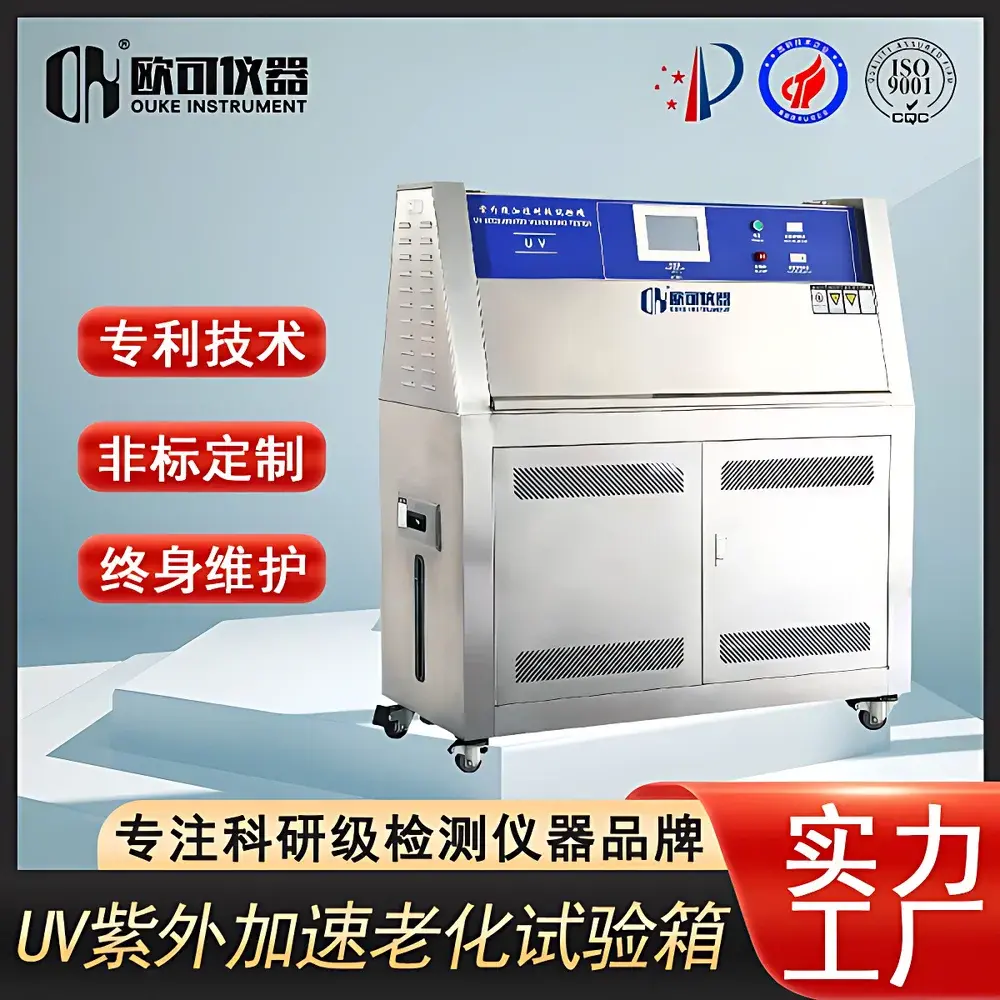
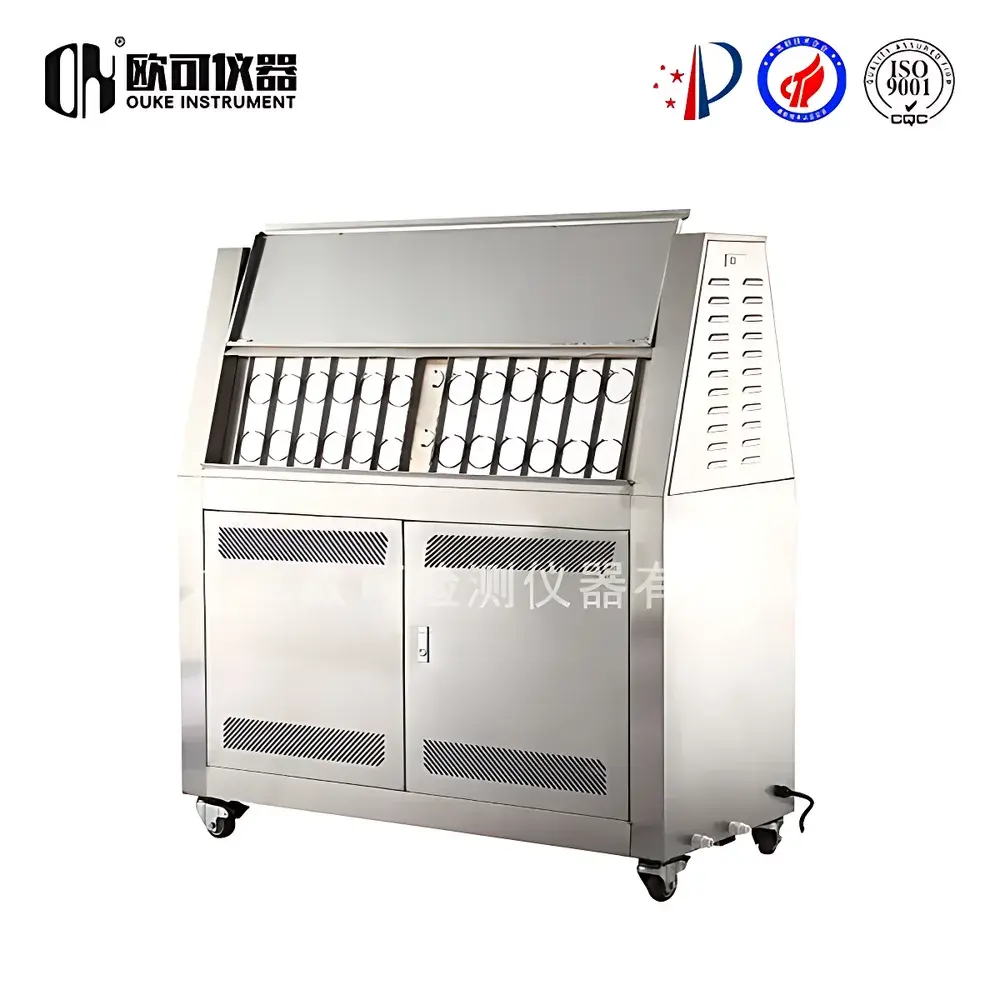
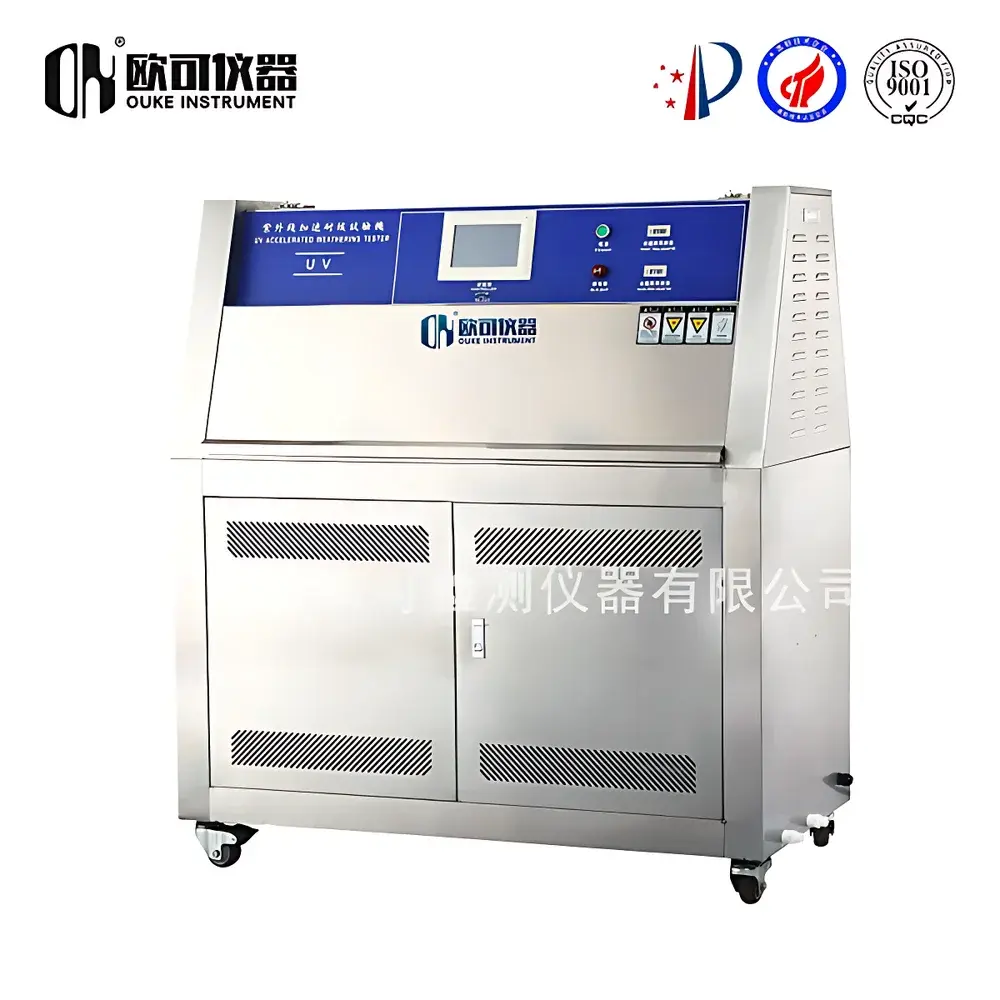
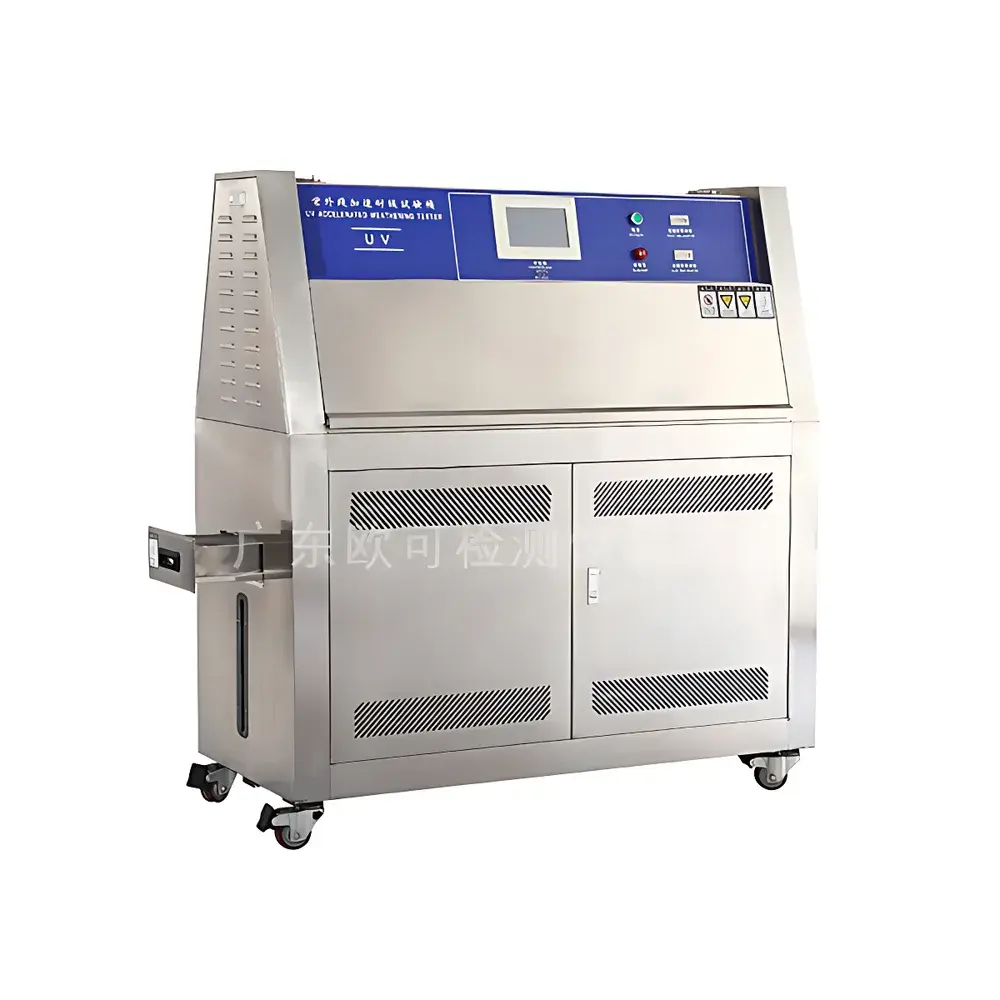
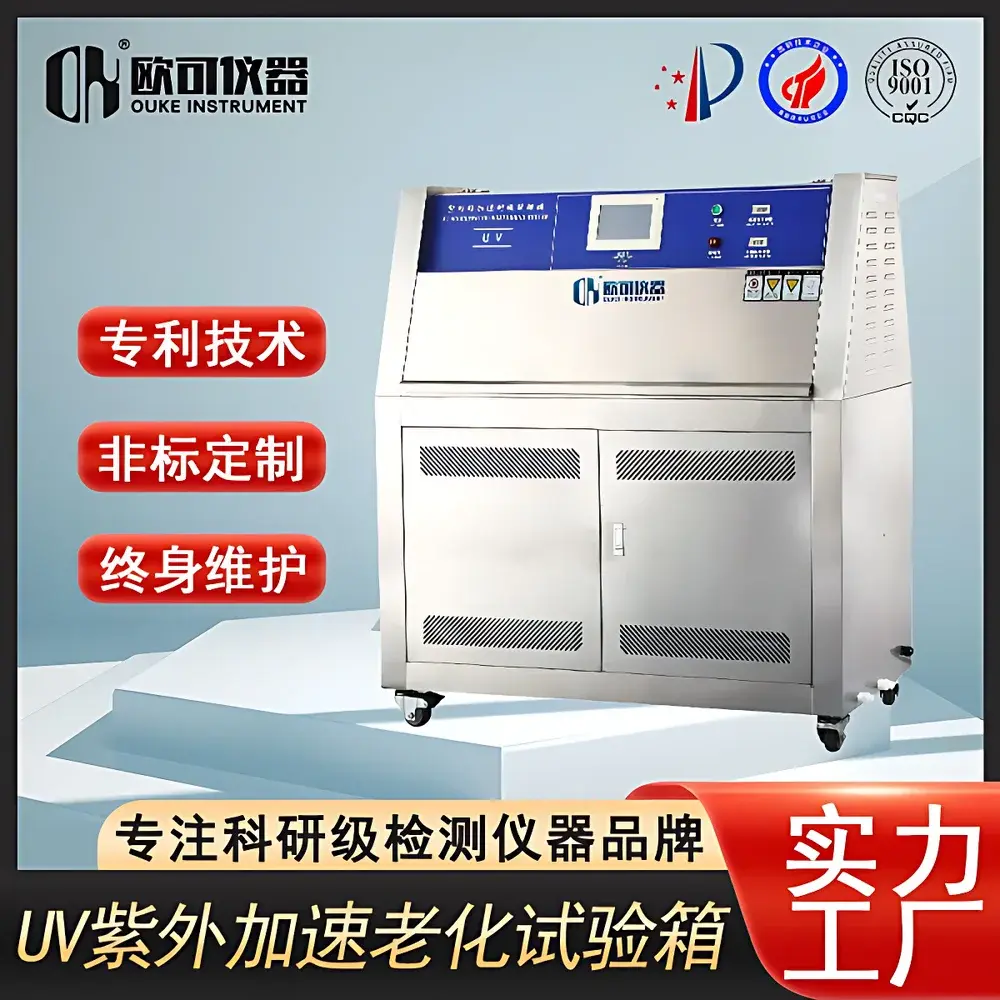
OK UV Aging Test Chamber OK-UV-290
| Brand | OK Instruments |
|---|---|
| Origin | Guangdong, China |
| Manufacturer Type | Direct Manufacturer |
| Product Category | Domestic |
| Model | OK-UV-290 |
| Humidity Range | ≥95% RH (in-chamber actual value) |
| Lamp Power | 40 W per tube |
| Irradiance Range | 0.72 W/m² |
| Exposure Time | 1–9999 h (adjustable) |
| Illumination Temperature Range | RT to 70 °C |
| UV Wavelength Range | 280–400 nm |
| Chamber Dimensions (L×W×H) | 1170 × 400 × 400 mm |
Overview
The OK UV Aging Test Chamber OK-UV-290 is a precision-engineered environmental test system designed to accelerate the photochemical degradation of polymeric and organic materials under controlled ultraviolet (UV) irradiation, condensation, and thermal cycling. It operates on the principle of fluorescent UV lamp-based photodegradation—specifically simulating the most damaging portion of terrestrial solar radiation (280–400 nm)—while integrating programmable condensation and optional water spray cycles to replicate dew formation and rain exposure. Unlike full-spectrum xenon arc testers, this chamber focuses on UV-driven aging mechanisms, making it ideal for evaluating surface-level degradation phenomena including chalking, gloss loss, color shift, cracking, embrittlement, and adhesion failure. Its architecture conforms to the physical and operational requirements of ASTM G154, ISO 4892-3, and GB/T 16422.3, supporting standardized cyclic testing protocols such as UV irradiation at elevated temperature followed by dark condensation or water spray phases.
Key Features
- Stainless steel interior chamber (304 grade) with double-wall insulation and anti-condensation heating jacket for uniform thermal distribution and long-term corrosion resistance.
- Interchangeable UV lamp configuration: Compatible with UVA-340 (peak 340 nm, spectral match to solar UV below 365 nm) and UVB-313 (peak 313 nm, higher-energy output for aggressive qualification testing).
- Precise irradiance control at 0.72 W/m² (measured at sample plane, 340 nm), maintained via calibrated sensor feedback loop—ensuring reproducibility across test runs and inter-laboratory comparisons.
- Programmable multi-stage cycles: Independent control of UV exposure duration (1–9999 h), black-panel temperature (RT to 70 °C), condensation time (heated water pan-induced dew cycle), and optional water spray intervals (pressure-regulated nozzles, deionized water compatible).
- Intelligent touchscreen controller with built-in data logging, real-time parameter monitoring, password-protected user profiles, and USB export capability for audit-ready test records.
- Integrated safety systems: Overtemperature cutoff, lamp overcurrent protection, door interlock, and UV-blocking viewing window with visible-light transmission for safe observation without interruption.
Sample Compatibility & Compliance
The OK-UV-290 accommodates flat or moderately contoured specimens up to 1170 mm in length, with standard sample racks accommodating 24 standard 75 × 150 mm panels. It supports non-destructive mounting of coated substrates, extruded profiles, molded parts, and textile swatches. All operational parameters—including irradiance setpoint, temperature ramp rates, and cycle sequencing—are traceable and configurable to meet GLP-compliant documentation requirements. The system’s control firmware logs timestamped events (lamp on/off, temperature deviation >±1 °C, humidity excursions) in accordance with FDA 21 CFR Part 11 data integrity principles when paired with secure networked storage. Testing protocols align with material-specific standards: ASTM D4329 for plastics, ASTM D4587 for coatings, ISO 11507 for automotive finishes, and AATCC TM186 for outdoor textiles.
Software & Data Management
The embedded controller features a deterministic real-time OS with non-volatile memory for storing ≥100 test programs and ≥30 days of continuous parameter history (temperature, irradiance, cycle phase). Export formats include CSV and PDF reports compliant with internal QA workflows. Optional Ethernet or RS-485 interfaces enable integration into centralized laboratory information management systems (LIMS) for automated result ingestion and trending analysis. Audit trails record operator ID, parameter changes, calibration events, and alarm acknowledgments—supporting ISO/IEC 17025 accreditation requirements. No cloud dependency or proprietary software licenses are required; all configuration and diagnostics are accessible via local interface.
Applications
- Automotive: Accelerated validation of exterior trim, clearcoats, EPDM seals, and thermoplastic olefin (TPO) fascias per SAE J2412 and GMW14124.
- Coatings & Inks: Quantification of ΔE* color shift, gloss retention (%), and blistering incidence after defined UV/condensation cycles.
- Plastics & Elastomers: Monitoring tensile strength decay, elongation-at-break reduction, and surface microcrack density per ISO 527 and ASTM D412.
- Architectural Products: Durability assessment of PVC window profiles, roofing membranes, and fiber-cement cladding under tropical-humid aging profiles.
- Research & Development: Screening of UV stabilizers (e.g., HALS, benzotriazoles), pigment dispersion efficacy, and weatherable resin formulations.
FAQ
What UV lamp types are supported, and how do they differ in application?
The chamber accepts both UVA-340 and UVB-313 lamps. UVA-340 replicates solar UV more accurately below 365 nm and is recommended for predictive outdoor durability studies. UVB-313 delivers higher photon flux at shorter wavelengths and is used for rapid pass/fail screening or extreme-condition qualification.
Is irradiance calibration traceable to NIST or equivalent national standards?
Yes—OK Instruments provides factory calibration certificates traceable to NIST-traceable reference spectroradiometers. Users may perform field verification using calibrated handheld UV meters (e.g., EIT PowerPuck) at the sample plane.
How often must UV lamps be replaced to maintain test validity?
Per ISO 4892-3, lamps should be replaced after 1600–2000 hours of operation or when irradiance drops >10% from initial setpoint—whichever occurs first. OK recommends logging cumulative lamp hours and scheduling replacements during routine maintenance windows.
Can the chamber operate continuously for extended durations (e.g., >1000 h)?
Yes—the system is rated for unattended 24/7 operation with thermal overload protection, redundant cooling fans, and fail-safe water level sensors in the condensation pan.
Does the unit comply with electromagnetic compatibility (EMC) and electrical safety directives for export?
All OK-UV-290 units shipped internationally carry CE marking per EN 61000-6-3 (EMI) and EN 61010-1 (safety), with additional CCC certification for domestic Chinese markets.



