
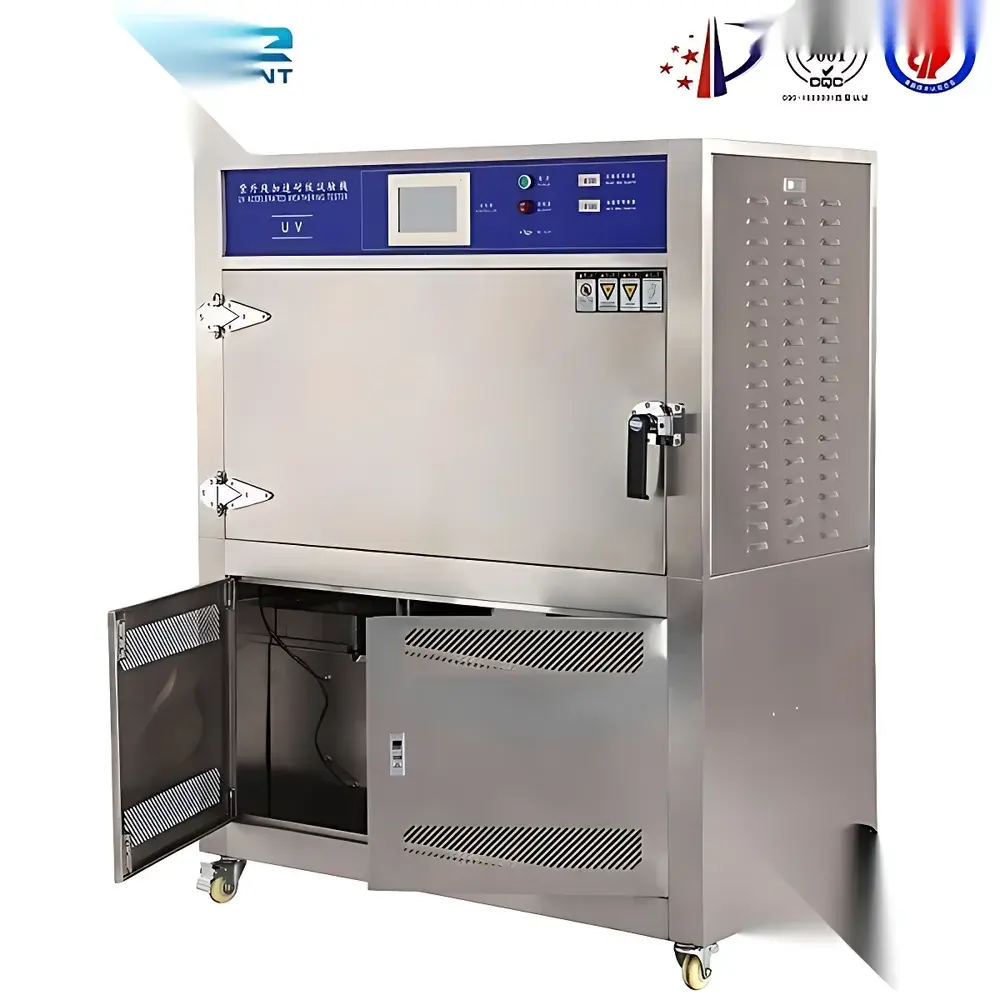
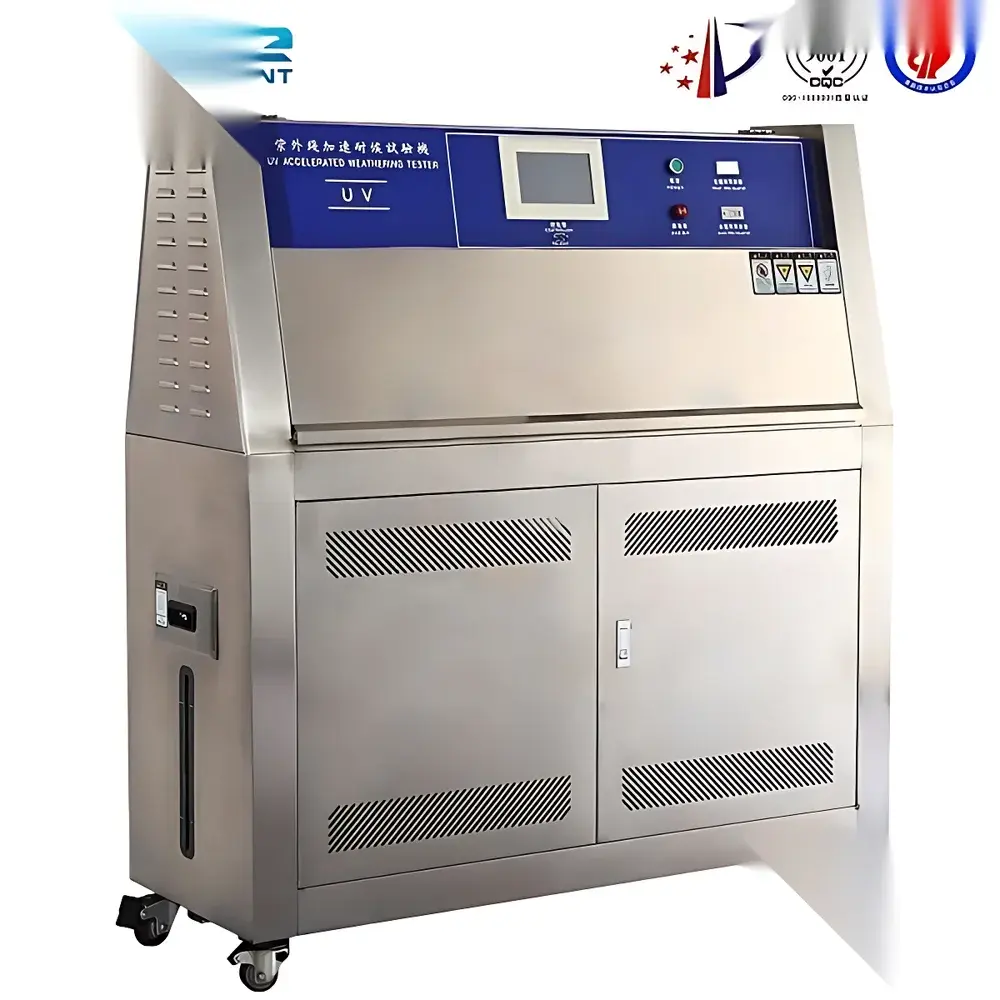
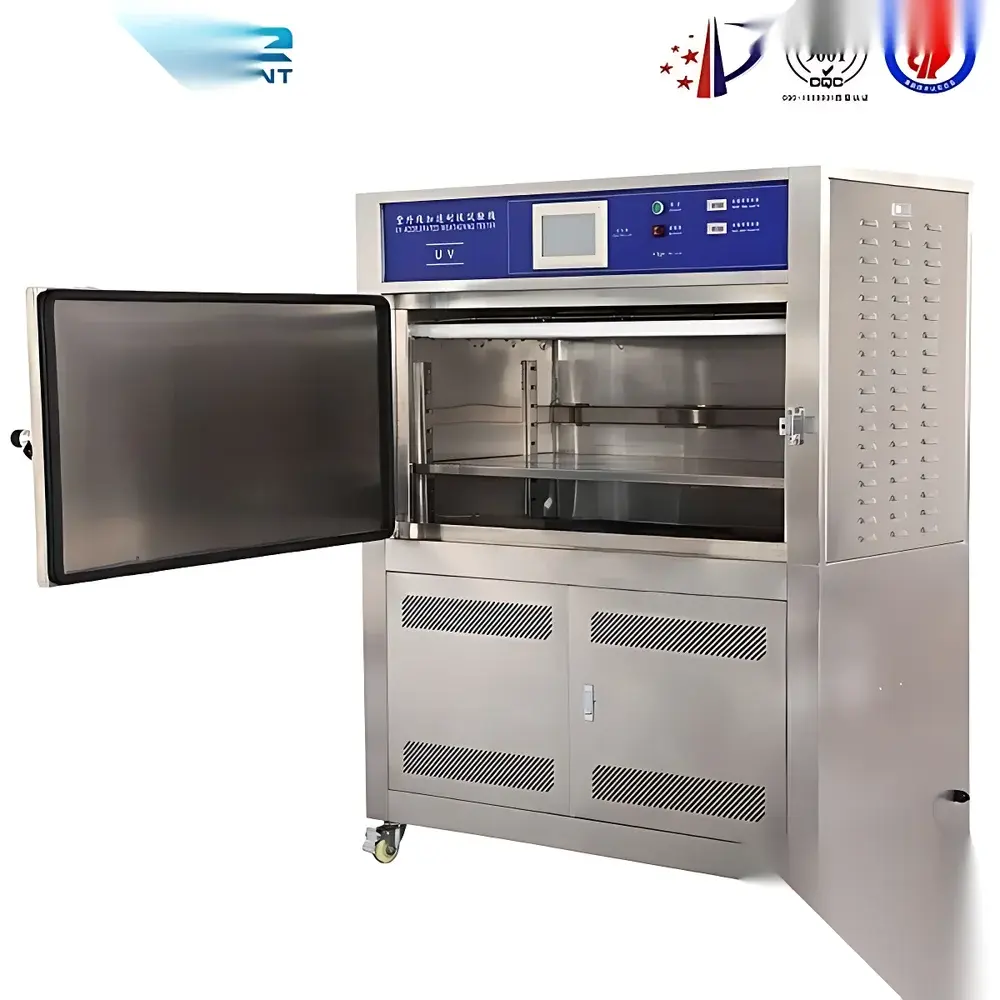
UV Aging Test Chamber OK-UV-290 by OEM Manufacturer
| Brand | OEM |
|---|---|
| Origin | Imported |
| Manufacturer Type | Authorized Distributor |
| Price | USD 3,150 (FOB) |
| Internal Chamber Dimensions (W×H×D) | 114 × 40 × 40 cm |
| External Dimensions (W×H×D) | 135 × 140 × 65 cm |
| Temperature Range | Ambient to 70 °C |
| Humidity Control | ≥95% RH during condensation cycle |
| Temp. Control Accuracy | ±0.5 °C |
| Temp. Uniformity | ±2 °C (horizontal) / ±3% (vertical) |
| UV Source | Fluorescent UVA-340 or UVB-313 lamps (typical lifespan: 2,000 h) |
| Spectral Range | 280–400 nm |
| Exposure Time Setting | 0–999 h (programmable) |
| Construction | Interior & Exterior – SUS 304 stainless steel |
| Heating System | U-shaped titanium alloy heating elements |
| Condensation Mechanism | Water-cooled cold surface condensation using tap water |
| Safety Features | Interlocked UV lamp cutoff upon door opening, over-temperature protection, low-water-level shutdown |
| Power Supply | AC 220 V ±5%, 50 Hz ±0.5 Hz |
Overview
The OK-UV-290 UV Aging Test Chamber is an engineered environmental test system designed to accelerate material degradation under controlled ultraviolet radiation, thermal stress, and moisture cycling—mimicking key outdoor weathering factors in a reproducible laboratory setting. Based on the ASTM G154 and ISO 4892-3 standards for fluorescent UV exposure, this chamber utilizes calibrated UVA-340 or UVB-313 lamps to deliver spectrally relevant irradiance within the 280–400 nm range—the most damaging portion of solar UV reaching Earth’s surface. Unlike broad-spectrum xenon arc systems, UV fluorescent technology offers high irradiance stability, lower operational cost, and superior repeatability for comparative polymer, coating, and textile aging studies. The chamber integrates three fundamental aging drivers: (1) UV photolysis, inducing bond scission and free radical formation; (2) thermal acceleration, governed by the Arrhenius relationship between temperature and reaction kinetics; and (3) cyclic condensation, simulating nocturnal dew formation via controlled surface cooling. This tri-modal stress profile enables accelerated simulation of months or years of natural exposure in days or weeks—supporting predictive lifetime modeling and formulation benchmarking.
Key Features
- Programmable microprocessor controller with intuitive interface supporting both English and Chinese language modes
- Interlocked safety architecture: automatic UV lamp de-energization upon door opening, preventing operator UV exposure
- Tap-water-compatible condensation system—no distilled or deionized water required—reducing operational overhead
- U-shaped titanium alloy heating elements ensure rapid, uniform thermal response and long-term corrosion resistance
- Front-access upward-swinging door design optimizes benchtop footprint and ergonomic sample loading/unloading
- Integrated irradiance calibration port compatible with NIST-traceable UV radiometers for periodic lamp output verification
- Dual-stage over-temperature and low-water-level protection circuits meeting IEC 61000-6-2 EMC and IEC 61010-1 safety requirements
Sample Compatibility & Compliance
The OK-UV-290 accommodates flat-panel specimens up to 110 × 35 cm (standard rack configuration), with custom rack layouts available for irregular or multi-tiered samples. It supports standardized test specimens per ASTM D6695 (paints), ASTM D4329 (plastics), ISO 11507 (coatings), and GB/T 14522 (Chinese national standard). All internal surfaces are fabricated from electropolished SUS 304 stainless steel—resistant to UV-induced chloride pitting and organic solvent exposure. The chamber complies with essential regulatory frameworks for quality-controlled testing environments, including GLP documentation readiness (audit-trail-capable event logging), ISO/IEC 17025 method validation support, and alignment with FDA 21 CFR Part 11 requirements when paired with validated software extensions.
Software & Data Management
The embedded controller logs real-time temperature, humidity, UV irradiance (when calibrated), and runtime data at user-defined intervals (1–60 min). Export is supported via USB 2.0 to CSV format for post-processing in Excel or statistical analysis platforms (e.g., JMP, Minitab). Optional PC-based software (OK-UVLink v3.2) adds remote monitoring, multi-chamber synchronization, automated report generation (PDF/HTML), and compliance-ready audit trails—including user login history, parameter change logs, and calibration certificate attachment. All software modules undergo annual validation per IQ/OQ protocols and retain full traceability for ISO 9001 and IATF 16949-certified laboratories.
Applications
- Polymer stabilization evaluation: quantifying HALS/UV absorber efficacy in polyolefins, PVC, and engineering thermoplastics
- Automotive interior materials: dashboard trim, seat fabrics, and sealants subjected to SAE J2412/J2527 cycles
- Architectural coatings: gloss retention, chalking resistance, and adhesion loss assessment per AAMA 2605
- Photovoltaic encapsulant yellowing: EVA and POE degradation kinetics under damp-heat + UV stress
- Medical device packaging: sterility barrier integrity after accelerated shelf-life simulation (ISO 11607)
- Textile colorfastness: ISO 105-B02 compliant exposure for dyed nylon, polyester, and blends
FAQ
What UV lamp types are supported, and how is spectral output verified?
The chamber accepts industry-standard F40 UVB-313 or UVA-340 fluorescent tubes. Spectral irradiance is verified using a handheld UV radiometer (e.g., ILT950UV) calibrated against NIST SRM 2242, with annual recalibration recommended.
Can the OK-UV-290 perform combined UV + spray cycles?
Yes—optional spray nozzles (OK-SPRAY-KIT) enable intermittent water spray per ASTM G154 Cycle 4, simulating rain erosion effects alongside UV exposure.
Is the condensation cycle fully automated and independent of ambient humidity?
Yes—the cold surface condensation system operates independently using chilled water circulation; ambient lab RH has no effect on internal condensation reliability.
How is lamp aging compensated during long-term tests?
The built-in irradiance compensation algorithm adjusts exposure time based on periodic sensor readings, maintaining cumulative radiant dose (J/m²) within ±5% tolerance across lamp life.
Does the unit meet CE or UKCA marking requirements?
Yes—certified to EN 61000-6-2 (EMC immunity) and EN 61010-1 (safety), with Declaration of Conformity supplied with each shipment.



