
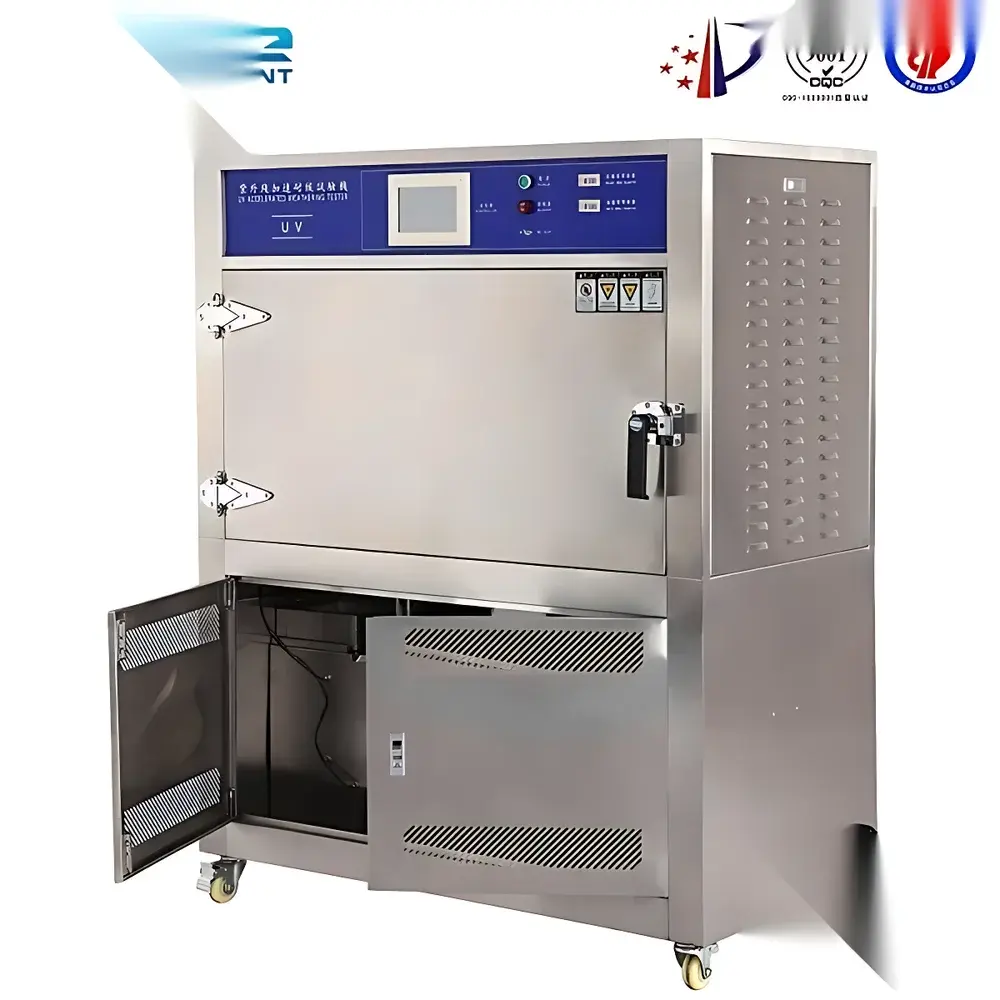
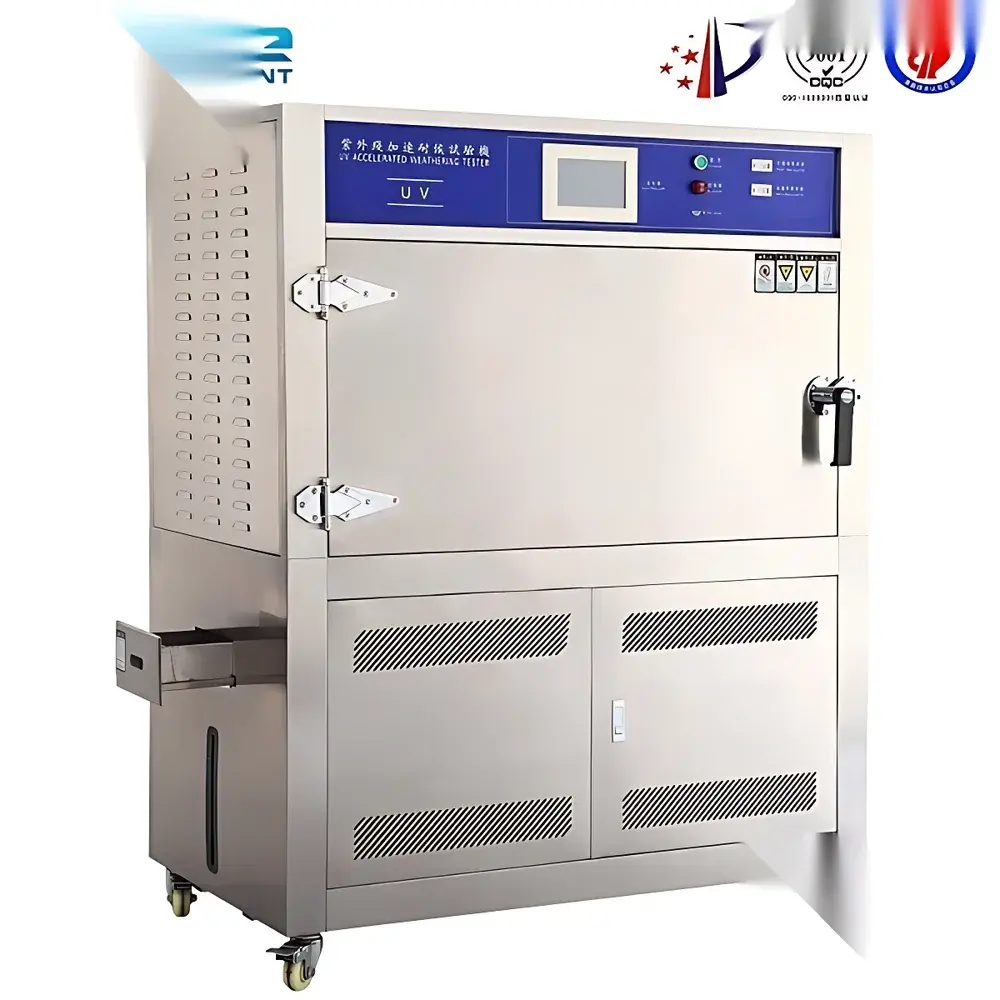
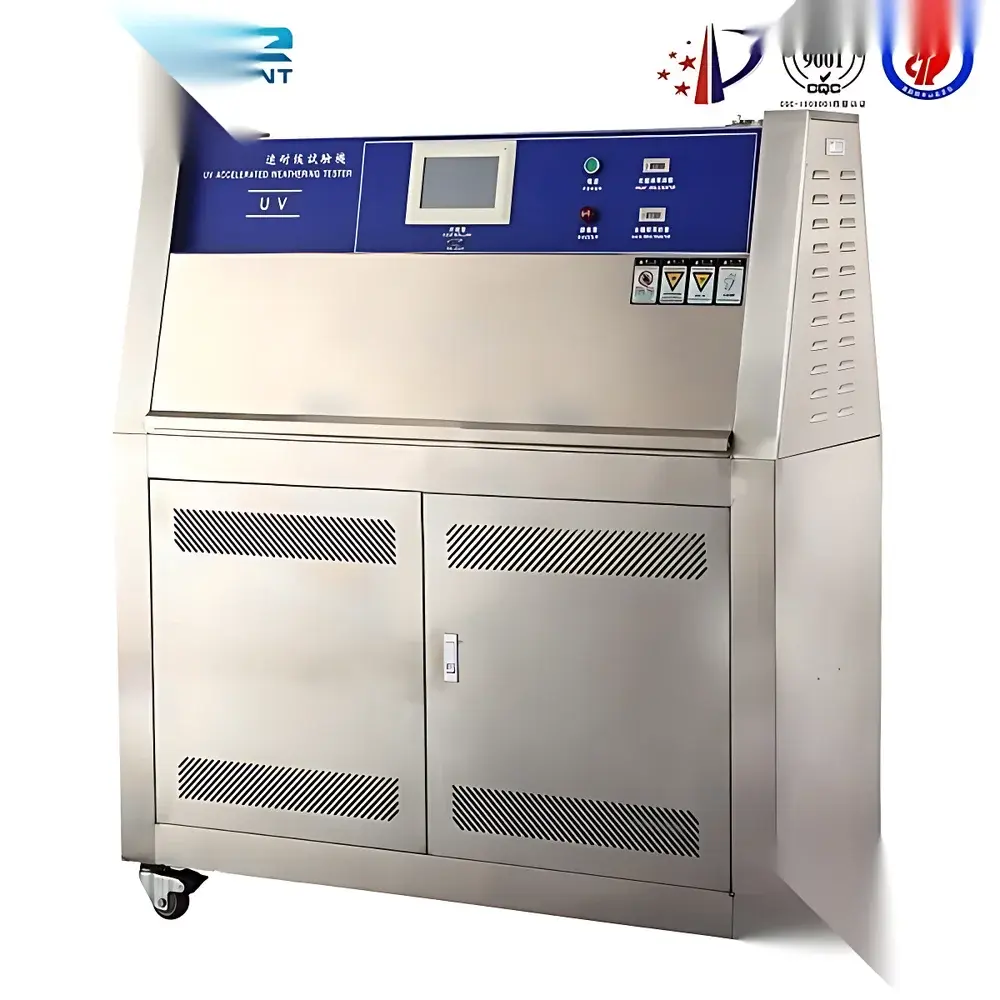
UV Aging Test Chamber OK-UV-290 by OEM Manufacturer
| Key | Brand: OEM |
|---|---|
| Origin | Imported |
| Manufacturer Type | Authorized Distributor |
| Price | USD 3,150 (FOB) |
| Chamber Internal Dimensions (W×H×D) | 114 × 40 × 40 cm |
| External Dimensions (W×H×D) | 135 × 140 × 65 cm |
| Temperature Range | Ambient to 70 °C |
| Humidity Range | ≥95% RH |
| Temp. Control Accuracy | ≤±0.5 °C |
| Temp. Uniformity | ≤±2 °C or ≤±3% |
| UV Source | Fluorescent UV Lamps (UVA-340 or UVB-313 equivalent) |
| Spectral Range | 280–400 nm |
| Lamp Lifetime | ~2000 h |
| Exposure Time Setting | 0–999 h |
| Construction Material | SUS 304 Stainless Steel (Interior & Exterior) |
| Heating System | U-shaped Titanium Alloy Heaters |
| Safety Features | Interlocked Door Cut-off, Over-Temperature Protection, Low-Water Level Shutdown |
| Power Supply | AC 220 V ±5%, 50 Hz |
Overview
The OK-UV-290 UV Aging Test Chamber is an engineered environmental simulation system designed to accelerate the photodegradation and moisture-induced aging of polymeric, coated, and composite materials under controlled ultraviolet irradiation and condensation cycles. Based on the fundamental principles of photochemical degradation—where UV photons (280–400 nm) initiate bond cleavage, free radical formation, and oxidative chain scission—the chamber replicates the dominant weathering stressors found in terrestrial outdoor exposure: solar UV radiation, thermal cycling, and cyclic condensation (simulating dew or nighttime humidity). Unlike xenon-arc or carbon-arc systems, this chamber employs fluorescent UV lamps calibrated to match the spectral output of natural sunlight below 400 nm, with selectable UVA-340 (sunlight-spectrum match) or UVB-313 (accelerated, high-energy output) lamp configurations. The result is a reproducible, laboratory-controlled method for quantifying material degradation kinetics—including gloss loss, chalking, cracking, embrittlement, color shift (ΔE), and tensile strength reduction—within days or weeks instead of months or years of field exposure.
Key Features
- Stainless steel construction (SUS 304) for corrosion resistance and long-term chamber integrity under humid UV conditions
- Precise temperature control (ambient to 70 °C) with ±0.5 °C accuracy and uniformity ≤±2 °C across the test area
- High-fidelity condensation cycle generation via heated water reservoir and controlled chamber wall cooling—achieving ≥95% RH without external humidification
- Interlocked safety circuitry: automatic UV lamp shutdown upon door opening, plus independent over-temperature and low-water-level protection
- Programmable exposure sequences supporting multi-step cycles (e.g., 4 h UV at 60 °C followed by 4 h condensation at 50 °C)
- U-shaped titanium alloy heating elements for rapid thermal response and stable setpoint maintenance
- Digital timer with 0–999 h range and power-failure memory retention
Sample Compatibility & Compliance
The OK-UV-290 accommodates flat-panel specimens up to 110 × 35 cm (standard rack configuration), with optional custom sample holders for irregular geometries. It supports standardized specimen mounting per ASTM D6675 and ISO 4892-3 protocols. The chamber is validated for conformance with internationally recognized weathering standards including ASTM G154 (fluorescent UV exposure), ASTM D4329 (plastics), ASTM D4587 (coatings), ASTM D4799 (wood finishes), SAE J2020 (automotive exterior materials), and ISO 4892-3 (methods for plastics). Its design enables full traceability for GLP-compliant testing environments; when paired with external data loggers and audit-ready calibration records, it satisfies requirements for FDA 21 CFR Part 11–aligned documentation workflows in regulated R&D labs.
Software & Data Management
While the base OK-UV-290 operates via intuitive front-panel digital controls, optional RS-485/Modbus RTU interface enables integration with LabVIEW, MATLAB, or enterprise LIMS platforms for remote monitoring and automated test logging. All temperature and exposure time parameters are stored in non-volatile memory. For compliance-driven applications, users may deploy third-party validation packages (e.g., IQ/OQ protocols) to verify chamber performance against ASTM E2499—ensuring repeatability across instrument lifetimes and inter-laboratory comparisons. Calibration certificates for temperature sensors and UV irradiance meters (traceable to NIST or PTB standards) are available upon request.
Applications
This chamber serves as a primary tool in formulation development and quality assurance for industries where long-term outdoor durability is mission-critical: automotive OEMs evaluating paint clearcoat adhesion and pigment stability; coating manufacturers qualifying acrylic, polyester, and fluoropolymer topcoats; polymer compounders assessing stabilizer package efficacy in PP, PE, and PVC; adhesive developers testing hydrolytic resistance of structural epoxies and PU sealants; and wood product suppliers validating UV-resistant stains and laminates. Its predictive correlation with real-world service life—particularly for short-wavelength UV-driven degradation—is well-documented in peer-reviewed literature across ASTM STP 1428 and ISO TR 11341 technical reports.
FAQ
What UV lamp types are compatible with the OK-UV-290?
Standard configurations include UVA-340 (peak 340 nm, closest match to solar UV below 400 nm) and UVB-313 (peak 313 nm, higher energy for aggressive acceleration). Lamp replacement requires recalibration of irradiance output.
Is ISO 4892-3 validation included with purchase?
The chamber is designed to meet ISO 4892-3 physical specifications; formal validation (IQ/OQ/PQ) must be performed on-site using certified reference instruments and documented per user’s internal SOPs.
Can the chamber operate unattended for extended durations?
Yes—provided water reservoirs are filled and ambient room conditions remain within 15–30 °C and 30–70% RH. Continuous operation beyond 72 h is recommended only with periodic visual inspection and lamp output verification.
Does the system support irradiance monitoring and feedback control?
The base model does not include real-time UV radiometry; however, optional calibrated UV sensor modules (with 280–400 nm spectral response) can be retrofitted and integrated into the control loop for closed-loop irradiance regulation.
How is temperature uniformity verified during qualification?
Per ASTM E2499, nine-point temperature mapping is conducted at three vertical levels using NIST-traceable Class A PT100 probes; results must demonstrate ≤±2 °C deviation from setpoint across all measurement points.



