
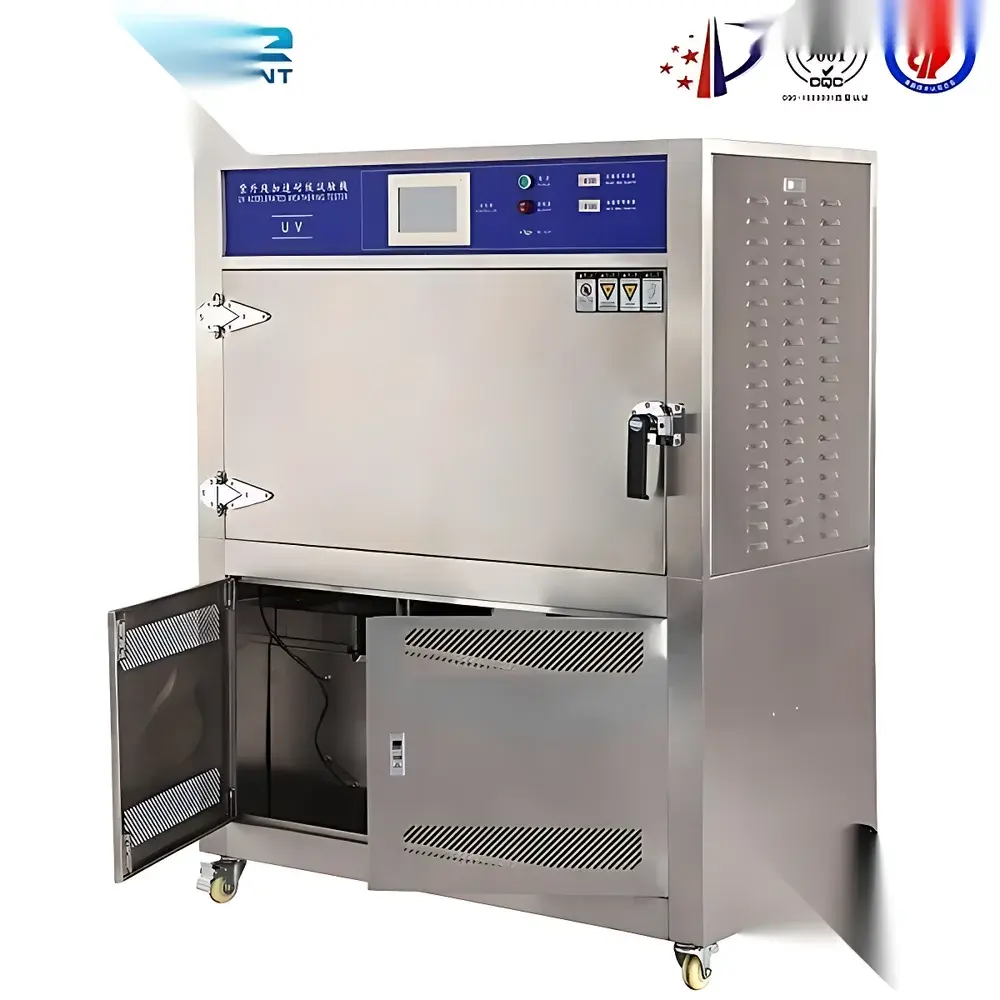
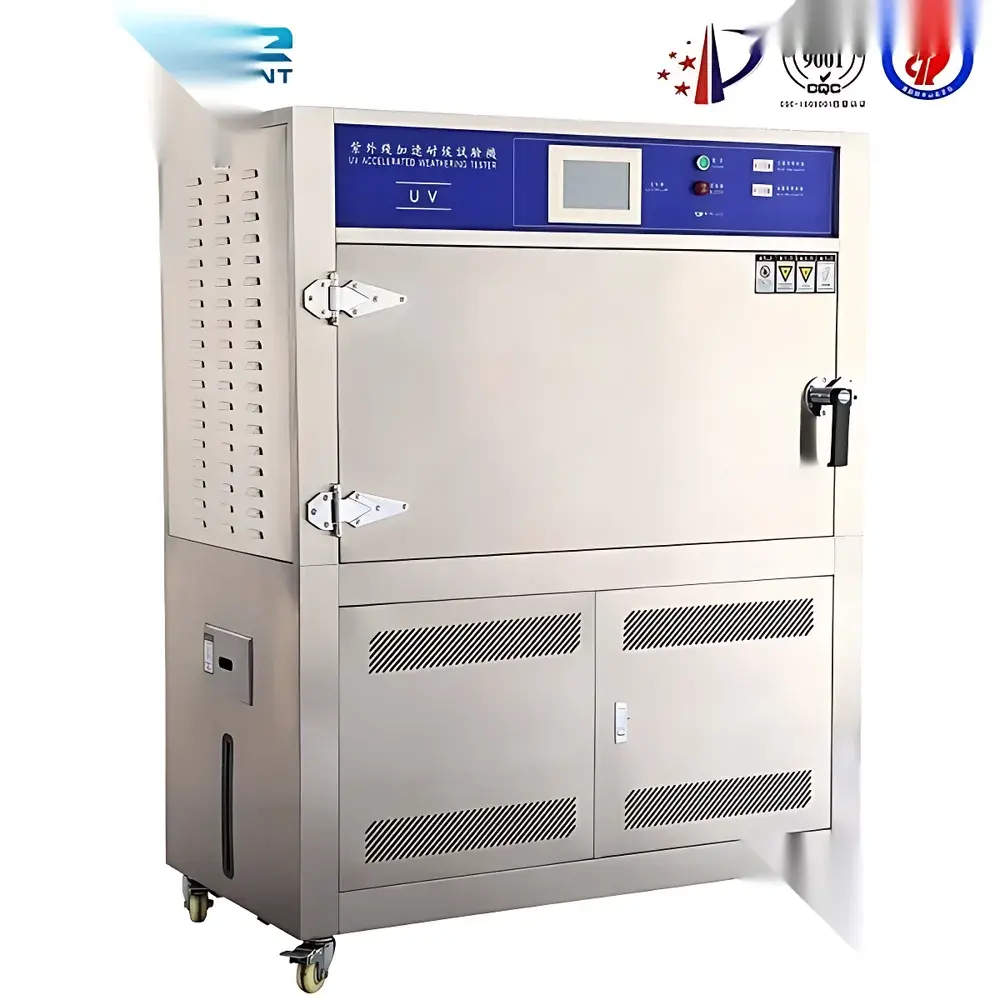
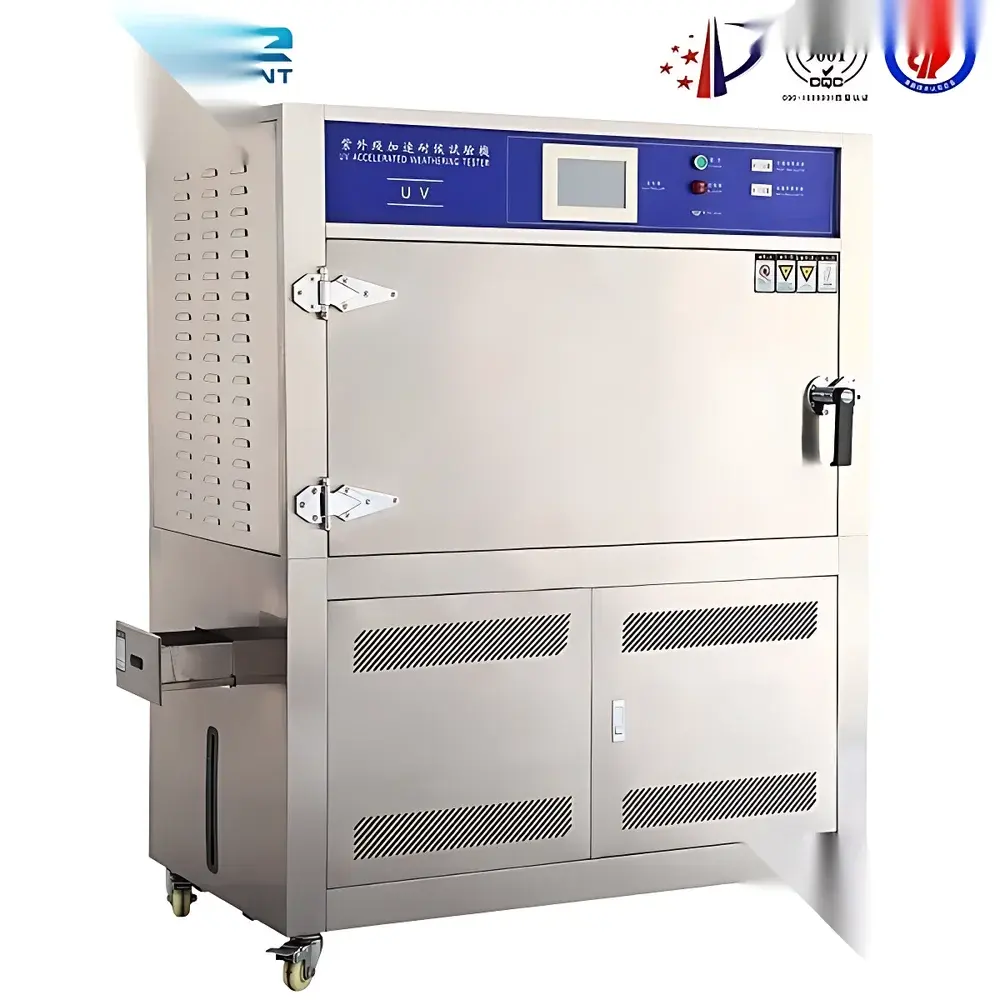
UV Aging Test Chamber – UV-313/UVA-340 Fluorescent Ultraviolet Exposure System
| Brand | Other Brands |
|---|---|
| Origin | Imported |
| Manufacturer Type | Authorized Distributor |
| Temperature Range | RT+10°C to 70°C |
| Humidity Range | ≥90% RH |
| Sample-to-Lamp Distance | 50 ± 2 mm |
| Lamp Center-to-Center Spacing | 70 mm |
| Irradiance | UVB-313: 0.6 W/m² @ 313 nm |
| UVA-340 | 0.68 W/m² @ 340 nm |
| Interior Dimensions (W×H×D) | 1140 × 390 × 400 mm |
| Exterior Dimensions (W×H×D) | 1300 × 1360 × 500 mm |
Overview
The UV Aging Test Chamber – UV-313/UVA-340 Fluorescent Ultraviolet Exposure System is an engineered environmental test instrument designed for accelerated weathering evaluation of polymeric and organic materials under controlled ultraviolet irradiation, condensation, and thermal stress. It operates on the principle of fluorescent ultraviolet (UV) radiation exposure—primarily utilizing UVB-313 and UVA-340 lamp spectra—to replicate the photochemical degradation mechanisms induced by solar UV radiation in real-world outdoor environments. Unlike broad-spectrum xenon arc or carbon arc sources, this chamber employs narrow-band fluorescent UV lamps with defined spectral power distributions aligned to key ISO, ASTM, and GB standards. The system integrates black panel temperature sensing, high-stability heating control, and programmable light/condensation cycles to simulate diurnal moisture accumulation (via condensation) and daytime UV exposure—enabling reproducible assessment of surface degradation phenomena including chalking, gloss loss, color shift, cracking, blistering, embrittlement, and oxidative crosslinking.
Key Features
- Compliant dual-lamp configuration: UVB-313 (peak at 313 nm, aggressive short-wave UV for rapid screening) and UVA-340 (peak at 340 nm, closely matching terrestrial solar UV below 360 nm)
- Black panel temperature control system using integrated aluminum sensor plates for accurate surface temperature monitoring during irradiation
- Fixed-position UV radiometer probe with calibrated photodiode detection—eliminates alignment drift and ensures long-term irradiance measurement stability
- Independent and fully programmable light and condensation phases; cycle duration configurable from minutes up to 1000 hours per segment
- High-humidity condensation mode maintains ≥90% RH via controlled water vapor saturation at elevated temperatures (RT+10°C to 70°C operational range)
- Standard sample mounting geometry: 50 ± 2 mm distance from lamp centerline, 70 mm lamp center-to-center spacing—ensuring uniform irradiance distribution per ASTM G53 and GB/T 16422.3
- Robust stainless steel interior chamber with quartz glass UV-transmissive viewing window and corrosion-resistant exterior housing
Sample Compatibility & Compliance
This chamber accommodates flat-panel specimens up to 1140 mm wide, compatible with standard ASTM D6675, ISO 4892-3, and GB/T 14522 test coupons. It supports rigid and flexible substrates including thermoplastics (e.g., PP, ABS, PC), coatings (automotive clearcoats, architectural paints), elastomers (EPDM, silicone), and fiber-reinforced composites. All operational parameters adhere strictly to internationally recognized exposure protocols: ASTM G53 (Standard Practice for Operating Fluorescent UV–Condensation Type Devices), ISO 4892-3:2016 (Plastics — Methods of exposure to laboratory light sources — Part 3: Fluorescent UV lamps), GB/T 16422.3–1997 (Plastics — Methods of exposure to laboratory light sources — Part 3: Fluorescent UV lamps), and GB/T 14522–93 (Artificial climate acceleration test methods for plastics, paints and rubbers used in machinery industry). The system architecture supports GLP-compliant documentation when paired with validated data logging software.
Software & Data Management
The chamber supports both manual (push-button) and microprocessor-based touch-panel controllers—offering real-time display of black panel temperature, chamber humidity, irradiance status, and elapsed cycle time. Optional RS485/Modbus RTU interface enables integration into centralized lab management systems. When equipped with certified third-party data acquisition modules, the system can generate audit-trail-enabled reports compliant with FDA 21 CFR Part 11 requirements—including user authentication, electronic signatures, and immutable timestamped event logs for irradiance calibration, cycle execution, and alarm history. Calibration certificates for UV radiometers are traceable to NIST or equivalent national metrology institutes.
Applications
This UV aging system is routinely deployed in R&D laboratories, quality assurance departments, and material certification bodies for: formulation optimization of UV stabilizers and HALS additives; comparative ranking of pigment durability in automotive OEM coatings; validation of weather resistance claims for outdoor signage and building façade materials; shelf-life prediction of medical device polymer housings; and regulatory pre-submission testing for IEC 61215 (photovoltaic modules) and UL 746C (polymeric materials for electrical equipment). Its ability to isolate UV-driven degradation pathways—decoupled from infrared thermal load or visible-light effects—makes it particularly valuable for mechanistic studies of photo-oxidation kinetics in polyolefins and acrylic resins.
FAQ
What UV lamp types are supported, and how do they differ in application?
The system supports UVB-313 and UVA-340 fluorescent lamps. UVB-313 provides higher-energy photons for accelerated failure analysis, while UVA-340 better replicates natural sunlight below 360 nm—making it preferred for correlation studies with outdoor exposure.
Is black panel temperature monitoring required by standards?
Yes—ASTM G154 and ISO 4892-3 mandate black panel (or black standard) temperature measurement as the primary thermal control parameter during UV exposure, since surface temperature governs reaction kinetics more accurately than air temperature.
Can the chamber perform cyclic testing with alternating UV and condensation phases?
Yes—light and condensation modes are independently programmable and can be sequenced into multi-stage cycles (e.g., 4 h UV at 60°C followed by 4 h condensation at 50°C), with total cycle duration configurable up to 1000 hours.
Does the system comply with FDA 21 CFR Part 11 for regulated environments?
Out-of-the-box hardware does not include Part 11 compliance features, but optional validated software packages with electronic signatures, audit trails, and role-based access control enable full Part 11 adherence in pharmaceutical and medical device QA labs.
What maintenance is required for UV lamp calibration and system validation?
Lamp output degrades over time; quarterly irradiance verification using a NIST-traceable UV radiometer is recommended. Annual recalibration of temperature and humidity sensors against certified reference standards is advised for ISO/IEC 17025-accredited operations.
Related Products



