
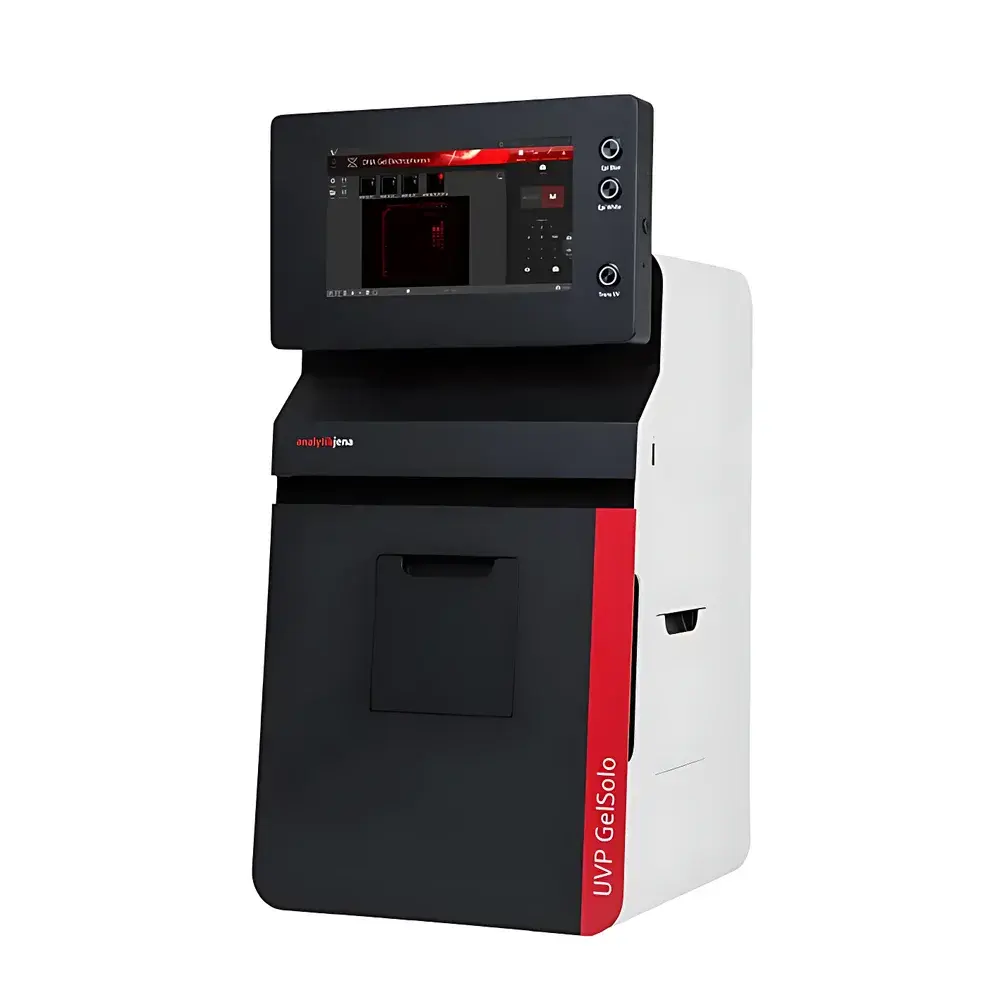
UVP GelSolo Standalone Gel Documentation System by Analytik Jena
| Brand | Analytik Jena |
|---|---|
| Origin | USA |
| Manufacturer | Analytik Jena |
| Country of Origin | Imported |
| Model | UVP GelSolo |
| Pricing | Available Upon Request |
Overview
The UVP GelSolo Standalone Gel Documentation System is an integrated, computer-free imaging platform engineered for rapid, reproducible documentation of nucleic acid and protein electrophoresis gels under multiple excitation wavelengths. Built upon a robust optical architecture featuring a high-sensitivity 5-megapixel monochrome CMOS sensor and precision f/1.4 lens assembly, the system captures high-contrast, low-noise images without external computing hardware. Its core design principle centers on operational autonomy, safety-first illumination, and regulatory-compliant workflow integrity—making it suitable for routine QC labs, academic teaching facilities, and GLP-aligned research environments where traceability, user protection, and minimal training overhead are critical.
Key Features
- Standalone operation via built-in 11.6-inch capacitive touch display with intuitive GUI—no PC, drivers, or software installation required
- Five selectable illumination modes: trans-UV (302 nm), trans-blue (470 nm), trans-white (LED white light), epi-white (reflected white light), and epi-blue (reflected blue light)
- Integrated UV-safe viewing window with >99.9% UV-B/C attenuation (280–320 nm), compliant with IEC 62471 photobiological safety standards
- Four-sided access door design enabling unobstructed gel handling and precise excision under real-time imaging—minimizing cross-contamination and UV exposure time
- Blue-light conversion plate included as standard, enabling ethidium bromide–free visualization and reducing photodamage to DNA during prolonged exposure
- Multi-language firmware interface (including English, Chinese, Spanish, French, German) supporting international lab deployment and multilingual staff training
Sample Compatibility & Compliance
The GelSolo accommodates standard vertical and horizontal electrophoresis formats—including agarose (0.5–4%), polyacrylamide (8–20%), SDS-PAGE, native PAGE, and 2D gels—up to 25 × 20 cm. It supports common fluorescent dyes (SYBR Safe, GelRed, SYPRO Ruby), chromogenic substrates (DAB, BCIP/NBT), and chemiluminescent detection when used with compatible film or high-dynamic-range exposure protocols. The system meets CE marking requirements per Directive 2014/30/EU (EMC) and 2014/35/EU (LVD), and its UV shielding design aligns with OSHA 1910.132 and ANSI Z136.1 guidelines for occupational laser and optical radiation safety. While not FDA 510(k)-cleared as a medical device, its imaging performance adheres to ISO/IEC 17025-relevant documentation rigor for analytical instrument validation.
Software & Data Management
Firmware-based image acquisition and analysis are embedded directly in the device’s ARM Cortex-A9 processor. Image capture, auto-exposure optimization, background subtraction, lane/band profiling, molecular weight estimation, and relative quantification (via pixel intensity integration) are performed onboard. All images are saved in TIFF (uncompressed) and JPEG formats with embedded EXIF metadata—including timestamp, illumination mode, exposure duration, lens aperture, and user ID. Audit trail functionality logs operator login events, parameter changes, and export actions—supporting basic 21 CFR Part 11 readiness through optional password-protected user roles (Admin, Technician, Viewer). Data export occurs via USB 2.0 port or Wi-Fi (802.11n) to network shares or LIMS-compatible endpoints; no proprietary cloud service is required or enabled by default.
Applications
- Routine documentation of agarose and polyacrylamide gels in molecular biology and protein biochemistry workflows
- Semi-quantitative analysis of PCR products, restriction digests, plasmid preps, and RNA integrity assays
- Western blot documentation using DAB or chemiluminescent substrates with adjustable long-exposure modes
- Educational laboratory instruction—enabling students to acquire, annotate, and export results without computational dependencies
- QC release testing in biomanufacturing settings where instrument qualification (IQ/OQ) must be demonstrable without third-party software dependencies
FAQ
Does the GelSolo require a dedicated computer for operation?
No—the system operates entirely independently using its onboard processor and touchscreen interface. A PC is only needed if users choose to export data to external analysis platforms.
Can the GelSolo perform chemiluminescent imaging?
Yes, with extended exposure times (up to 30 minutes) and optimized gain settings, the system captures low-light chemiluminescent signals from Western blots using standard HRP- or AP-conjugated antibodies.
Is the UV source replaceable by the end user?
UV lamps are field-replaceable modules with tool-free access; replacement kits include lamp, ballast, and alignment guide—full procedure documented in the Service Manual (Revision D, 2023).
What file formats are supported for image export?
TIFF (16-bit grayscale, uncompressed), JPEG (high-quality RGB), and CSV (for band intensity tables). No proprietary binary formats are used.
How is user access controlled for compliance purposes?
Three-tier role-based authentication (Admin/Technician/Viewer) enforces parameter lockout, audit log visibility, and export permissions—configurable via the Settings > Security menu.



