
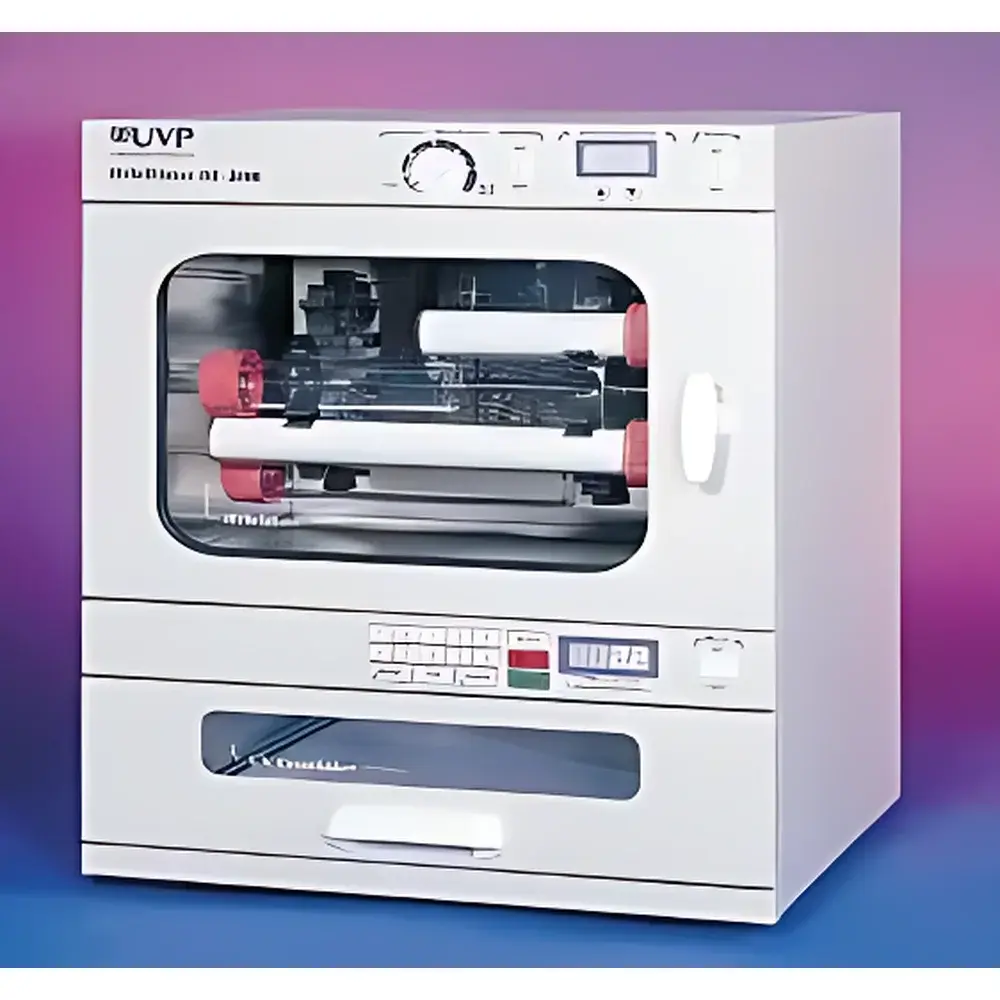
UVP HL-2000 Hybridization Oven with Integrated UV Crosslinker
| Brand | UVP |
|---|---|
| Origin | USA |
| Model | HL-2000 |
| Instrument Type | Nucleic Acid Hybridization Oven |
| Hybridization Bottle Capacity | 20 × 35×150 mm + 10 × 35×300 mm |
| Rotation Speed | 10–15 rpm |
| Temperature Range | Ambient to 99.9 °C |
| Temperature Control Accuracy | ±0.1 °C |
| Temperature Uniformity | ±0.3 °C (chamber), ±0.1 °C (within bottle) |
| UV Wavelength | 254 nm |
| UV Power Output | Standard low-pressure mercury lamp configuration |
| Dimensions (W×H×D) | 445 × 610 × 381 mm |
| Net Weight | 27.3 kg |
| Standard Configuration | Main unit + one 35×300 mm hybridization tube |
Overview
The UVP HL-2000 Hybridization Oven with Integrated UV Crosslinker is an engineered solution for high-fidelity nucleic acid hybridization and membrane immobilization in molecular biology laboratories. Designed around the principles of controlled thermal convection, uniform rotational agitation, and calibrated short-wavelength ultraviolet irradiation, the HL-2000 integrates two essential workflows—hybridization incubation and UV crosslinking—into a single, space-efficient platform. Unlike standalone hybridization ovens or benchtop crosslinkers, the HL-2000 maintains functional independence between its upper UV crosslinking module and lower hybridization chamber, enabling concurrent or sequential operation without cross-contamination or workflow interruption. Its temperature-controlled rotating chamber ensures consistent probe-target annealing kinetics across all samples, while the 254 nm UV source delivers reproducible covalent DNA–membrane binding—critical for Northern, Southern, and dot blot applications requiring high signal-to-noise ratios and low background.
Key Features
- Modular dual-function architecture: Independent control of hybridization chamber (lower section) and UV crosslinking module (upper section), eliminating the need for instrument reconfiguration between steps.
- Precision temperature regulation: Microprocessor-controlled heating system with ±0.1 °C setpoint accuracy and ±0.3 °C uniformity across the chamber volume—validated per ASTM E2251 for laboratory oven performance verification.
- Optimized rotational mixing: Programmable 10–15 rpm rotation minimizes shear stress on fragile nucleic acid probes while ensuring homogeneous hybridization kinetics and preventing localized depletion at membrane surfaces.
- Calibrated 254 nm UV irradiation: Low-pressure mercury vapor lamp with fixed spectral output, delivering consistent energy density (mJ/cm²) for covalent immobilization of DNA and RNA onto nylon or nitrocellulose membranes—compatible with standard protocols outlined in Molecular Cloning (Sambrook & Russell).
- Robust mechanical design: Stainless-steel hybridization chamber, reinforced acrylic UV shield with interlock safety switch, and thermally insulated housing to maintain ambient lab stability during extended incubations (up to 72 h).
- LED-based user interface: Real-time digital display of setpoint and actual temperature, rotation status, and UV exposure timer; no software dependency for basic operation.
Sample Compatibility & Compliance
The HL-2000 accommodates standard cylindrical hybridization tubes (35 × 150 mm and 35 × 300 mm), supporting both small-scale probe labeling and high-yield membrane hybridizations. Its chamber geometry enables uniform heat transfer and rotational symmetry for up to 20 small-format tubes or 10 extended-length tubes simultaneously. The system complies with IEC 61010-1:2010 for electrical safety in laboratory equipment and incorporates UV shielding meeting ANSI Z136.1-2022 requirements for optical radiation hazards. While not certified for GLP/GMP production environments, the HL-2000 supports audit-ready documentation when used within validated research workflows adhering to ISO/IEC 17025 quality management principles for testing laboratories.
Software & Data Management
The HL-2000 operates as a stand-alone instrument with no embedded firmware or network connectivity. All operational parameters—including temperature setpoint, rotation activation, and UV exposure duration—are configured manually via front-panel controls. For laboratories requiring electronic recordkeeping, external data loggers (e.g., compliant with FDA 21 CFR Part 11 Annex 11) may be interfaced via analog voltage outputs (available upon request from UVP technical support). No proprietary software is required, minimizing validation overhead in regulated academic or contract research settings.
Applications
- Southern and Northern blot hybridization using radiolabeled or chemiluminescent probes
- Dot and slot blot membrane fixation prior to antibody or oligonucleotide probing
- Pre-hybridization blocking and post-hybridization wash optimization under controlled thermal rotation
- Immobilization of PCR-amplified fragments or synthetic oligos onto charged membranes for microarray validation
- Validation studies requiring side-by-side comparison of hybridization efficiency across temperature gradients (e.g., Tm determination)
FAQ
Can the UV crosslinker and hybridization oven operate simultaneously?
Yes—the HL-2000’s hardware-isolated modules allow concurrent UV exposure and temperature-controlled rotation without interference.
Is calibration documentation available for the temperature control system?
UVP provides a factory calibration certificate traceable to NIST standards; annual recalibration services are offered through authorized service centers.
What safety features prevent accidental UV exposure?
A dual-interlock mechanism disables UV emission whenever the top access door is unlatched or opened beyond 5° of vertical alignment.
Are replacement hybridization tubes supplied by UVP?
Yes—UVP stocks 35 × 150 mm and 35 × 300 mm borosilicate glass tubes with PTFE-lined caps (Cat. No. HL-TUBE-150 and HL-TUBE-300), compatible with repeated autoclaving.
Does the HL-2000 meet requirements for ISO 13485-certified IVD development labs?
While the instrument itself is not IVD-certified, its design and documentation package support inclusion in ISO 13485-compliant development workflows when integrated into a broader equipment qualification protocol (IQ/OQ/PQ).




