
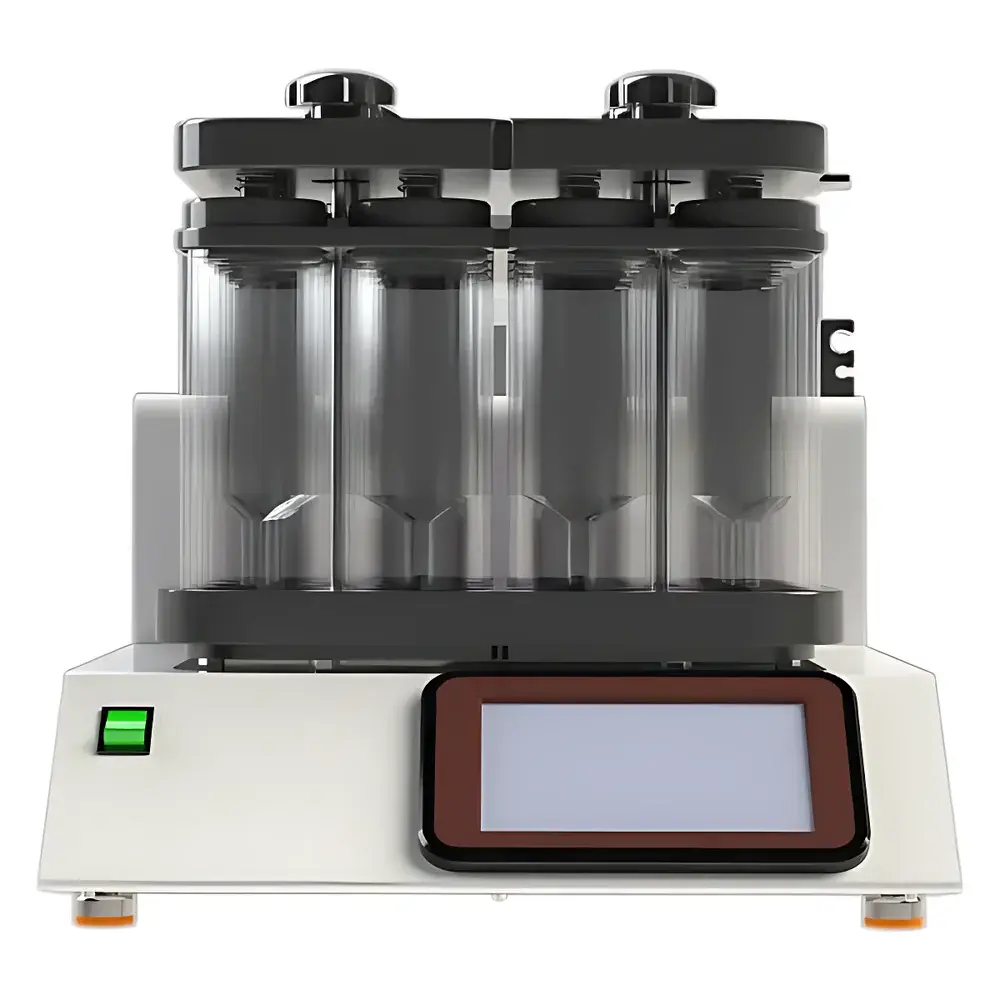
UXS PCE Series Parallel Vacuum Concentrator
| Brand | UXS |
|---|---|
| Origin | Beijing, China |
| Manufacturer Type | Direct Manufacturer |
| Instrument Type | Vacuum Centrifugal Concentrator |
| Temperature Range | Ambient to 60 °C |
| Temperature Control Accuracy | ±1 °C |
| Sample Capacity | 300 mL per position (16 positions) |
| Solvent Collection Flask Capacity | Up to 2000 mL (round-bottom or flat-bottom) |
| Contact Materials | PTFE, PEEK, EPDM, Borosilicate Glass |
| Control Interface | 7-inch color touchscreen |
| Method Storage | 50 user-defined protocols |
| ECO² Mode | Enabled for energy and solvent conservation |
| Real-time Parameter Display | Vacuum level (mbar), vortex speed (rpm), bath temperature (°C), elapsed time |
| In-Run Parameter Adjustment | Vortex speed adjustable during operation with auto-save to active method |
Overview
The UXS PCE Series Parallel Vacuum Concentrator is an engineered solution for high-throughput, reproducible sample concentration in analytical, pharmaceutical, and life science laboratories. It operates on the principle of simultaneous vacuum-assisted evaporation under controlled thermal and mechanical agitation—combining reduced pressure (to lower solvent boiling points), precise water-bath heating (to accelerate vaporization), and programmable orbital vortex motion (to enhance surface renewal and prevent bumping or foaming). Unlike sequential concentrators, the PCE system processes up to 16 samples—each with independent 300 mL capacity—in true parallel mode, significantly reducing batch processing time while maintaining inter-sample consistency. Its fully transparent acrylic chamber enables continuous visual monitoring without interrupting vacuum integrity or thermal equilibrium, supporting real-time decision-making during critical concentration steps such as endpoint detection or co-solvent removal.
Key Features
- Parallel processing of 16 samples (300 mL each) under uniform vacuum and temperature conditions
- Integrated 7-inch color touchscreen interface with intuitive graphical workflow navigation
- Precision temperature control from ambient to 60 °C with ±1 °C accuracy across the entire bath volume
- Adjustable orbital vortex agitation (speed range configurable per method; typical range 0–1200 rpm) with dynamic in-run modification and automatic method retention
- ECO² operating mode—intelligently modulates vacuum pump duty cycle and heater output to minimize power consumption and solvent loss without compromising evaporation rate
- Chemically inert wetted path constructed from PTFE, PEEK, EPDM elastomers, and borosilicate glass—compatible with aggressive solvents including acetonitrile, methanol, chloroform, and ethyl acetate
- Dual-flask support: accommodates both round-bottom and flat-bottom collection vessels up to 2000 mL capacity
- Real-time display of vacuum level (mbar), vortex speed (rpm), water-bath temperature (°C), and elapsed run time—all accessible and editable during active operation
Sample Compatibility & Compliance
The PCE Series supports a broad spectrum of sample matrices—including aqueous buffers, organic extracts, peptide digests, nucleic acid preparations, and small-molecule drug candidates—without cross-contamination risk due to its sealed, modular rotor design and individually isolated sample wells. All fluid-contact materials comply with USP Class VI biocompatibility standards and meet ISO 10993-5 cytotoxicity requirements. The instrument architecture supports GLP/GMP-aligned workflows: method storage (50 protocols), timestamped parameter logging, and non-volatile memory retention ensure full traceability. While not FDA 21 CFR Part 11–certified out-of-the-box, the system’s audit-ready data structure—including user ID tagging, method version history, and immutable run logs—facilitates validation under regulated environments when integrated with compliant LIMS or ELN platforms.
Software & Data Management
The embedded controller firmware provides native method creation, execution, and archival without external PC dependency. Each stored protocol retains complete configuration: target temperature, vacuum setpoint, vortex profile (ramp/hold steps), ECO² activation status, and runtime duration. During operation, the system continuously logs all measured parameters at 1-second intervals to internal flash memory. Export is supported via USB port in CSV format for downstream analysis in Excel, MATLAB, or statistical process control (SPC) software. No proprietary drivers or cloud services are required—data ownership remains fully local and export-controlled per institutional IT policy.
Applications
- Routine concentration of LC-MS and GC-MS sample extracts prior to reconstitution and injection
- High-throughput preparation of clinical trial biosamples (plasma, urine, tissue homogenates) for metabolomics or pharmacokinetic profiling
- Parallel solvent exchange in oligonucleotide synthesis and purification workflows
- Removal of volatile reaction byproducts following solid-phase peptide synthesis (SPPS)
- Pre-concentration of environmental water samples for trace contaminant analysis (e.g., PAHs, PCBs, pesticides)
- Stabilization of thermolabile compounds—such as labile glycoproteins or enzyme inhibitors—via low-temperature vacuum evaporation
FAQ
What vacuum level can the PCE Series achieve?
The system achieves a base vacuum of ≤5 mbar using the integrated diaphragm pump; final operational setpoints are user-definable between 5–100 mbar.
Is remote monitoring or control possible?
No Ethernet or Wi-Fi interface is built-in; however, USB-based data export enables integration into centralized lab automation systems via custom scripting.
Can the PCE handle viscous or foaming samples?
Yes—the programmable vortex agitation mitigates foam formation, and optional anti-foam sensor add-ons (sold separately) may be deployed for highly surfactant-laden matrices.
How is calibration verified?
Temperature calibration is performed using NIST-traceable PT100 probes; vacuum sensor linearity is validated against certified reference gauges per ISO 27874 guidelines.
What maintenance is required?
Routine tasks include periodic inspection of O-rings, cleaning of the condenser coil, and replacement of the vacuum pump oil every 6 months under continuous use—full procedures documented in the bilingual (English/Chinese) service manual.



