
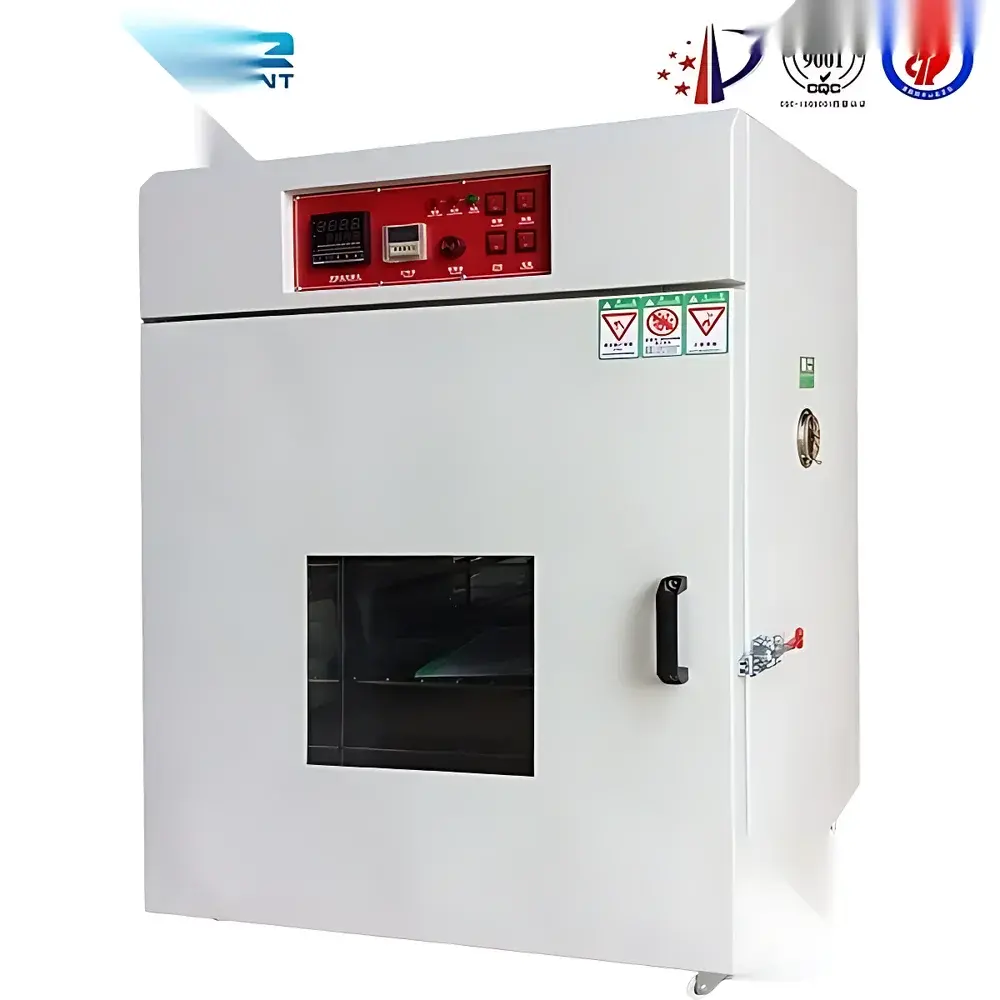
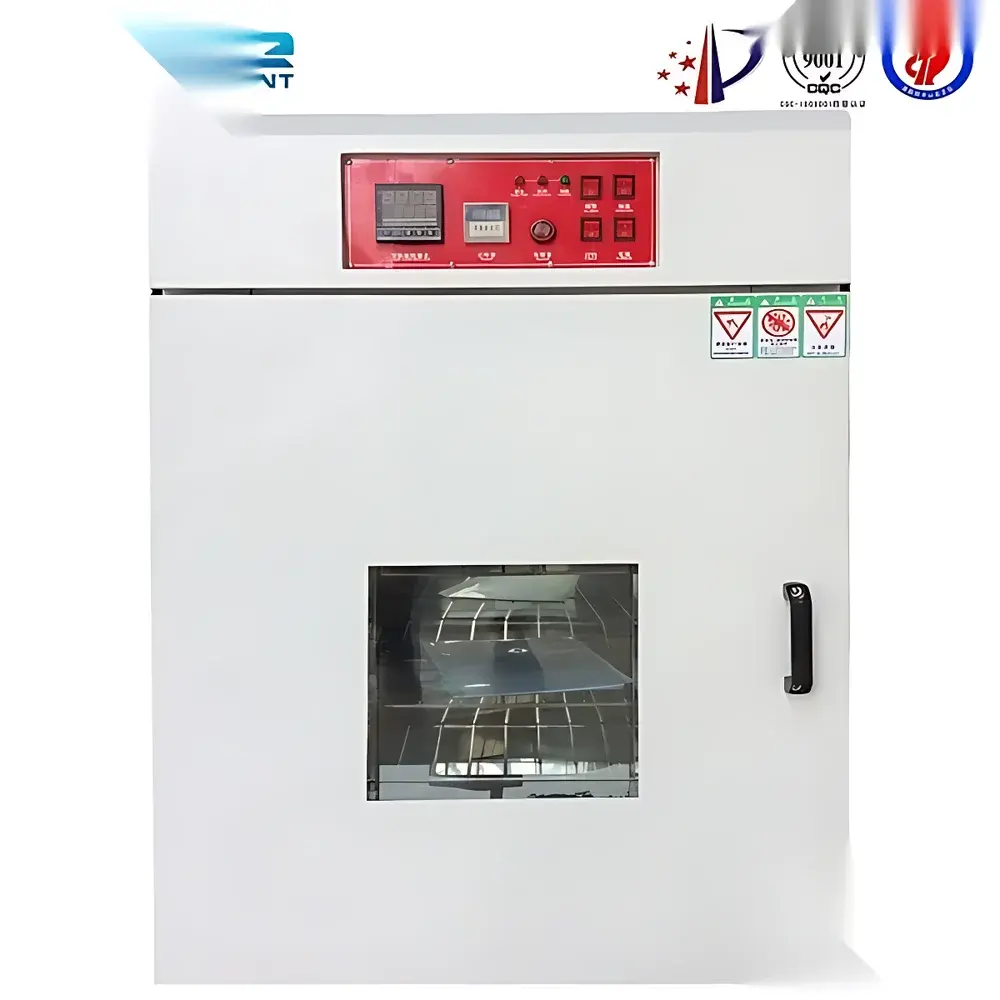
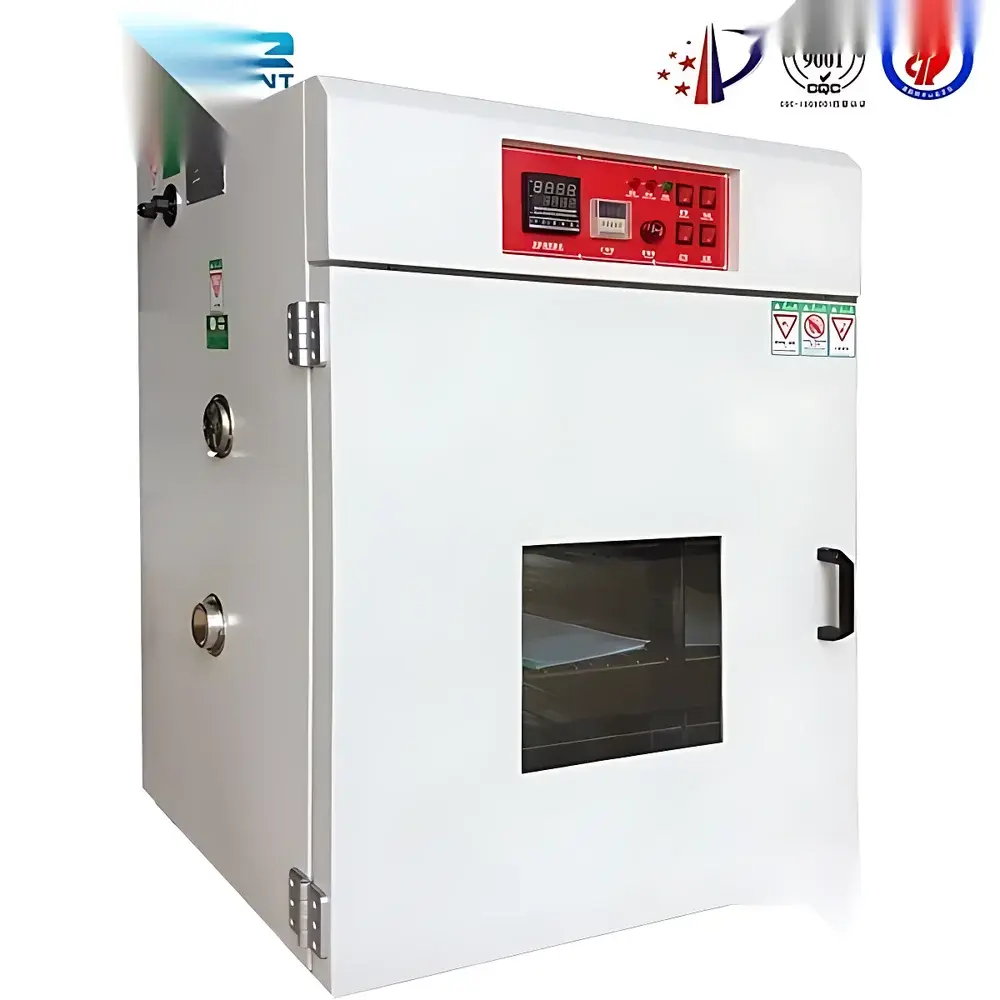
Vacuum High-Temperature Oven for Thermal Aging and Environmental Testing
| Temperature Range | RT +10°C to 300°C (customizable up to 500°C) |
|---|---|
| Internal Chamber Dimensions | 450 × 400 × 400 mm (W×H×D) |
| External Dimensions | 650 × 900 × 600 mm (W×H×D) |
| Temperature Uniformity | ±1.5°C |
| Control Accuracy | ±0.5°C |
| Heating System | Dual independent 2 kW far-infrared Ni-Cr alloy heaters |
| Sensor | PT100 platinum resistance thermometer |
| Controller | Microprocessor-based digital touch controller with timer (0–999 min) |
| Air Circulation | Forced convection via bottom-mounted blower with left-side air outlet |
| Standard Shelving | 3 stainless steel wire shelves (SUS304) |
| Power Supply | AC220V ±5%, 50 Hz, 2000 W |
| Compliance | GB/T 2423.2 (High-Temperature Test Method B) |
| Safety Features | Leakage current protection, over-temperature alarm & cut-off, thermal fuse backup |
Overview
The Vacuum High-Temperature Oven is a precision-engineered environmental test chamber designed for accelerated thermal aging, material stability evaluation, and high-temperature conditioning under controlled atmospheric conditions. Unlike standard forced-air ovens, this model integrates vacuum capability—enabling low-oxygen or inert-atmosphere processing—to prevent oxidation, degradation, or surface contamination during extended thermal exposure. It operates on the principle of convective heat transfer enhanced by intelligent microprocessor-regulated power modulation, ensuring stable thermal profiles across the entire working volume. The chamber meets the structural and procedural requirements of GB/T 2423.2 (identical in technical scope to IEC 60068-2-2), making it suitable for qualification testing of electronic components, polymer composites, battery materials, and aerospace-grade adhesives where thermal endurance and dimensional stability under sustained elevated temperatures are critical performance metrics.
Key Features
- Independent dual-heating system with two 2 kW far-infrared Ni-Cr alloy heating elements—enabling precise zone control and rapid thermal ramping without thermal overshoot.
- PT100 platinum resistance sensor mounted at multiple strategic locations for real-time feedback and spatial temperature validation.
- Microprocessor-based digital touch controller with programmable timer (0–999 minutes), data logging interface, and auto-recovery function after power interruption.
- Forced-air circulation architecture: centrifugal blower draws ambient air through bottom-mounted heating ducts and directs uniform airflow from the left-side outlet, minimizing thermal stratification.
- Robust dual-layer construction—inner chamber fabricated from SUS304 stainless steel (electropolished finish) for corrosion resistance and easy decontamination; outer shell of cold-rolled steel with powder-coated epoxy finish.
- Integrated safety architecture including Class II leakage current protection, dual-stage over-temperature cutoff (mechanical and electronic), and redundant thermal fusing per heating zone.
Sample Compatibility & Compliance
This oven accommodates non-volatile, non-flammable solid specimens—including PCB assemblies, ceramic substrates, elastomeric seals, and coated metal coupons—within its 72 L internal volume. Liquids, volatile solvents, or explosive compounds must not be processed due to inherent pressure and ignition risks under vacuum and elevated temperature. All operational parameters align with GB/T 2423.2 for high-temperature storage and operational life testing. While not certified to UL 61010-1 or IEC 61000-6-3 out-of-the-box, the unit’s electrical design adheres to fundamental EMC and safety principles required for laboratory integration. Optional upgrades include RS485 Modbus RTU output for SCADA integration and NIST-traceable calibration documentation upon request.
Software & Data Management
The embedded controller supports local parameter configuration, profile programming (up to 10 multi-step cycles), and real-time display of setpoint, actual temperature, elapsed time, and remaining timer duration. An optional USB data export module enables CSV-formatted temperature history download for post-test analysis in Excel or MATLAB. For regulated environments (e.g., ISO/IEC 17025-accredited labs), firmware version logs, user access levels (operator/administrator), and audit trail functionality can be enabled to satisfy GLP/GMP traceability requirements. No cloud connectivity or proprietary software installation is required—operation remains fully self-contained and offline-capable.
Applications
- Accelerated aging of lithium-ion battery cathode materials under inert vacuum to assess structural integrity at 200–300°C.
- Pre-baking of optical lens assemblies prior to anti-reflective coating deposition to eliminate residual moisture and organic volatiles.
- Thermal stress screening of automotive ECU housings per OEM-specific high-temperature soak protocols (e.g., Ford WSS-M99P1111-A).
- Outgassing characterization of space-grade polymers per ECSS-Q-ST-70-02C, using vacuum-enabled mass loss monitoring.
- Post-cure stabilization of fiber-reinforced composites in aerospace manufacturing workflows requiring repeatable 250°C holds.
FAQ
Can this oven operate under full vacuum while heating to 300°C?
Yes—vacuum compatibility is maintained across the full temperature range; however, ultimate vacuum level depends on connected pump performance (recommended: two-stage rotary vane pump with ≤5 Pa base pressure).
Is the temperature uniformity specification verified per ASTM E2203?
No—ASTM E2203 applies to pharmaceutical stability chambers; this unit’s uniformity (±1.5°C) is validated per internal protocol using nine-point thermocouple mapping per GB/T 2423.2 Annex A.
What maintenance is required for long-term reliability?
Quarterly inspection of door gasket integrity, annual verification of PT100 calibration against reference standard, and biannual cleaning of air intake filters and blower housing.
Does the controller support external data acquisition via analog output?
Standard configuration includes 0–5 V analog output for temperature signal mirroring; 4–20 mA and RS485 Modbus RTU are available as factory-installed options.
Is CE marking applicable for EU shipment?
The base unit complies with EMC Directive 2014/30/EU and Low Voltage Directive 2014/35/EU; CE declaration requires end-user site-specific risk assessment and final assembly verification per Machinery Directive 2006/42/EC if integrated into larger systems.



