
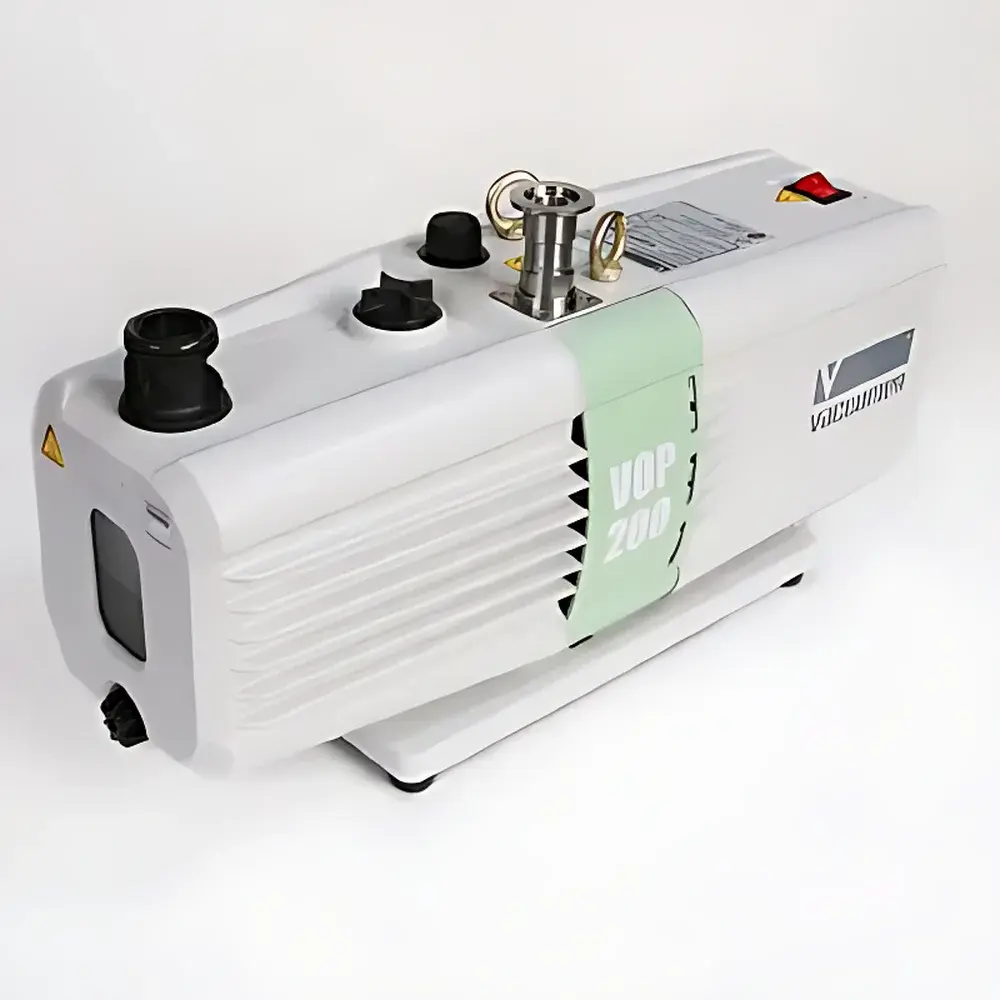
Vacuumer VOP 200 Direct-Drive Rotary Vane Vacuum Pump
| Brand | Vacuumer |
|---|---|
| Origin | South Korea |
| Pump Type | Oil-Lubricated Rotary Vane |
| Model | VOP 200 |
| Ultimate Vacuum Pressure | 6.7 × 10⁻² Pa (6.7 × 10⁻¹ Pa with gas ballast enabled) |
| Pumping Speed | 220 L/min (50 Hz) / 260 L/min (60 Hz) |
| Motor | Single-phase 220 V, 550 W, 4-pole |
| Motor Speed | 1430 RPM (50 Hz) / 1730 RPM (60 Hz) |
| Recommended Oil | COSMA-100 |
| Oil Capacity | 1100 mL |
| Suction Port | NW25 (ISO-KF) |
| Operating Temperature Range | 7–40 °C |
| Dimensions (W × L × H) | 189 × 524 × 253 mm |
| Weight | 30 kg |
Overview
The Vacuumer VOP 200 is a direct-drive, oil-lubricated rotary vane vacuum pump engineered for stable, continuous operation in demanding laboratory and light industrial environments. Based on the proven Couette-type compression principle, it achieves high volumetric efficiency through precision-machined vanes rotating eccentrically within a cylindrical stator chamber. The pump’s integrated gas ballast valve enables controlled admission of atmospheric air into the compression stage, allowing effective removal of condensable vapors—critical when evacuating solvents during freeze-drying or solvent recovery processes. Its forced-oil circulation system, combined with an internal cooling fin array, ensures thermal stability under extended duty cycles. Designed for ISO 21028-1-compliant reliability, the VOP 200 delivers repeatable ultimate vacuum performance down to 6.7 × 10⁻² Pa (with gas ballast closed), making it suitable for applications requiring moderate to high vacuum levels without resorting to secondary pumping stages.
Key Features
- Direct-coupled motor architecture eliminates belt slippage and transmission losses, improving energy efficiency and reducing maintenance intervals.
- Integrated overload protection circuitry safeguards the motor against thermal runaway during prolonged operation or inlet overpressure conditions.
- Dual-mode gas ballast valve—manually adjustable for optimized vapor handling across diverse sample matrices (e.g., aqueous, organic, or mixed-solvent systems).
- Reverse-flow prevention mechanism minimizes backstreaming of oil vapor into vacuum chambers, supporting cleaner process environments and extending downstream component life.
- Low-vibration, low-noise design (<62 dB(A) at 1 m) achieved via dynamic rotor balancing and elastomeric motor mount isolation—essential for vibration-sensitive instrumentation such as electron microscopes or surface analysis tools.
- Forced-lubrication oil delivery system maintains consistent film thickness on vanes and stator walls, enhancing sealing integrity and wear resistance over time.
Sample Compatibility & Compliance
The VOP 200 is compatible with non-corrosive, non-reactive gases and vapors commonly encountered in analytical and preparative workflows—including water vapor, ethanol, acetone, and hydrocarbon solvents. It is not rated for halogenated, acidic, or highly polymerizing media without upstream cold traps or chemical scrubbers. The pump conforms to IEC 61000-6-3 (EMC emission standards) and IEC 61000-6-2 (immunity). Its mechanical construction complies with ISO 8573-1:2010 Class 4 for particulate and oil aerosol content in exhaust streams. For GLP/GMP-regulated laboratories, the unit supports traceable operational logs when integrated with compatible vacuum controllers (e.g., Vacuumer VC-300 series), enabling audit-ready records per FDA 21 CFR Part 11 requirements when paired with validated software.
Software & Data Management
While the VOP 200 operates as a standalone analog pump, it is fully interoperable with Vacuumer’s digital vacuum control ecosystem. When connected to the VC-300 series controller via analog 0–10 V or RS-485 Modbus RTU interface, users gain real-time monitoring of inlet pressure, motor current draw, oil temperature, and runtime hours. The VC-300 firmware includes configurable alarm thresholds (e.g., high-temperature shutdown, low-oil-level warning) and auto-log functionality compliant with ALCOA+ data integrity principles. All logged data are exportable in CSV format for integration into LIMS or ELN platforms. No proprietary drivers or cloud dependencies are required—system architecture prioritizes local data sovereignty and network isolation.
Applications
- Vacuum drying ovens and lyophilizers requiring stable base pressure and vapor-handling capability.
- Gas chromatography (GC) and mass spectrometry (MS) auxiliary vacuum systems for ion source and detector evacuation.
- Thin-film deposition setups—including thermal evaporation and sputtering—where clean, oil-backed vacuum is acceptable.
- Semiconductor R&D tooling, including mask aligners and plasma etch pre-vacuum stages.
- Materials science laboratories performing outgassing studies, permeability testing, or vacuum impregnation of porous substrates.
- Quality control labs conducting ASTM E595-compliant total mass loss (TML) and collected volatile condensable materials (CVCM) testing.
FAQ
What oil type is mandatory for optimal performance and warranty compliance?
COSMA-100 synthetic hydrocarbon oil is specified by Vacuumer for viscosity stability, oxidation resistance, and low vapor pressure. Substitution with non-approved oils voids the 24-month limited warranty.
Can the VOP 200 be operated continuously for 24/7 duty cycles?
Yes—provided ambient temperature remains within 7–40 °C, oil level is verified weekly, and gas ballast is engaged during solvent-rich evacuation phases to prevent oil emulsification.
Is the NW25 flange compatible with standard ISO-KF vacuum components?
Yes—the NW25 port adheres strictly to ISO 2861-1:2015 dimensional tolerances and mates directly with commercially available ISO-KF 25 fittings, bellows, and valves.
Does the pump include an exhaust filter or oil mist separator?
No—Vacuumer supplies the VOP 200 without an integrated oil mist separator; however, optional OEM-certified exhaust filters (model OF-25) are available to meet local occupational exposure limits (OELs) for oil aerosols.
How often should the oil be changed under typical lab usage?
Every 1,500 operating hours or semiannually—whichever occurs first—with oil analysis recommended after the first 500 hours to establish site-specific degradation trends.
Related Products



