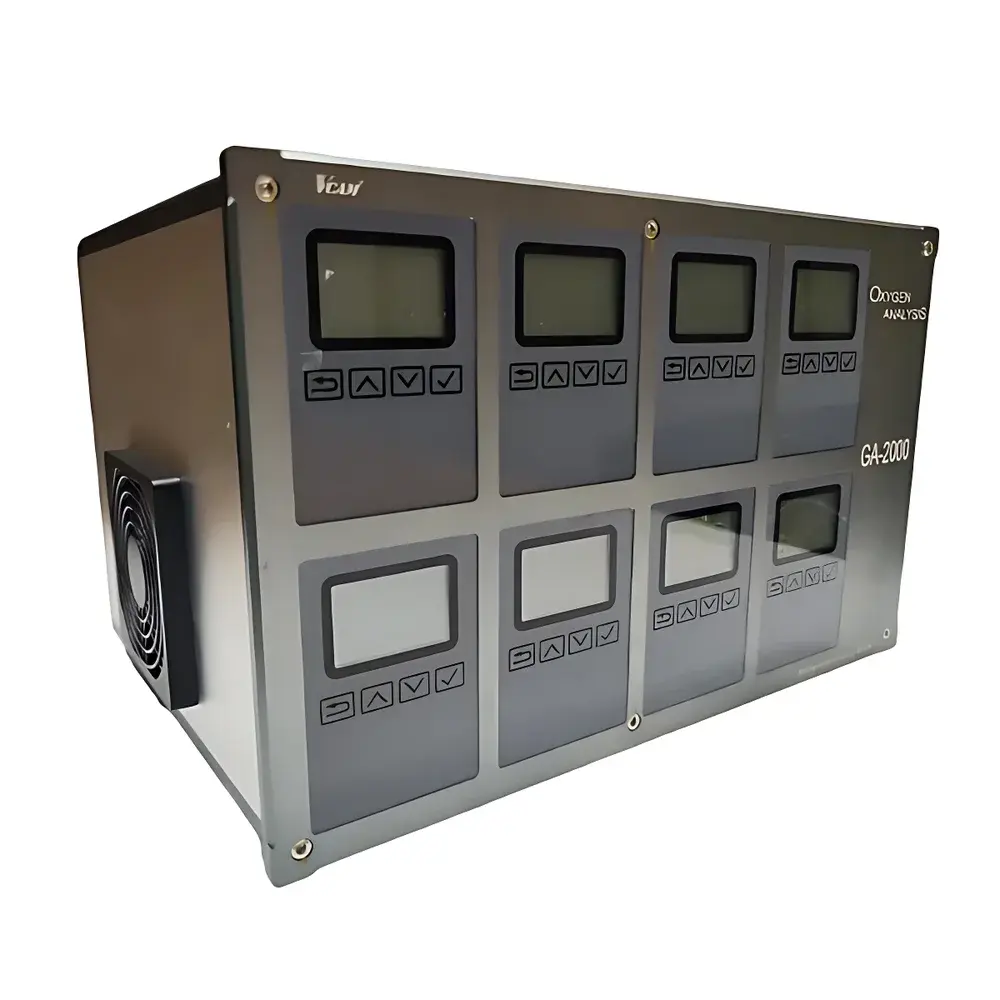
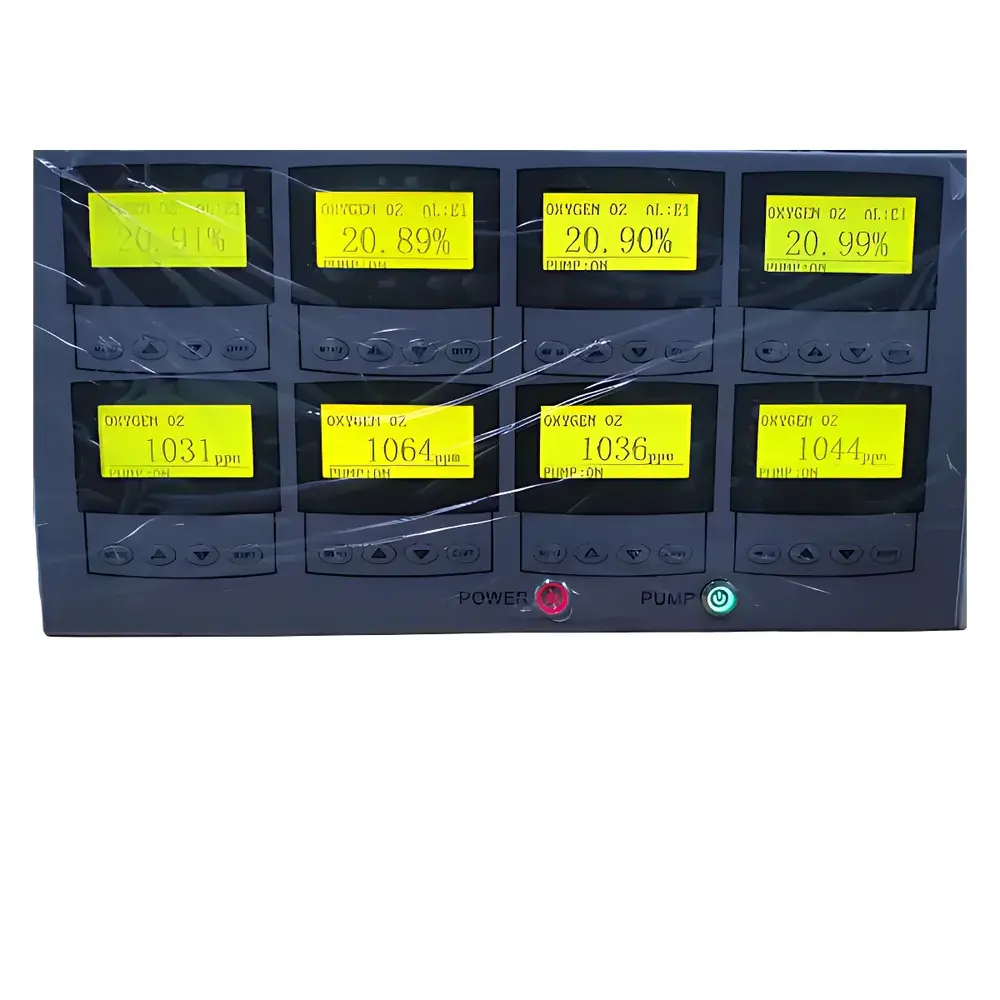
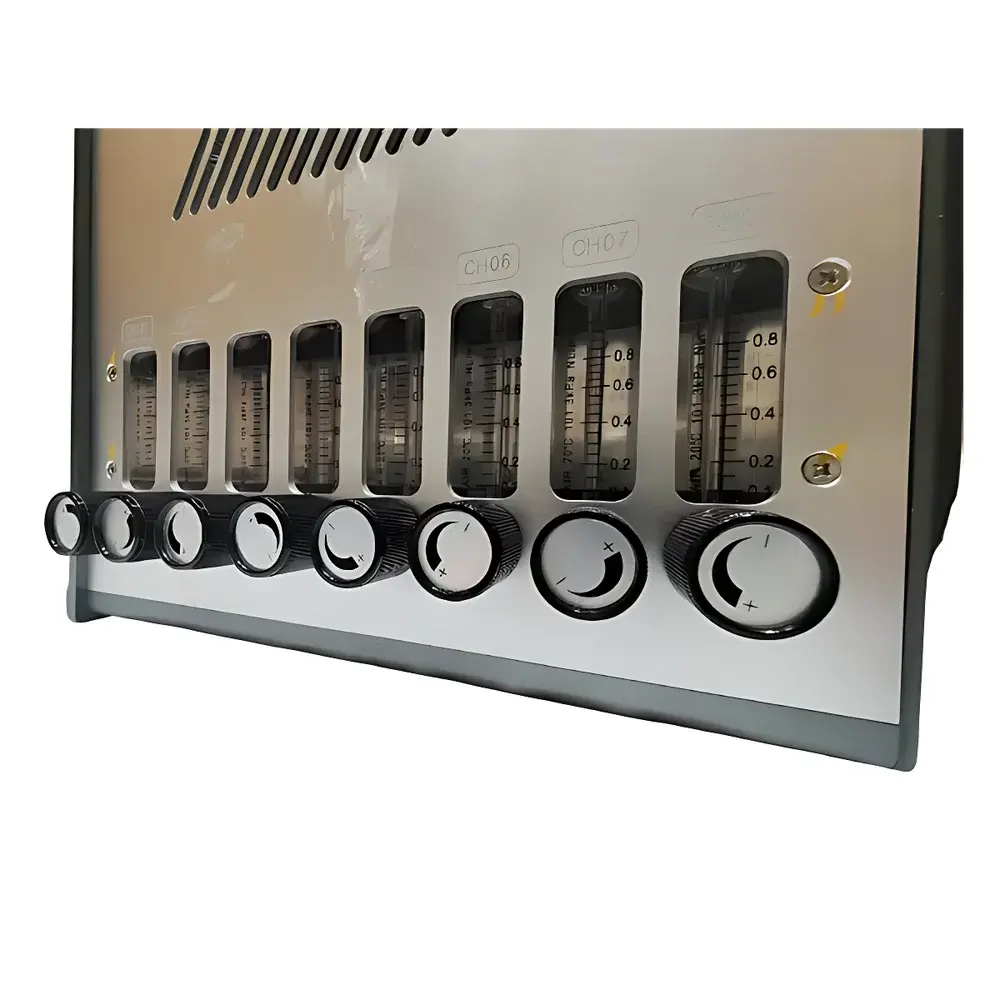
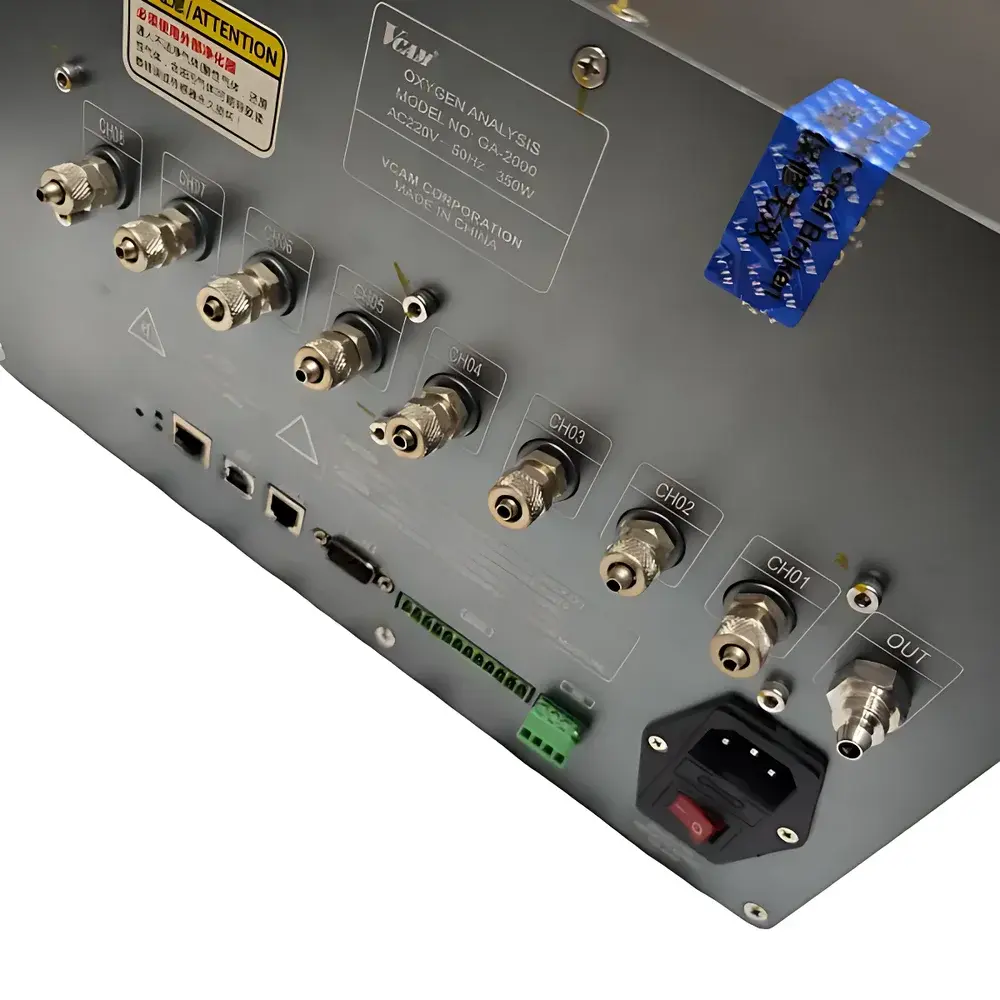
Vcam GA2000 CH1-14 Multi-Channel Oxygen Analyzer
| Brand | Vcam |
|---|---|
| Model | GA2000 CH1-14 |
| Origin | Guangdong, China |
| Channel Capacity | 2–14 configurable analog input channels |
| Measurement Range | 1 ppm – 25% O₂ (full-scale selectable per channel) |
| Accuracy | ±3% of reading for 25%–1% O₂ |
| Response Time (T90) | <60 s |
| Output Interface | 4–20 mA / RS485 Modbus RTU / Ethernet (optional) |
| Compliance | Designed to support GLP/GMP-aligned process validation and FDA 21 CFR Part 11 audit-trail readiness via optional software module |
Overview
The Vcam GA2000 CH1-14 is a modular, multi-channel paramagnetic and electrochemical oxygen analyzer engineered for real-time, high-stability oxygen concentration monitoring in inerted industrial thermal processing environments. Utilizing dual-sensor architecture—paramagnetic detection for %O₂ ranges (0–25%) and high-sensitivity electrochemical cells for trace-level quantification (1 ppm–1000 ppm)—the system delivers simultaneous, independent measurements across up to 14 user-configurable channels. Each channel supports dedicated calibration, range selection, and alarm thresholds, enabling precise spatial mapping of oxygen ingress across multi-zone reflow ovens, vacuum brazing furnaces, nitrogen-purged wave soldering systems, and dry-room battery electrode coating lines. Its measurement principle adheres to ISO 8573-3 for compressed gas purity verification and ASTM D6375 for inert atmosphere integrity assessment—critical for preventing oxidation-induced defects in SMT assembly, semiconductor packaging, and lithium-ion battery electrode manufacturing.
Key Features
- Modular channel architecture supporting 2 to 14 independently calibrated oxygen sensing inputs—scalable without hardware replacement.
- Dual-mode sensor integration: Paramagnetic cells for 0–25% O₂ (high linearity, zero drift compensation) and electrochemical sensors for 1–1000 ppm (temperature-compensated, long-term stability >12 months).
- Synchronized temperature monitoring per channel (±0.5 °C accuracy) to correct O₂ partial pressure drift and enable dew-point-referenced reporting.
- Real-time anti-oxidation logic engine: Automatically triggers purge flow adjustment, chamber pressure modulation, or thermal ramp hold upon O₂ excursion beyond user-defined limits.
- Integrated barcode scanner interface (USB/RS232) for lot-specific traceability—associates each O₂ reading with PCB serial number, furnace batch ID, or electrode coil ID.
- Ruggedized 19-inch rack-mount enclosure (IP65 front panel) with conformal-coated PCBs for operation in high-humidity, flux-laden, or particulate-rich production environments.
Sample Compatibility & Compliance
The GA2000 CH1-14 is validated for continuous sampling of nitrogen, argon, hydrogen-nitrogen blends, and vacuum-backed atmospheres with dew points down to –70 °C. Sample gas conditioning is supported via optional heated sample lines (up to 180 °C), particulate filtration (0.1 µm), and moisture removal membranes. The analyzer meets IEC 61000-6-2/6-4 for electromagnetic compatibility in factory-floor deployment and complies with UL 61010-1 for electrical safety. When paired with Vcam’s TraceLink™ data acquisition software, it supports ALCOA+ data integrity principles—including attributable, legible, contemporaneous, original, and accurate records—and generates audit-ready compliance reports aligned with ISO 9001, IATF 16949, and J-STD-001D Annex E requirements for solder process control.
Software & Data Management
Vcam TraceLink™ v4.2 (included) provides centralized configuration, real-time dashboard visualization, and automated report generation. Each channel logs timestamped O₂ values at 1 Hz resolution with embedded temperature compensation coefficients. Data export formats include CSV, PDF (with digital signature), and SQL-compatible structured datasets. Role-based access control (RBAC), electronic signatures, and full 21 CFR Part 11 audit trail functionality are available through the optional GxP Module—enabling secure, validated operation in regulated medical device and automotive electronics manufacturing. Historical trend analysis supports root-cause investigation of yield loss events correlated with O₂ excursions, furnace door seal degradation, or nitrogen supply impurity spikes.
Applications
- Electronics manufacturing: Monitoring oxygen levels across preheat, soak, reflow, and cooling zones in SMT reflow ovens to prevent copper oxidation and solder balling.
- Semiconductor packaging: Ensuring sub-10 ppm O₂ stability during die attach and wire bonding under forming gas (N₂/H₂) environments.
- Lithium-ion battery production: Verifying <5 ppm O₂ in electrode drying ovens and cell assembly dry rooms to inhibit Ni-rich cathode decomposition.
- Aerospace component brazing: Validating inert atmosphere integrity during high-temperature vacuum brazing of titanium and Inconel assemblies.
- Medical device sterilization: Supporting ethylene oxide (EtO) cycle qualification by documenting residual O₂ levels prior to gas introduction.
FAQ
Can the GA2000 CH1-14 be integrated with existing MES or SCADA systems?
Yes—it supports native Modbus RTU over RS485 and TCP/IP Modbus TCP, with pre-built drivers for Siemens SIMATIC, Rockwell FactoryTalk, and Siemens MindSphere.
Is sensor cross-talk possible between adjacent channels?
No—each channel employs galvanically isolated signal conditioning and individually referenced zero/span calibration to eliminate inter-channel interference.
What maintenance intervals are recommended for long-term accuracy?
Electrochemical sensors require annual replacement; paramagnetic cells are field-calibratable every 6 months using certified zero air and 20.9% O₂ reference gases.
Does the system support dynamic range switching during operation?
Yes—auto-ranging mode enables seamless transition between %O₂ and ppm modes per channel based on real-time concentration thresholds.
How is data integrity ensured during power interruption?
Onboard non-volatile memory retains all configuration parameters and the last 72 hours of buffered measurements, with automatic resynchronization upon recovery.