
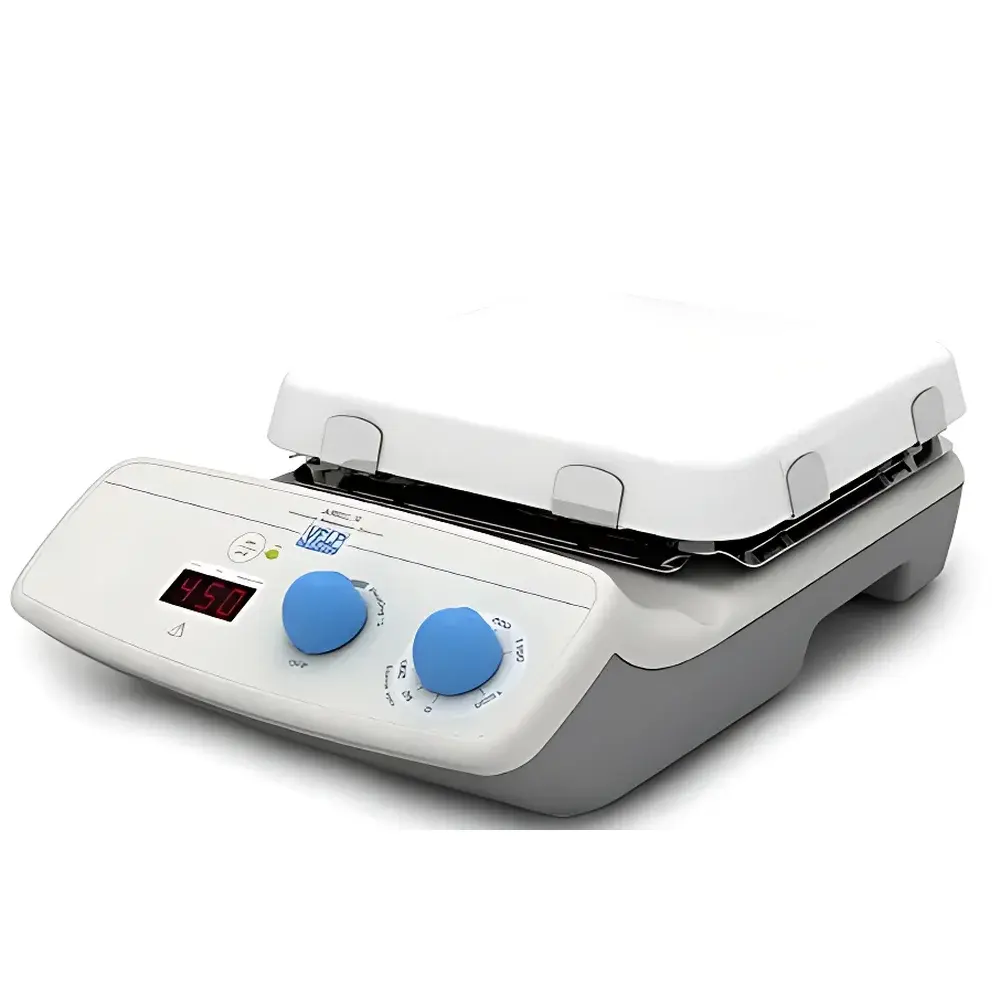
VELP AREC.X Digital Hotplate Magnetic Stirrer
| Brand | VELP |
|---|---|
| Origin | Italy |
| Model | AREC.X |
| Stirring Capacity | 15 L (H₂O) |
| Speed Range | 0–1500 rpm |
| Temperature Range | Ambient to 550 °C |
| Heating Plate Diameter | 180 mm |
| Power | 800 W |
| Display | LCD |
| Protection Rating | IP42 (per CEI EN 60529) |
| Weight | 3.3 kg |
| Dimensions | 203 × 94 × 344 mm |
| Temperature Accuracy | ±0.5 °C (with VTF digital thermostat), ±1.0 °C (with external Pt100 probe) |
| Max External Probe Temp | 250 °C |
| Compatible Accessories | VTF digital thermostat, Pt100 probe holder, support rod, stirring bars (6×35 mm, 9.5×60 mm, 10×40 mm), flask heating blocks (250/500/1000 mL) |
Overview
The VELP AREC.X Digital Hotplate Magnetic Stirrer is an engineered solution for laboratories requiring simultaneous precise temperature control and high-torque magnetic agitation in a single compact platform. Designed and manufactured in Italy, the AREC.X operates on the principle of electromagnetic induction to drive PTFE- or glass-coated stirring bars within vessels, while its ceramic heating plate delivers uniform thermal energy across a wide operational range—from ambient conditions up to 550 °C. Its microprocessor-based control architecture ensures dynamic speed regulation, maintaining consistent rotational velocity regardless of sample viscosity changes—a critical requirement in reaction monitoring, titration, dissolution testing, and synthesis protocols where mechanical stability directly impacts reproducibility.
Key Features
- Ceramic white heating surface (180 mm diameter) with exceptional corrosion resistance and ease of cleaning—ideal for acidic, alkaline, or organic solvent applications.
- LCD display with intuitive interface for independent or coupled control of speed (0–1500 rpm) and plate temperature (ambient to 550 °C).
- Integrated overtemperature safety system: electronic panel activates visual alarm above 50 °C and remains active until surface cools below threshold—preventing operator exposure and sample degradation.
- Separate control panel design physically isolated from the heating zone, enhancing user safety and long-term electronics reliability.
- Microprocessor-driven constant-speed algorithm compensates for real-time viscosity shifts during mixing—ensuring stable shear input across evolving rheological profiles.
- 800 W power output enables robust agitation of volumes up to 15 L (water-equivalent), supporting scalable benchtop process development and quality control workflows.
- Ergonomic tilt-handled chassis improves accessibility and reduces strain during extended operation or vessel loading/unloading.
Sample Compatibility & Compliance
The AREC.X accommodates standard laboratory glassware—including round-bottom flasks, beakers, and crystallization dishes—up to 15 L capacity when used with appropriately sized magnetic stir bars (e.g., 9.5×60 mm or 10×40 mm). Optional flask-specific heating blocks (250/500/1000 mL) provide improved thermal coupling and vessel stability. For temperature-critical applications, the unit supports external Pt100 probe integration (max 250 °C, ±1.0 °C accuracy) or optional VTF digital thermostat (±0.5 °C up to 300 °C), enabling traceable, GLP-compliant thermal validation. The device conforms to CE marking requirements under Directive 2014/30/EU (EMC) and 2014/35/EU (LVD), and meets IP42 ingress protection per CEI EN 60529 for limited dust and splash resistance.
Software & Data Management
While the AREC.X operates as a standalone instrument, its analog/digital I/O compatibility allows integration into automated lab environments. When paired with the VTF digital thermostat, users gain access to programmable ramp-hold temperature profiles and timer-based activation—enabling unattended overnight reactions or standardized dissolution cycles. Though no native PC software is embedded, the system supports manual logging of setpoints and runtime parameters via its LCD interface. All temperature and speed settings are retained after power cycling, supporting repeatable method execution in regulated environments adhering to ISO/IEC 17025 or FDA 21 CFR Part 11 principles when combined with documented procedural controls.
Applications
- Chemical synthesis requiring controlled heating and homogeneous mixing under reflux or inert atmosphere.
- Pharmaceutical dissolution testing per USP , where precise temperature maintenance and consistent agitation are mandatory.
- Titrations involving colorimetric endpoint detection—enabled by the white ceramic surface’s high contrast background.
- Material science sample preparation, including polymer dissolution, nanoparticle dispersion, and catalyst slurry homogenization.
- Environmental analysis workflows such as BOD/COD digestion, heavy metal leaching, and extraction protocols demanding thermal stability and mechanical consistency.
- Food & beverage QA/QC procedures including viscosity calibration standards preparation and emulsion stability assessment.
FAQ
What is the maximum recommended vessel size for optimal stirring performance?
For consistent vortex formation and thermal uniformity, use vessels with diameters ≤150 mm at full 15 L capacity; smaller volumes (≤5 L) allow wider flask compatibility.
Can the AREC.X be used with non-magnetic containers?
No—magnetic coupling requires ferromagnetic or paramagnetic base materials; stainless steel or aluminum vessels are incompatible unless fitted with internal stir bars and external drive mechanisms.
Is the VTF thermostat required for accurate temperature measurement?
The built-in plate sensor provides ±1.0 °C accuracy; the VTF + Pt100 combination achieves ±0.5 °C in solution—essential for pharmacopeial compliance.
Does the unit support RS232 or USB data export?
No native serial or USB interface is provided; data recording must be performed manually or via external dataloggers connected to the VTF thermostat’s analog outputs.
What safety certifications does the AREC.X hold?
It carries CE marking compliant with EU Low Voltage (2014/35/EU) and Electromagnetic Compatibility (2014/30/EU) directives, and meets IP42 per CEI EN 60529 for environmental protection.



