
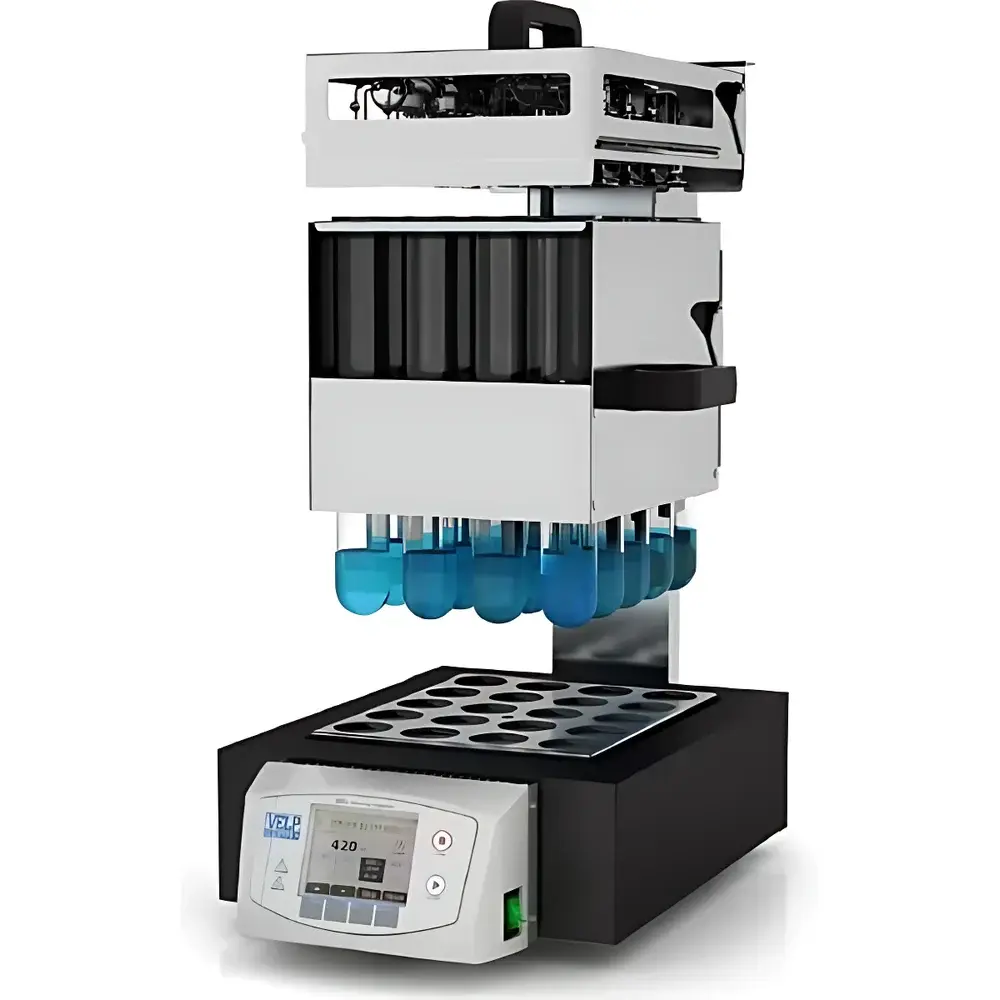
VELP DKL Series Automated Digestion System
| Brand | VELP |
|---|---|
| Origin | Italy |
| Model | DKL Series |
| Heating Temperature Range | Room Temperature to 450 °C |
| Temperature Control Accuracy | ±0.5 °C |
| Programmable Heating Profiles | 54 Predefined + 24 User-Defined |
| Heating Ramp Stages | 4 |
| Heating Duration | 0–999 min |
| Automatic Lift Arm | Yes |
| Compliance Standards | AOAC, EPA, DIN, ISO |
| Display Interface | Multilingual (including Chinese) |
| Available Configurations | DKL8 (8-position), DKL12 (12-position), DKL20 (20-position), DKL42 (42-position) |
Overview
The VELP DKL Series Automated Digestion System is a precision-engineered thermal digestion platform designed for complete, reproducible sample mineralization prior to elemental analysis—particularly nitrogen determination via Kjeldahl methodology. Built upon Couette-flow–assisted convection and uniform radial heating architecture, the system delivers controlled, programmable thermal decomposition of organic matrices in acid media (e.g., H₂SO₄, H₂O₂, or HClO₄). Its core operational principle relies on precise temperature ramping, dwell stabilization, and automated mechanical positioning to eliminate manual intervention during both digestion and post-digestion cooling phases. Engineered for laboratories requiring high-throughput, trace-level elemental quantification—especially in food, feed, environmental, and agricultural testing—the DKL system integrates seamlessly into validated workflows compliant with international regulatory frameworks including AOAC Official Methods of Analysis, EPA Method 3050B/3051A, DIN 10497, and ISO 8586.
Key Features
- Automated lift arm mechanism synchronizes sample rack elevation with thermal cycle phase—raising samples into heating zone for digestion and lowering them into ambient air for passive cooling, minimizing operator exposure and thermal inertia errors.
- TEMS (Thermal Energy Management System) technology dynamically modulates power delivery across four independent heating ramp stages, reducing energy consumption by up to 30% compared to conventional fixed-power digesters without compromising temperature stability or repeatability.
- High-resolution PID temperature control ensures ±0.5 °C accuracy across the full 20–450 °C operating range, verified via NIST-traceable calibration protocols.
- 54 factory-loaded digestion programs—including optimized methods for cereals, dairy, soil, and wastewater sludge—are supplemented by 24 user-definable profiles supporting multi-step ramp-hold-cool sequences.
- Compact footprint design (optimized for benchtop integration) achieves rapid thermal response: <22 minutes to reach 420 °C from ambient, enabled by low-thermal-mass ceramic heating elements and enhanced airflow channeling.
- Intuitive multilingual touchscreen interface—including native Chinese language support—features real-time temperature graphing, program progress tracking, and event logging with timestamped annotations.
Sample Compatibility & Compliance
The DKL Series accommodates standard digestion tubes (e.g., borosilicate glass, quartz, or PTFE-lined) ranging from 100 mL to 300 mL capacity. It supports open-vessel wet digestion protocols for diverse sample types: solid foods (meat, grains, legumes), biological tissues, soils, sediments, and municipal sludge. All models comply with CE marking requirements and meet electromagnetic compatibility (EMC) standards per EN 61326-1. Instrument validation documentation includes IQ/OQ templates aligned with GLP and ISO/IEC 17025 laboratory accreditation criteria. Data integrity features—such as operator login audit trails, parameter change logs, and non-editable run records—support adherence to FDA 21 CFR Part 11 when integrated with compliant LIMS environments.
Software & Data Management
The embedded firmware provides local data retention for ≥1,000 complete digestion cycles, each storing setpoints, actual temperatures (recorded every 10 seconds), lift arm status, and error flags. Optional USB export enables CSV-formatted reports compatible with Microsoft Excel, LabWare LIMS, or Empower CDS. No proprietary software installation is required for basic operation; advanced remote monitoring and fleet management are available via VELP’s optional Ethernet-enabled DKL Connect module, which supports SNMP v3 and TLS 1.2 encrypted communication for secure network integration.
Applications
- Kjeldahl nitrogen determination in compliance with ISO 5983-1, AOAC 984.13, and USP <281>
- Heavy metal extraction (As, Cd, Pb, Hg) for ICP-OES/MS analysis per EPA 3050B and ISO 11466
- Phosphorus and potassium recovery from plant tissue for agronomic nutrient profiling
- Digestion of polymeric packaging materials prior to halogen screening (ASTM D7359)
- Preparation of certified reference materials (CRMs) for interlaboratory validation studies
FAQ
What safety certifications does the DKL Series hold?
The system carries CE marking under the EU Machinery Directive 2006/42/EC and Low Voltage Directive 2014/35/EU, with conformity verified by TÜV SÜD.
Can the DKL be integrated with an automated Kjeldahl distillation unit?
Yes—VELP’s UDK 159 and UDK 169 distillation modules feature synchronized digital handshake protocols enabling fully unattended digestion–distillation–titration sequences.
Is method validation support available for ISO 17025 accreditation?
VELP provides documented evidence packages including temperature uniformity mapping reports, repeatability studies (n≥6 at 250 °C and 420 °C), and uncertainty budgets per GUM guidelines.
Does the system support password-protected method editing?
Yes—three-tier access control (Operator, Supervisor, Administrator) restricts modification of critical parameters such as max temperature, ramp rates, and lift timing.
What maintenance intervals are recommended for long-term reliability?
Annual verification of thermocouple calibration and lift arm mechanical alignment is advised; no routine consumables are required beyond standard digestion tube replacements.




