
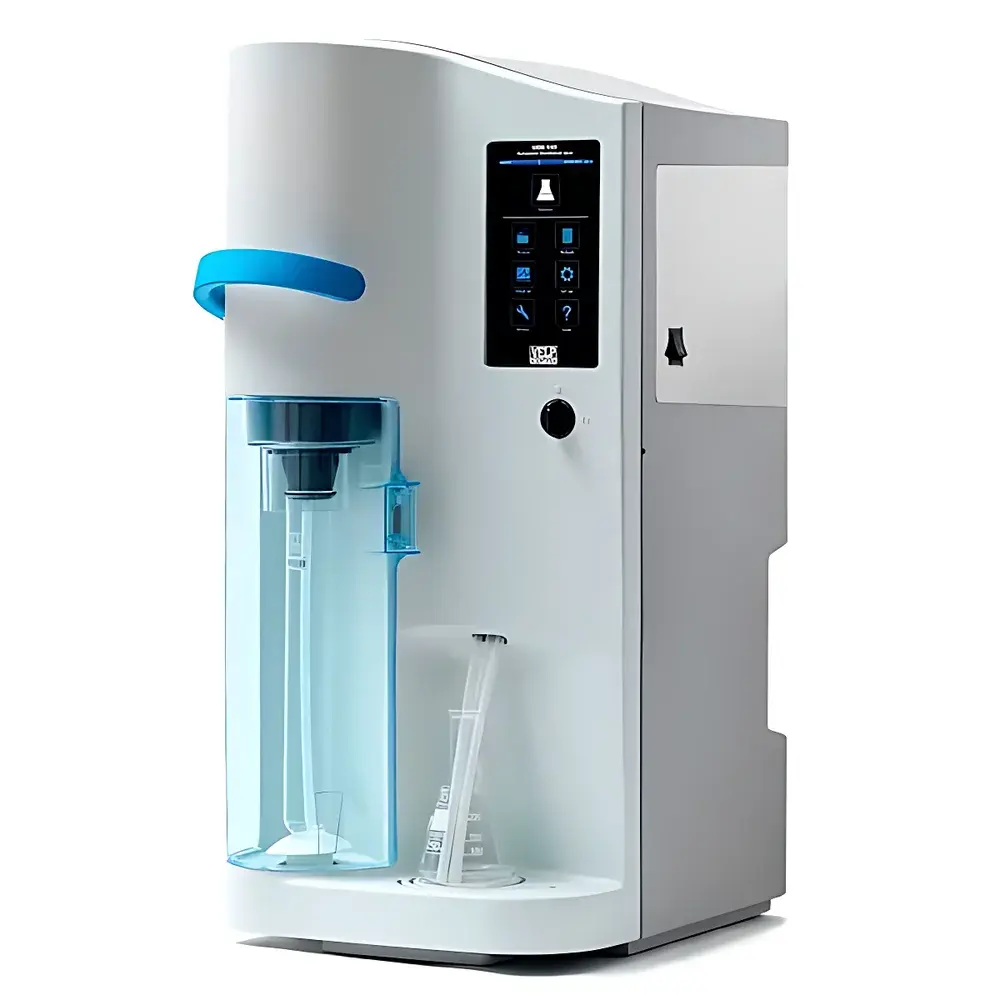
VELP UDK149 Automated Kjeldahl Nitrogen Determinator
| Brand | VELP |
|---|---|
| Origin | Italy |
| Model | UDK149 |
| Instrument Type | Automated Kjeldahl Nitrogen Determinator |
| Distillation Time | 1–99 min (typical cycle: 3.5 min per sample) |
| Repeatability | ≤1% RSD |
| Nitrogen Recovery Rate | ≥99.5% |
| Power Consumption | 2100 W |
| Dimensions (L×W×H) | 385 × 780 × 416 mm |
| Weight | 27 kg |
| Safety Compliance | Integrated thermal, mechanical, and fluid-flow interlocks |
| Interface Ports | RS232, dual USB, TTL, Ethernet |
| Display | 3.5-inch capacitive touchscreen |
| Control Architecture | Fully programmable microprocessor-based automation system |
| Cooling System | High-efficiency titanium condenser (low water consumption) |
Overview
The VELP UDK149 Automated Kjeldahl Nitrogen Determinator is a fully integrated, microprocessor-controlled system engineered for precise, reproducible total nitrogen quantification in accordance with standardized Kjeldahl methodology (ISO 8968-1, AOAC 984.13, ASTM D1122, USP & EP monographs). It implements classical wet digestion–distillation–titration workflow with complete automation of reagent dosing, steam generation, condensation, distillate collection, and endpoint detection via external potentiometric titration. The system employs a built-in steam generator with dynamic pressure regulation, ensuring consistent vapor delivery across variable load conditions. Its titanium condenser delivers high thermal efficiency and corrosion resistance—critical for long-term operation with aggressive alkaline and acidic reagents. Designed for routine QC/QA laboratories in food, feed, agricultural, environmental, and pharmaceutical sectors, the UDK149 meets GLP-compliant data integrity requirements through audit-trail-capable software integration and hardware-level safety interlocks.
Key Features
- Fully automated sequence control: independent programming of alkali volume, boric acid volume, steam flow rate, distillation duration (1–99 min), residual waste discharge, and titration initiation
- Integrated steam generator with auto-dilution, auto-alkalization, and auto-acidification functions—eliminating manual reagent handling
- Titanium condenser with optimized surface area and low coolant demand, reducing operational water consumption by up to 40% versus conventional copper units
- 3.5-inch capacitive touchscreen interface supporting multi-language operation (including English, German, French, Spanish, and Chinese), with intuitive icon-driven navigation and real-time status feedback
- Comprehensive safety architecture: position sensors for digestion tube alignment, interlocked safety door monitoring, steam generator overtemperature cutoff, and continuous coolant flow verification
- Modular connectivity: RS232, dual USB ports, TTL I/O, and Ethernet enable seamless integration with external potentiometric titrators (e.g., SCHOTT, METTLER TOLEDO, SARTORIUS), LIMS, and laboratory PCs
- Onboard firmware allows user-defined report templates—including customizable parameter fields, header/footer metadata, and export formats (CSV, PDF)
Sample Compatibility & Compliance
The UDK149 accommodates standard 100–500 mL digestion tubes (e.g., Kjeldahl borosilicate glass) and supports sample weights typical for nitrogen analysis (0.1–5 g, depending on matrix concentration). It complies with international regulatory frameworks governing analytical instrumentation: its hardware design satisfies IEC 61010-1 (safety of electrical equipment), while its operational logic aligns with FDA 21 CFR Part 11 requirements when paired with validated titration software and electronic signature modules. Method validation documentation—including recovery studies (≥99.5% across protein, ammonium sulfate, and casein reference materials), precision assessments (≤1% RSD at n=10), and robustness testing under variable ambient temperature/humidity—is available upon request for GMP/GLP audits.
Software & Data Management
The UDK149 operates without proprietary PC software; all configuration, method storage, and result logging occur locally via embedded firmware. Up to 99 user-defined methods can be saved onboard, each specifying exact reagent volumes, timing parameters, and safety thresholds. Experimental data—including sample ID, timestamp, distillation time, titrant volume, calculated %N or %protein, and system diagnostic flags—are stored in non-volatile memory and exportable via USB or network transfer. When interfaced with compliant titration platforms, full audit trails—including operator ID, edit history, and electronic signatures—can be generated to satisfy ISO/IEC 17025 and pharmaceutical quality system requirements.
Applications
The UDK149 delivers reliable nitrogen determination in diverse matrices: crude protein content in cereals, dairy products, meat, and pet food (per AOAC 981.10, ISO 20483); total Kjeldahl nitrogen (TKN) in wastewater and soil extracts (EPA 351.2, ISO 11261); ammonium-nitrogen in fertilizers (ISO 5315); and non-protein nitrogen (NPN) assessment in feedstuffs. Its high recovery rate and repeatability make it suitable for accreditation-critical workflows where traceability, method equivalence, and inter-laboratory comparability are mandated.
FAQ
Does the UDK149 include an integrated titrator?
No—the UDK149 is designed for interoperability with external potentiometric titrators via RS232 or USB. Recommended models include SCHOTT TitroLine 7700, METTLER TOLEDO DL series, and SARTORIUS TITRINO.
Can the instrument operate without a continuous cooling water supply?
Yes—the titanium condenser enables efficient heat exchange with minimal water flow; optional recirculating chillers or low-flow municipal supplies are compatible.
Is method validation support provided for regulatory submissions?
VELP supplies IQ/OQ documentation templates and application notes aligned with ISO/IEC 17025, AOAC, and USP guidelines. Full PQ support requires site-specific qualification under client SOPs.
What maintenance intervals are recommended?
Daily: cleaning of receiver cup and steam outlet; monthly: inspection of gaskets, tubing, and condenser surfaces; annual: calibration verification of liquid dispensing pumps and temperature sensors by authorized service personnel.
How is data integrity ensured during power interruption?
Critical process variables and timestamps are written to flash memory at each operational step; the system resumes from last stable state upon reboot, with no loss of method parameters or pending results.




