
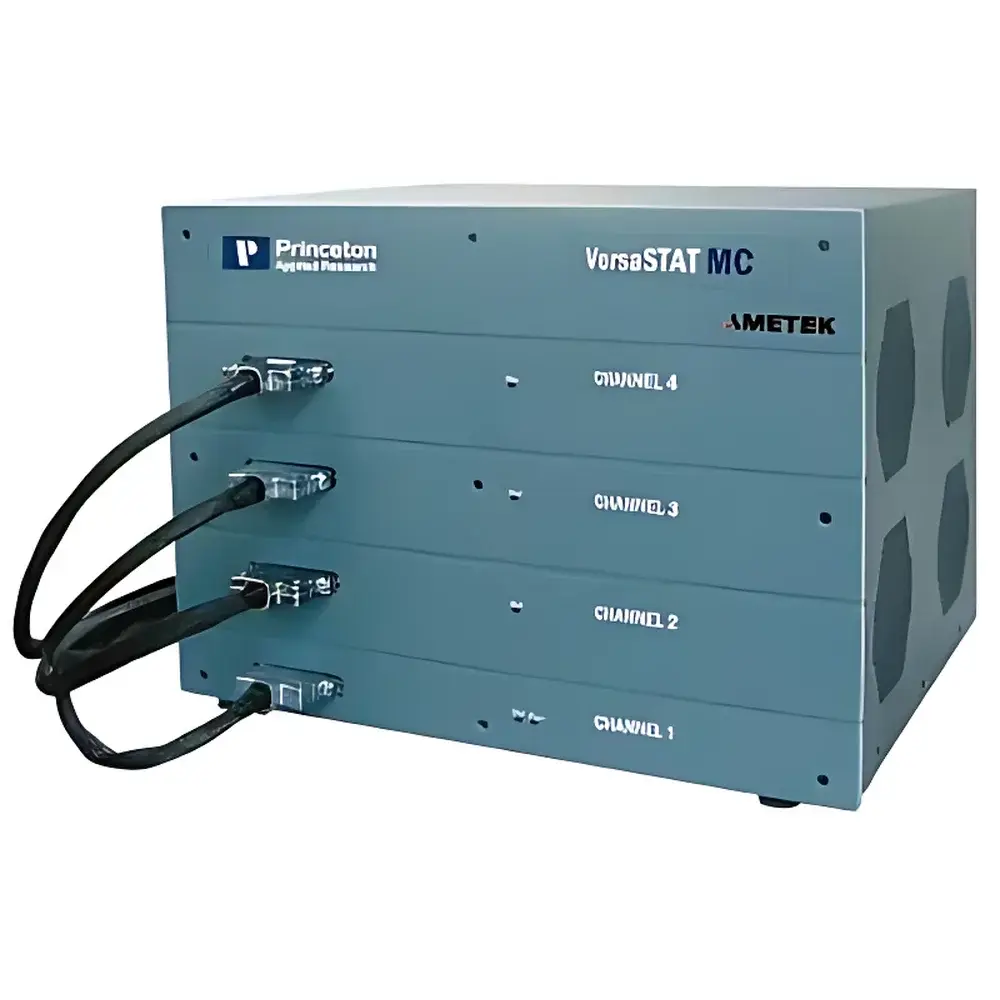
VersaSTAT MC Multi-Channel Multifunctional Electrochemical Workstation
| Brand | Princeton Applied Research (PAR) |
|---|---|
| Origin | USA |
| Model | VersaSTAT MC |
| Current Range | 200 nA – 2 A |
| Current Accuracy | ±0.2% of reading |
| Potential Accuracy | ±0.2% of reading ± 2 mV |
| Potentiostatic Range | ±10 V |
| EIS Frequency Range | 10 µHz – 1 MHz |
Overview
The VersaSTAT MC Multi-Channel Multifunctional Electrochemical Workstation is a high-performance, modular potentiostat/galvanostat system engineered for precision electrochemical characterization across research, industrial QA/QC, and academic teaching environments. Developed by Princeton Applied Research—a division of AMETEK with over four decades of expertise in electrochemical instrumentation—the VersaSTAT MC implements controlled-potential and controlled-current techniques grounded in classical electrochemical theory, including Butler–Volmer kinetics, linear diffusion-controlled mass transport, and small-signal perturbation analysis for impedance spectroscopy. Its architecture supports true multi-channel operation (up to four independent channels per unit, configurable via optional expansion modules), enabling parallel experiments on multiple working electrodes under identical or differentiated conditions—critical for high-throughput corrosion screening, battery electrode evaluation, or sensor array validation. The system operates on a 3-electrode configuration (working, reference, counter), with optional 4-electrode support for uncompensated resistance correction and grounded cell configurations compliant with ASTM G5/G59/G102 standards.
Key Features
- Multi-channel capability: Up to four fully isolated electrochemical channels in a single chassis, each with independent control, timing, and data acquisition.
- Wide dynamic current range: 200 nA to 2 A (with internal 2 A option), offering 120 fA current resolution at the lowest range—enabling accurate measurement of microelectrode currents and low-rate corrosion processes.
- High-fidelity potential control: ±10 V compliance range, 300 nV resolution (±10 mV range), ≤350 ns rise time, and ≥8 V/µs slew rate ensure fidelity in fast-scan voltammetry (e.g., cyclic voltammetry up to 5000 V/s) and transient techniques such as chronoamperometry and pulse methods.
- Integrated Frequency Response Analyzer (FRA): Built-in EIS module covering 10 µHz to 1 MHz, supporting both potentiostatic and galvanostatic EIS modes with automatic IR compensation (positive feedback and current-interrupt options).
- Dual 16-bit ADCs per channel: Three synchronized 16-bit analog-to-digital converters (500 kS/s aggregate sampling) enable simultaneous high-resolution acquisition of potential, current, and auxiliary signals with 10 µs time resolution.
- Robust analog front-end: Differential electrometer input with >1012 Ω input impedance, <5 pA leakage current, and 60 dB CMRR at 100 kHz ensures stability during low-current measurements in high-impedance systems (e.g., coated metals, biological membranes).
Sample Compatibility & Compliance
The VersaSTAT MC accommodates standard three-electrode electrochemical cells (e.g., glassy carbon, platinum, Ag/AgCl), rotating disk electrodes (RDE), microelectrodes, thin-film sensors, and custom-designed corrosion coupons—including ASTM G102-compliant flat-panel and crevice specimens. It supports immersion testing in aqueous electrolytes (NaCl, H2SO4, artificial seawater), non-aqueous battery electrolytes (LiPF6/EC:DMC), and conductive polymer gels. Hardware and software comply with ISO/IEC 17025 documentation requirements for test method validation and are routinely deployed in GLP-regulated environments. Data integrity features—including electronic signatures, audit trails, and user-access controls—align with FDA 21 CFR Part 11 readiness when configured with PAR’s Studio software in validated mode.
Software & Data Management
Studio software serves as the unified control and analysis platform for all VersaSTAT instruments. It provides experiment scripting via drag-and-drop sequence builders or Python-based automation (via COM interface), real-time visualization of raw and processed data (Nyquist/Bode plots, Tafel fits, equivalent circuit modeling using ZView®-compatible formats), and batch processing for statistical comparison across sample sets. All experimental parameters, instrument settings, calibration logs, and raw binary data (.DTA files) are stored in timestamped, metadata-enriched project archives. Export options include CSV, Excel, MATLAB (.mat), and industry-standard CITS-compatible formats. Version-controlled software updates and firmware patches are delivered through AMETEK’s secure customer portal, ensuring traceability and long-term maintainability.
Applications
- Corrosion science: Linear polarization resistance (LPR), Tafel extrapolation, electrochemical noise analysis (ENA), and EIS-based coating degradation assessment per ASTM D1141, D1654, and ISO 16773.
- Battery & energy storage: Galvanostatic intermittent titration technique (GITT), hybrid pulse power characterization (HPPC), state-of-charge (SOC) profiling, and SEI growth monitoring via low-frequency EIS.
- Sensor development: Amperometric detection limits down to sub-picoampere levels; calibration curve generation for enzyme-based biosensors and ion-selective electrodes.
- Electrocatalysis & fuel cells: Rotating ring-disk electrode (RRDE) studies, oxygen reduction reaction (ORR) activity mapping, and catalyst stability evaluation under accelerated stress tests (AST).
- Academic instruction: Predefined experiment templates for undergraduate electrochemistry labs—including cyclic voltammetry of ferrocene, corrosion inhibition efficiency, and double-layer capacitance determination—support reproducible pedagogical outcomes.
FAQ
Is the VersaSTAT MC suitable for battery cycling tests requiring high current pulses?
Yes—the optional 2 A internal current source supports pulse discharge profiles up to 20 A when paired with external current amplifiers, meeting requirements for GSM/CDMA battery testing per IEC 61960.
Can multiple VersaSTAT MC units be synchronized for large-scale array testing?
Yes—hardware trigger I/O (TTL) and USB-based master-slave configuration enable precise temporal alignment across up to 16 channels in distributed setups.
Does the system support real-time IR compensation during EIS acquisition?
Yes—both positive feedback and current-interrupt IR compensation are implemented in real time, with adjustable compensation percentage and automatic optimization based on solution resistance estimates.
What level of software validation support is available for regulated industries?
AMETEK provides IQ/OQ documentation packages, 21 CFR Part 11 configuration guides, and on-site validation assistance for pharmaceutical, medical device, and aerospace clients operating under GxP frameworks.
Is remote operation possible over LAN or VPN?
Studio software supports TCP/IP-based remote desktop access and networked instrument sharing via Windows Remote Desktop Protocol (RDP) or third-party secure tunneling solutions—without compromising local data security policies.






