
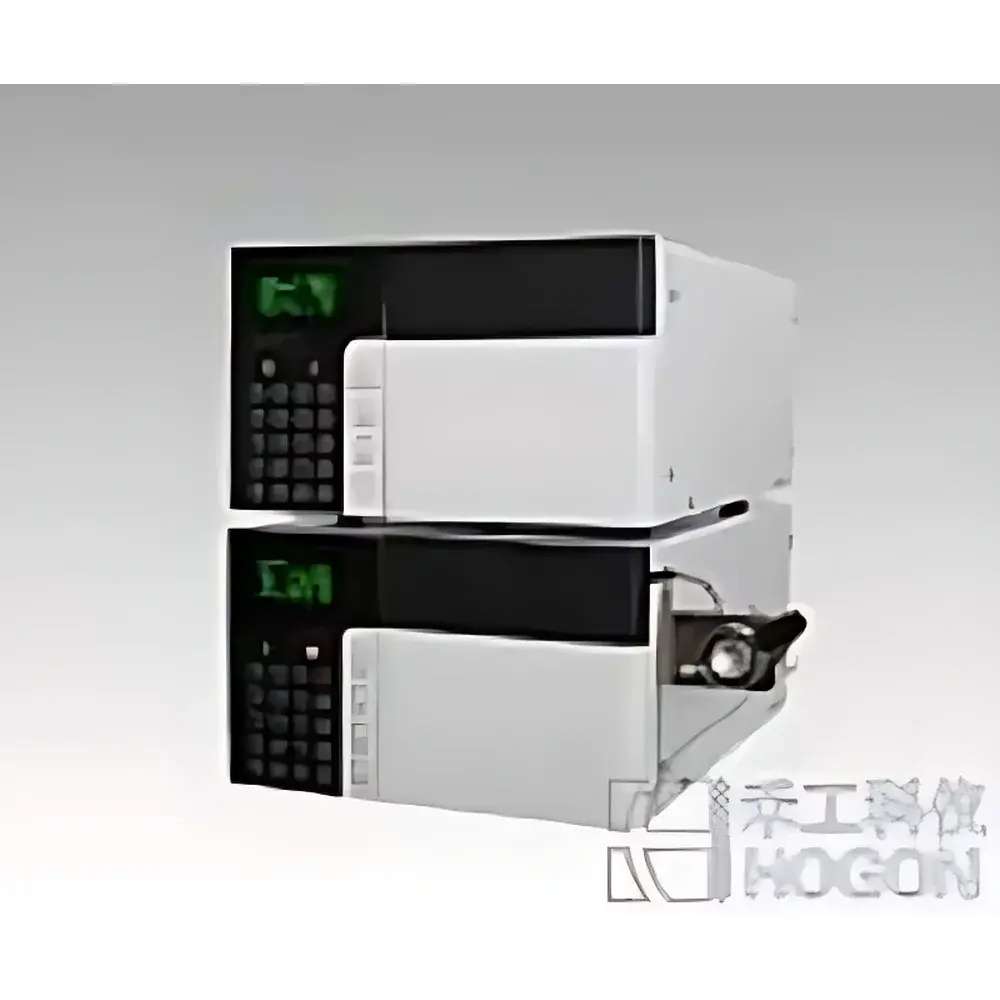
VERTEX VI500 High-Performance Liquid Chromatograph (HPLC)
| Brand | Vertex |
|---|---|
| Origin | Shanghai, China |
| Model | VERTEX VI500 |
| Instrument Type | Conventional HPLC System |
| Flow Rate Range | 0.001–9.999 mL/min |
| Max Operating Pressure | 40 MPa |
| Injection Volume Range | 1–5000 µL (1 µL increment |
| Column Oven Temperature Range | 4–85 °C |
| UV Detector Wavelength Range | 190–720 nm (D₂ lamp), up to 940 nm with optional W lamp |
| Data Acquisition Rate | 100 Hz |
| Baseline Noise (UV) | ≤ ±0.2 × 10⁻⁵ AU (empty cell) |
| Wavelength Accuracy | ±1 nm |
| Wavelength Precision | < 0.1 nm |
| RI Detector Refractive Index Range | 1.00–1.75 |
| RI Detector Noise | ≤ 2.5 nRIU |
| Sample Capacity | 2 × 48 vials (2 mL), optional 96-/384-well plates |
| Auto-sampler Cycle Time | 17 s (injection only), 60 s including needle wash |
| Injection Reproducibility (full-loop) | RSD < 0.3% |
| Column Oven Temp Stability | ±0.1 °C |
| Power Supply | AC 110/220 V, 50/60 Hz |
| Dimensions (W×D×H) | 260 × 360 × 170 mm |
| Weight | 10.0 kg |
Overview
The VERTEX VI500 High-Performance Liquid Chromatograph is a modular, research-grade analytical HPLC system engineered for precision, long-term operational stability, and compliance-ready deployment in regulated laboratory environments. Built upon a dual-pump architecture—comprising a high-pressure analytical pump (0.001–9.999 mL/min, ≤42 MPa) and an optional semi-preparative pump (0.01–80 mL/min, ≤20 MPa)—the system implements isocratic and gradient elution with flow accuracy better than ±0.06% RSD under standard conditions. Its core separation mechanism relies on liquid-phase partitioning across packed stationary phases, with detection via dual-wavelength UV-Vis absorbance (190–940 nm with D₂ + W lamp option) and/or differential refractometry (1.00–1.75 RIU). The system operates without centralized controller dependency, utilizing embedded microprocessor control for real-time pressure monitoring, flow calibration, and fault diagnostics—enabling autonomous operation in standalone or networked configurations.
Key Features
- Modular design supporting field-upgradable components: UV/Vis detector, RI detector, auto-sampler (AS5000), column oven, and binary/quaternary gradient modules
- High-stability dual-piston reciprocating pump with ceramic-coated plunger rods and wear-resistant pump head geometry—designed to minimize seal wear and eliminate plunger misalignment over extended service life
- UV detector featuring thermally stabilized optical path, selectable D₂ and tungsten lamps, 5-mm flow cell, and baseline noise ≤ ±0.2 × 10⁻⁵ AU (empty cell, 1 s response)
- RI detector with 8-µL flow cell, temperature-compensated optics, and linear dynamic range >600 µRIU—optimized for non-UV-absorbing analytes including carbohydrates, polymers, and excipients
- AS5000 autosampler offering full-loop, partial-loop, and carryover-free injection modes; programmable volume (1–5000 µL); <0.05% carryover; refrigerated sample compartment (4 °C to ambient −3 °C)
- Column oven with PID-controlled heating/cooling (4–85 °C), ±0.1 °C setpoint accuracy, and rapid thermal equilibration (<15 min from ambient to 60 °C)
- Embedded Ethernet interface (10/100BASE-T) compliant with TCP/IP stack—enabling remote instrument control, status polling, and integration into LIMS or chromatography data systems (CDS)
Sample Compatibility & Compliance
The VERTEX VI500 supports reversed-phase, normal-phase, ion-exchange, size-exclusion, and hydrophilic interaction liquid chromatography (HILIC) methods using standard 2–5 µm particle-packed columns (2.1–4.6 mm ID, up to 250 mm length). It accommodates aqueous, organic, and corrosive mobile phases—including TFA, HFBA, and low-pH buffers—within its chemically resistant fluidic path (PEEK, sapphire, and stainless-steel wetted materials). The system meets key performance verification criteria outlined in USP , ASTM E260, and ISO 17025 for method validation. All detectors provide audit-trail-capable event logging, user-accessible calibration records, and timestamped parameter changes—supporting GLP/GMP workflows under FDA 21 CFR Part 11 when paired with compliant CDS software. Optional IQ/OQ documentation packages are available for installation and operational qualification per GAMP 5 guidelines.
Software & Data Management
The VERTEX VI500 operates with ChromaSight Pro workstation software—a Windows-based platform supporting method development, sequence definition, real-time chromatogram display, peak integration (tangent skim, valley-to-valley, exponential skimming), and report generation (PDF, CSV, XML). The software implements electronic signatures, role-based access control (admin/operator/analyst profiles), and secure data archiving with SHA-256 hash integrity checks. Raw data files (.chd) are stored in vendor-neutral format compliant with ASTM E1923-19 metadata standards. Integration with third-party CDS platforms—including Empower, Chromeleon, and OpenLab—is supported via ASCII export and vendor-provided API libraries. All system events—including pressure spikes, lamp usage hours, flow deviations, and temperature excursions—are logged with UTC timestamps and retained for ≥12 months by default.
Applications
The VERTEX VI500 delivers validated performance across pharmaceutical QC (assay, related substances, dissolution testing), food safety (mycotoxin quantification, pesticide residue screening), environmental analysis (PAHs, phenols, surfactants), polymer characterization (Mn, Mw, PDI via SEC), and natural product isolation (flavonoids, alkaloids, terpenes). Its UV detector sensitivity (LOD = 1 × 10⁻⁸ g/mL for naphthalene in methanol) enables trace-level impurity profiling per ICH Q2(R2). The RI detector provides orthogonal detection for sugar alcohols, glycosides, and polysaccharides where UV chromophores are absent. In-process control applications include batch release testing in fine chemical synthesis and biomanufacturing—leveraging the system’s 72-hour unattended run capability and automated method switching.
FAQ
Is the VERTEX VI500 compatible with UHPLC columns?
Yes—the system’s 42 MPa maximum pressure rating and low-volume flow path (≤15 µL dwell volume) support 1.7–2.7 µm particle columns at flow rates up to 2.0 mL/min, though optimal performance requires matching tubing ID and detector cell volume.
What regulatory documentation is provided for GxP environments?
Factory-issued IQ/OQ protocols, calibration certificates (NIST-traceable flow/pressure/wavelength standards), and 21 CFR Part 11 readiness assessment reports are included. Full validation support services are available upon request.
Can the UV detector operate without a tungsten lamp?
Yes—the D₂ lamp alone covers 190–700 nm; the tungsten lamp is optional and extends coverage to 940 nm for visible-range compounds such as dyes and transition metal complexes.
How is maintenance accessibility designed?
All critical wear parts—including pump seals, UV flow cells, and RI detector cells—are front-accessible without disassembling the main chassis, reducing mean time to repair (MTTR) to <15 minutes for routine replacements.
Does the system support gradient delay compensation?
Yes—ChromaSight Pro includes adjustable dwell volume correction algorithms that automatically adjust gradient start times based on system volume measurements, ensuring retention time reproducibility across instruments.




