
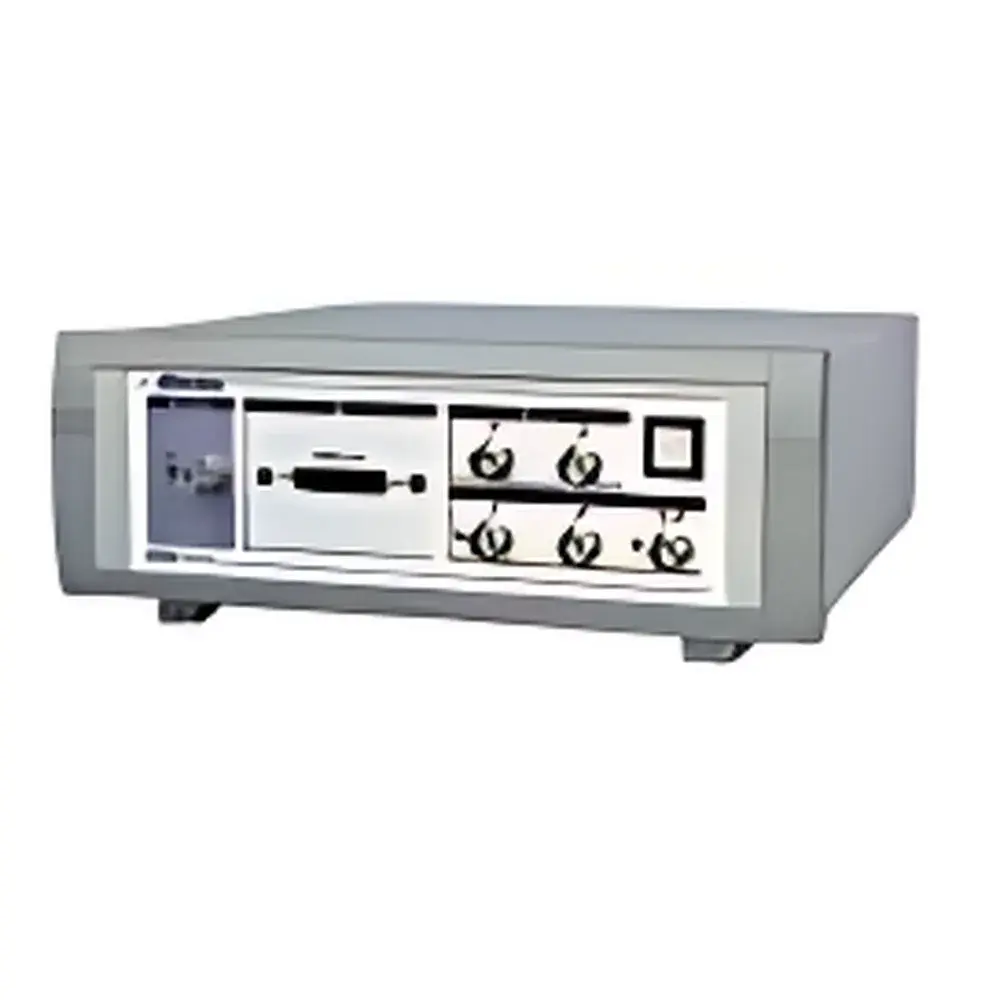
Vertilon IQSP Multi-Channel Photon Counting Data Acquisition System
| Brand | Vertilon |
|---|---|
| Origin | USA |
| Model | IQSP |
| Channel Configurations | 32–64 channels |
| Resolution | 14–16 bits |
| Dynamic Range | 84–96 dB |
| Max Charge Capacity | 2 × 10⁻⁹ C to 5 × 10⁻¹² C |
| Equivalent Max Photons | 3,121–12,484 photons |
| Input Noise Charge | 30–55 × 10⁻¹⁵ C |
| Equivalent Input Noise Photons | 0.19–0.34 photons |
| Max Trigger Frequency | 120–390 kHz |
| Max Continuous Events | 500,000–1,000,000 |
| Event Pair Resolution | 2.5–7.0 µs |
| Sustained Average Event Rate | 35–65 k events/s |
| USB Throughput | 5.3 MB/s |
| PMT Interface Compatibility | Hamamatsu multi-anode PMTs (R5900U-L16, H7260, H8500D, H8711, H7546) |
| Detector Geometry Support | Linear arrays & 2D anode configurations (e.g., 4×4, 8×8) |
| HV Bias Supply | Integrated cathode bias input per channel |
| Pre-amplification | Dynode-stage fast output with optional dynode circuitry |
| Software | Windows-native GUI, USB-class-compliant driver, real-time histogramming and event list export |
Overview
The Vertilon IQSP Multi-Channel Photon Counting Data Acquisition System is a high-fidelity, time-resolved signal digitization platform engineered for quantitative spectroscopic detection in demanding photon-starved environments. Built upon charge-integration architecture compliant with standard photomultiplier tube (PMT) signal conditioning principles, the IQSP series delivers deterministic, low-noise acquisition of discrete photoelectron events from multi-anode PMTs, avalanche photodiodes (APDs), and single-photon avalanche diodes (SPADs). Its core functionality centers on precise charge-to-digital conversion (QDC) across up to 64 parallel channels, enabling simultaneous temporal and spatial resolution of luminescence decay profiles, time-of-flight mass spectra, fluorescence lifetime imaging (FLIM), and synchrotron-based X-ray fluorescence mapping. The system operates under strict adherence to charge conservation and linearity constraints inherent to analog front-end integration circuits, ensuring traceable signal integrity across its full dynamic range.
Key Features
- Scalable channel density: Factory-configured modules support 32 or 64 independent input channels—optimized for linear arrays (e.g., Hamamatsu R5900U-L16, H7260) and 2D multi-anode detectors (e.g., H8500D 8×8, H7546 4×4).
- High-resolution charge digitization: 14-bit (IQSP5xx) and 16-bit (IQSP4xx) ADCs deliver 84 dB and 96 dB dynamic range respectively—enabling quantification of weak signals while preserving saturation headroom for intense bursts.
- Sub-microsecond event discrimination: Minimum inter-event resolution of 2.5 µs (IQSP580) supports high-density photon arrival statistics without pile-up distortion—critical for TCSPC and pulsed-laser excitation applications.
- Real-time single-photon sensitivity: Input noise floor as low as 0.19 equivalent photons (30 fC RMS) permits reliable detection at the quantum limit—validated against NIST-traceable photocurrent standards.
- Flexible triggering architecture: TTL-compatible trigger inputs support external synchronization with laser pulsers, boxcar integrators, or delay generators—ensuring phase-locked acquisition across multi-instrument setups.
- Integrated high-voltage interface: Dedicated cathode bias inputs per channel accommodate standard PMT operating voltages (−500 V to −1500 V); optional dynode-stage preamplification available for fast-rise-time signal preservation.
Sample Compatibility & Compliance
The IQSP system is explicitly designed for compatibility with Hamamatsu multi-anode PMT families used in commercial and research-grade spectrometers—including R5900U-L16 (16-channel linear), H7260 (32-channel linear), H8500D (64-channel 8×8 array), H8711 (16-channel linear), and H7546 (64-channel 4×4 array). All detector interfaces comply with IEC 61000-4 electromagnetic immunity standards and meet UL/CSA Class I safety requirements for laboratory instrumentation. Firmware and software adhere to FDA 21 CFR Part 11 principles for audit trail generation, electronic signature support, and data integrity assurance—making the system suitable for GLP-compliant analytical workflows in pharmaceutical and environmental testing laboratories.
Software & Data Management
Supplied with PhotoniQ Control Suite—a native Windows application built on .NET Framework 4.8—the IQSP provides real-time histogram visualization, event-list streaming (in HDF5 and ASCII formats), and time-tagged photon list (TTPL) export for offline correlation analysis. The USB 2.0 interface implements vendor-class drivers certified under Microsoft WHQL, eliminating third-party driver dependencies. Data buffers are managed via ring-buffer DMA transfers to minimize host-CPU latency; sustained throughput remains stable at 5.3 MB/s even during continuous 64-channel acquisition at maximum trigger rates. Calibration files (gain, offset, nonlinearity) are stored in non-volatile memory and auto-loaded on device enumeration—ensuring measurement reproducibility across instrument reboots and platform migrations.
Applications
- Time-resolved fluorescence spectroscopy (TRFS) and fluorescence lifetime imaging microscopy (FLIM)
- Pulsed neutron detection and scintillation decay analysis in nuclear instrumentation
- Mass spectrometry signal digitization for TOF-MS and MALDI-TOF systems
- X-ray photon counting in synchrotron beamlines and micro-XRF mapping
- Quantum optics experiments requiring coincidence timing and Hanbury Brown–Twiss (HBT) correlation
- UV-Vis-NIR spectrometer readout for high-throughput process analytical technology (PAT) deployments
FAQ
Is the IQSP compatible with non-Hamamatsu multi-anode PMTs?
Yes—provided the detector outputs analog current pulses within ±1 V amplitude and <10 ns rise time, and shares compatible pinout geometry with supported Hamamatsu models. Custom adapter boards can be commissioned upon request.
Does the system support hardware-based dead-time correction?
No—dead-time compensation is implemented algorithmically in post-processing using validated exponential recovery models embedded in PhotoniQ Analysis Tools.
Can multiple IQSP units be synchronized for large-area detector tiling?
Yes—via external TTL master clock distribution and programmable trigger delay offsets (<1 ns resolution), enabling sub-pixel spatial registration across modular detector arrays.
What calibration standards are provided with shipment?
Each unit ships with NIST-traceable charge injection test signals (1 pC to 1 nC), factory-generated linearity reports, and temperature-stabilized gain drift characterization over 0–40 °C.
Is Linux or macOS driver support available?
Native drivers are Windows-only; however, a documented C/C++ SDK with POSIX-compliant API wrappers enables integration into cross-platform scientific computing environments (e.g., Python via ctypes, MATLAB MEX).




