
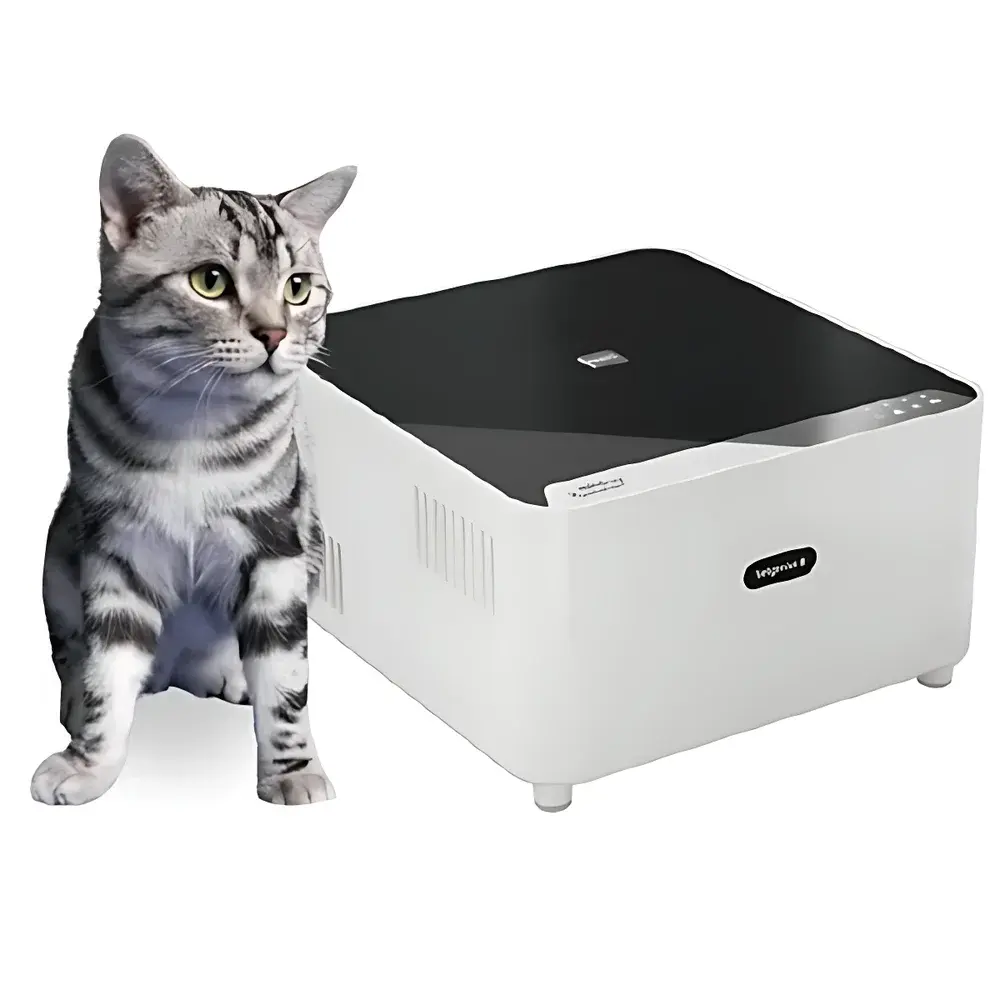
Vetgenies 8 Real-Time Fluorescent Quantitative PCR System
| Brand | Mindray |
|---|---|
| Origin | Shanghai, China |
| Manufacturer Type | Authorized Distributor |
| Country of Origin | China |
| Model | Vetgenies 8 |
| Instrument Type | Veterinary Real-Time qPCR Platform |
| Nucleic Acid Extraction | Optional On-Device Lysis (Extraction-Free Workflow Supported) |
| Detection Chemistry | Dual-Channel SYBR Green I and Probe-Based (FAM/HEX) Fluorescence Detection |
| Thermal Cycling Accuracy | ±0.25 °C |
| Ramp Rate | Up to 5.0 °C/s |
| Reaction Volume | 10–50 µL |
| Throughput | 8 Samples per Run |
| Optical System | Integrated LED Excitation & Photodiode Detection |
| Data Output | Ct Values, Amplification Curves, Melting Curves, Qualitative/Quantitative Reports |
Overview
The Vetgenies 8 Real-Time Fluorescent Quantitative PCR System is a compact, veterinary-focused thermal cycler engineered for nucleic acid detection and quantification directly from minimally processed biological samples. It operates on the principle of sequence-specific fluorescence monitoring during exponential DNA amplification—leveraging either intercalating dyes (e.g., SYBR Green I) or hydrolysis probe chemistries (e.g., FAM- and HEX-labeled probes) to generate real-time signal accumulation proportional to amplicon yield. Unlike conventional endpoint PCR, this platform delivers quantitative cycle threshold (Ct) values with high reproducibility across replicates, enabling absolute or relative quantification of target pathogens—including viruses, bacteria, and parasites—in animal clinical specimens. Its design emphasizes operational robustness in field clinics and diagnostic laboratories where space, power stability, and technician training are constrained.
Key Features
- Integrated extraction-free workflow compatibility: Supports direct lysis of swabs, blood, tissue homogenates, and fecal suspensions using proprietary buffer systems—eliminating centrifugation, column purification, and RNAse/DNase handling steps.
- Dual-channel optical detection architecture: Simultaneous excitation at 470 nm and 530 nm with matched photodiode-based emission capture ensures reliable discrimination between SYBR Green and dual-probe assays without spectral crosstalk.
- Precision thermal control: Peltier-driven block with active temperature feedback maintains ±0.25 °C uniformity across all 8 reaction positions; ramp rates up to 5.0 °C/s accelerate assay turnaround time without compromising denaturation or annealing fidelity.
- Embedded touchscreen interface: 7-inch capacitive display with intuitive, icon-driven navigation—designed for glove-compatible operation and multilingual UI (English, Spanish, Portuguese, Mandarin preloaded).
- Onboard data security: Audit-trail logging of user logins, protocol modifications, run start/stop timestamps, and result exports—aligned with GLP documentation requirements for veterinary diagnostic reporting.
Sample Compatibility & Compliance
The Vetgenies 8 accepts standard 0.2 mL thin-wall PCR tubes and 8-tube strips, accommodating viscous or particulate-rich matrices common in veterinary diagnostics (e.g., nasal swab eluates, whole-blood lysates, bronchoalveolar lavage fluid). It has been validated per ISO 13485:2016 for in vitro diagnostic use in animal health applications and supports method verification under CLIA-equivalent veterinary laboratory standards. While not FDA-cleared for human IVD use, its assay development framework complies with OIE (WOAH) guidelines for transboundary animal disease surveillance—including foot-and-mouth disease virus (FMDV), avian influenza A (H5/H7), and classical swine fever virus (CSFV) detection protocols.
Software & Data Management
The Vetgenies Analysis Suite (v3.2) provides local instrument control, real-time curve visualization, automatic baseline and threshold setting, melt curve deconvolution, and export of CSV- and PDF-formatted reports compliant with ISO/IEC 17025 record retention. Data files include embedded metadata (operator ID, sample ID, assay name, thermal profile version), supporting traceability during regulatory audits. The software supports optional network integration via Ethernet or Wi-Fi for centralized data aggregation in multi-instrument labs—though no cloud storage or remote access functionality is implemented to preserve data sovereignty per regional veterinary data governance policies (e.g., EU GDPR Annex II, USDA APHIS biosecurity directives).
Applications
- Rapid differential diagnosis of respiratory infections in companion animals (e.g., canine parvovirus, feline calicivirus, Bordetella bronchiseptica).
- Monitoring antimicrobial resistance gene expression (e.g., mecA, tetM, ermB) in bacterial isolates from mastitis or dermatological cases.
- Validation of vaccine efficacy through quantification of pathogen load reduction post-immunization in herd health programs.
- Surveillance testing for zoonotic agents—including Leptospira spp., Brucella abortus, and Toxoplasma gondii—in livestock and wildlife populations.
- Research-grade gene expression profiling in rodent models using endogenous reference genes (e.g., GAPDH, ACTB) with inter-run calibration support.
FAQ
Does the Vetgenies 8 require external nucleic acid extraction kits?
No—its onboard lysis protocol enables direct amplification from raw samples. However, purified DNA/RNA may be loaded if higher sensitivity or multiplexing beyond 2 targets is required.
Can the system perform melt curve analysis?
Yes—post-amplification high-resolution melting (HRM) is supported for genotyping, SNP detection, and amplicon identity confirmation.
Is the software compatible with LIMS integration?
Yes—CSV and XML export formats are structured to align with common veterinary LIMS platforms; API-based integration requires site-specific validation.
What maintenance is required for long-term reliability?
Annual optical calibration and thermal block verification are recommended; no consumable optics or laser modules are used—the LED excitation source has a rated lifetime exceeding 20,000 hours.
Does the instrument meet electromagnetic compatibility (EMC) standards for clinical environments?
Yes—it conforms to IEC 61326-1:2013 Class B emission limits and IEC 61000-4 series immunity testing for use in veterinary hospitals and mobile diagnostic units.
Related Products




