
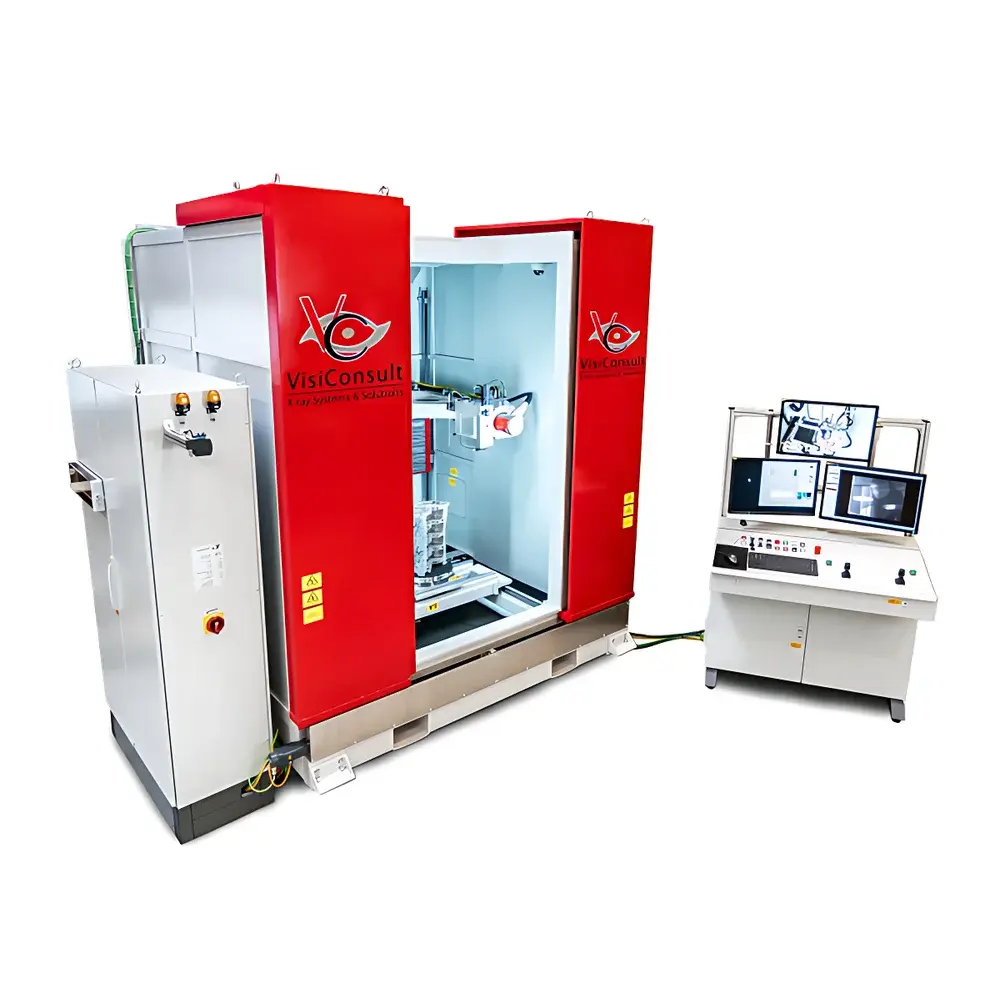
VisiConsult XRH222TL Industrial Heavy-Duty Micro-CT System
| Brand | VisiConsult |
|---|---|
| Origin | Germany |
| Model | XRH222TL |
| Loading Configuration | Top-load (crane/forklift compatible) |
| Imaging Modes | 2D radiography, 3D computed tomography (CT), real-time radioscopy |
| Inspection Capabilities | Automated Defect Recognition (ADR), DICONDE-compliant archiving |
| Application Scope | Castings, aerospace components, welded assemblies, composite structures |
| Compliance | Meets DIN EN ISO 17636-2, ASTM E2737, and NDT regulatory frameworks for industrial CT |
Overview
The VisiConsult XRH222TL Industrial Heavy-Duty Micro-CT System is a high-stability, top-loading X-ray computed tomography platform engineered for non-destructive evaluation (NDE) of large-scale and high-mass industrial components. Unlike conventional floor-loading micro-CT systems constrained by gantry height or part weight limits, the XRH222TL integrates a vertically oriented manipulator architecture with reinforced mechanical axes capable of handling specimens up to 2,200 kg and dimensions exceeding Ø1,800 mm × H2,500 mm. Its core measurement principle relies on cone-beam geometry with high-power microfocus X-ray source (≤5 µm focal spot) and large-area flat-panel detector (≥4,096 × 4,096 pixels), enabling both high-resolution 2D digital radiography and volumetric 3D reconstruction with isotropic voxel resolution down to 20 µm — scalable via geometric magnification. The system operates under controlled radiation shielding per IEC 61331-1 and is certified for Class II radiation device operation in accordance with German RöV and EU Directive 2013/59/Euratom.
Key Features
- Top-load configuration enables seamless integration with overhead cranes or forklifts — eliminating need for structural modifications such as shielded rooms or floor pits.
- Dual-mode imaging architecture supports real-time radioscopy (up to 30 fps), static DR acquisition, and full-volume CT scanning with automated trajectory optimization (helical, circular, or user-defined orbits).
- Integrated ADR (Automated Defect Recognition) engine based on morphology-driven segmentation and machine learning–assisted classification — configurable for porosity, inclusions, shrinkage cavities, and lack-of-fusion in additive manufacturing parts.
- High-precision rotary stage with ±0.005° angular repeatability and load-balanced tilt axis ensures geometric fidelity across multi-gigabyte reconstructions.
- Radiation-hardened control cabinet with dual redundant safety interlocks, emergency stop circuitry compliant with EN ISO 13850, and dose monitoring via calibrated ionization chamber.
- Modular software interface supports both manual operator-guided workflows and fully automated batch inspection sequences synchronized with PLC-level factory automation protocols (OPC UA, Modbus TCP).
Sample Compatibility & Compliance
The XRH222TL accommodates a broad spectrum of industrial specimen types including aluminum and titanium investment castings, nickel-based superalloy turbine blades, carbon-fiber-reinforced polymer (CFRP) airframe sections, thick-section welds (up to 300 mm steel equivalent), and ceramic matrix composites. All acquisitions adhere to ASTM E2737–22 (“Standard Practice for Digital Radiographic Testing”) and ISO 17636–2:2022 (“Non-destructive testing of welds — Radiographic testing — Part 2: X- and gamma-ray techniques with digital detectors”). Image metadata embedding follows ASTM E2339–21 (Digital Imaging and Communication in Non-Destructive Evaluation – DICONDE), ensuring audit-ready traceability for AS9100 Rev D, ISO 9001:2015, and FAA AC 20-178B compliance requirements. Radiation safety documentation includes full shielding analysis reports, annual dose mapping, and ALARA validation records.
Software & Data Management
The system ships with VisiConsult’s proprietary CT Suite v5.x — a modular application suite comprising Acquisition Studio (for scan parameter definition and hardware orchestration), Reconstruction Engine (GPU-accelerated FDK and iterative SART algorithms), and Analysis Workbench (with GD&T-aligned metrology tools, wall-thickness mapping, and porosity quantification per ISO 15530-3). All datasets are stored in vendor-neutral DICOM-RT format with embedded DICOM-SR structured reports. Long-term archival complies with FDA 21 CFR Part 11 requirements through electronic signatures, role-based access control, and immutable audit trails. Integration with enterprise PDM/PLM systems (e.g., Teamcenter, Windchill) is supported via RESTful API and DICONDE-compliant DICOM gateways.
Applications
The XRH222TL serves critical inspection roles across regulated sectors: verification of internal integrity in aerospace castings per AMS2644; detection of delamination and fiber waviness in primary composite structures; dimensional validation of additively manufactured fuel nozzles against CAD nominal geometry; assessment of solder joint voiding in high-power electronics enclosures; and failure analysis of high-pressure hydraulic manifolds. In foundry environments, it replaces destructive metallography for statistical process control (SPC) of porosity distribution. Its offline deployment mode supports R&D labs conducting material behavior studies under thermal or mechanical loading, while online integration enables in-line CT inspection stations within Industry 4.0 production cells.
FAQ
What is the maximum part weight and envelope the XRH222TL can accommodate?
The system accepts parts up to 2,200 kg mass and Ø1,800 mm diameter × 2,500 mm height — verified under static and dynamic load conditions per DIN 50100.
Does the system support quantitative CT metrology traceable to national standards?
Yes — certified volumetric calibration using NIST-traceable phantoms (e.g., PTB CT-Phantom 1.0) enables sub-pixel spatial accuracy and ISO 15530-3–compliant dimensional reporting.
Can ADR rules be customized for proprietary defect classes?
Yes — users define rule sets via XML-based templates specifying grayscale thresholds, shape descriptors, connectivity constraints, and contextual location filters.
Is remote operation and diagnostic support available?
All units include embedded Telematics Module (TM-220) supporting encrypted VNC sessions, predictive maintenance alerts, and firmware-over-the-air (FOTA) updates.
How does the system ensure data integrity during long-duration CT scans?
RAID-6 storage arrays with write-caching disabled, journaling filesystems (XFS), and cyclic redundancy checksums (CRC32c) are applied at acquisition layer to prevent silent corruption.



