
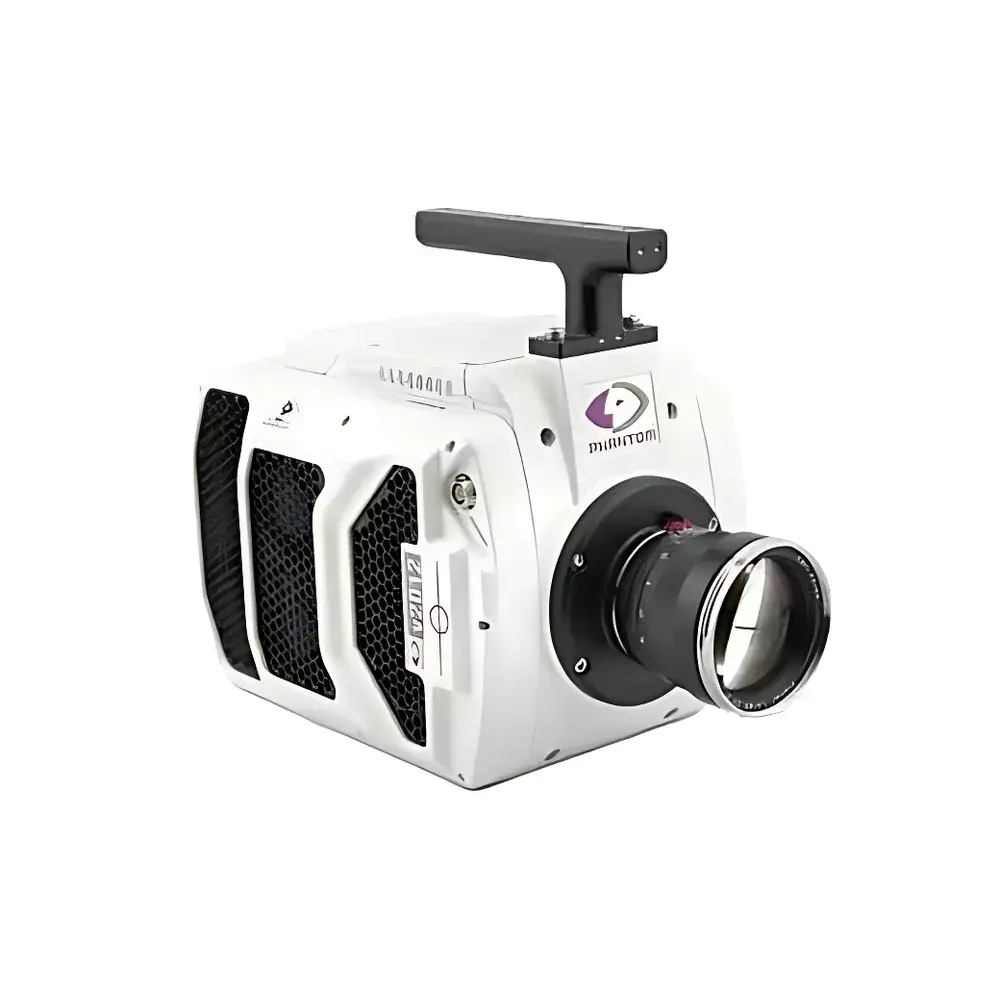
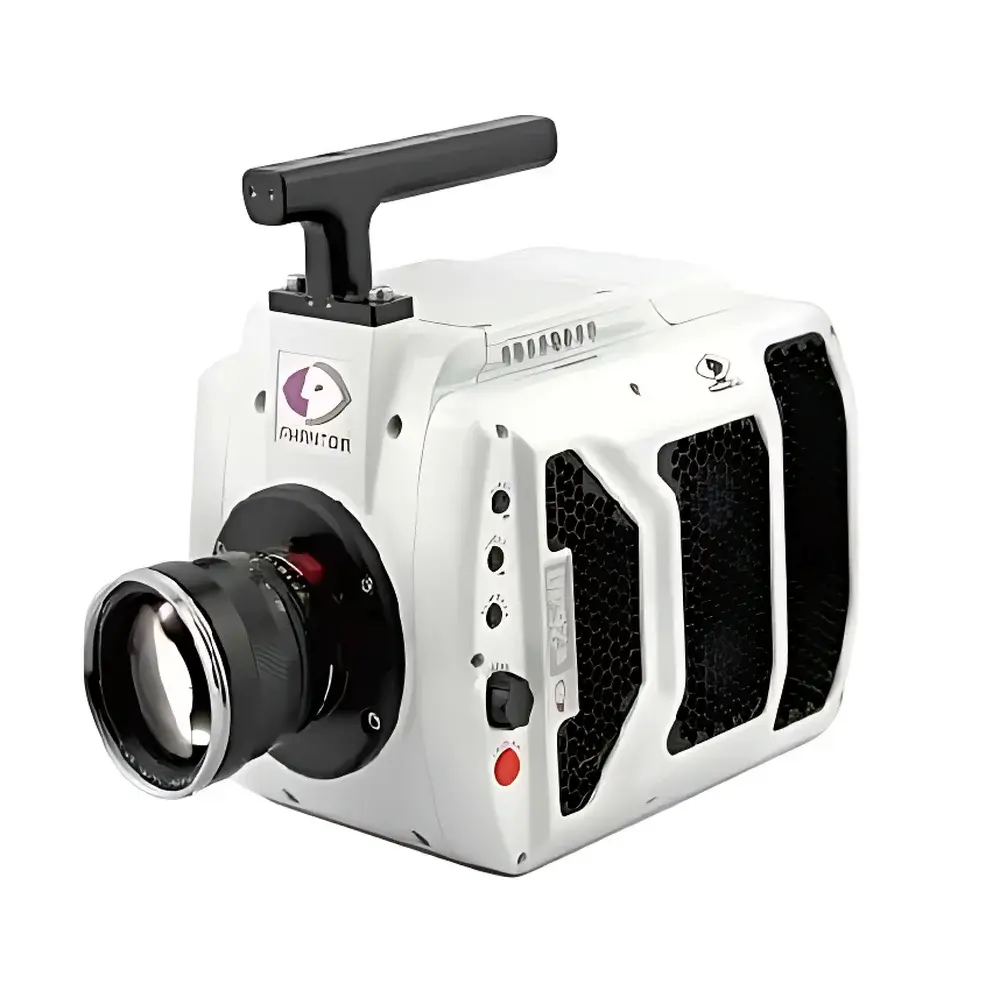
Vision Research Phantom High-Speed Camera
| Origin | USA |
|---|---|
| Manufacturer Type | Authorized Distributor |
| Origin Category | Imported |
| Model | Phantom |
| Price Range | USD 14,000 – 72,000 (FOB) |
| Effective Pixels | Up to 9.4 MP (4096 × 2304) |
| Pixel Size | 5.6 µm to 28 µm |
Overview
The Vision Research Phantom High-Speed Camera is an industrial-grade, scientific CMOS-based imaging system engineered for ultra-high temporal resolution and quantitative optical diagnostics. Leveraging advanced back-illuminated CMOS sensor architecture, proprietary EDR (Extended Dynamic Range) exposure control, and Cinemag non-volatile solid-state storage, the Phantom platform delivers deterministic frame rates up to 680,000 fps at reduced resolutions—enabling precise capture of transient physical phenomena in combustion dynamics, fluid mechanics, material deformation, and plasma physics. Its core measurement principle relies on synchronized global shutter acquisition with sub-microsecond exposure control, ensuring minimal motion blur and high spatiotemporal fidelity across PIV (Particle Image Velocimetry), LIF (Laser-Induced Fluorescence), PTV (Particle Tracking Velocimetry), and DIC (Digital Image Correlation) workflows. Designed for integration into controlled laboratory environments and ISO/IEC 17025-compliant test facilities, the system meets structural and thermal stability requirements for repeatable metrology-grade imaging under variable ambient lighting and vibration conditions.
Key Features
- CMOS sensor options spanning 1.2 MP (640 × 480) to 9.4 MP (4096 × 2304), with pixel sizes from 5.6 µm to 28 µm—optimized for trade-offs between spatial resolution, sensitivity, and frame rate
- ISO 12232 Saturation-based sensitivity up to 100,000 T, enabling low-light imaging at microsecond exposure durations without compromising signal-to-noise ratio
- EDR technology: dual-exposure control per frame (e.g., 1 µs + 100 µs) to simultaneously resolve saturated and underexposed regions—critical for laser sheet illumination or shockwave boundary visualization
- Cinemag V non-volatile storage: scalable capacity up to 8 TB (UHS/Flex4K series), supporting continuous recording at 1 Gpixel/s (e.g., >60 minutes at 2048 × 1952 @ 2500 fps)
- Data interface: standard Gigabit Ethernet + optional 10GbE; sustained download bandwidth up to 600 MB/s for rapid dataset retrieval and pipeline integration
- Robust thermal management and mechanical housing compliant with IEC 60529 IP20 rating for benchtop and optical table deployment
Sample Compatibility & Compliance
The Phantom series interfaces seamlessly with standard optical components—including ND filters, dichroic beamsplitters, and laser synchronization modules—via TTL, LVDS, and programmable trigger I/O. All models support GenICam-compliant metadata embedding (including timestamp, exposure, gain, and ROI parameters) for traceable data provenance. The system is compatible with ASTM E2847-21 (Standard Practice for High-Speed Imaging of Transient Events) and supports audit-ready logging per FDA 21 CFR Part 11 when deployed with validated software configurations. Firmware and firmware update logs are retained with SHA-256 checksums, satisfying GLP/GMP documentation requirements for regulated R&D environments.
Software & Data Management
Phantom cameras operate natively with Phantom Camera Control (PCC) v4.x, a cross-platform application supporting real-time preview, parametric sweep automation, and hardware-accelerated playback. Raw image sequences are saved in lossless Phantom Cine (.cine) format with embedded calibration metadata, convertible to TIFF, HDF5, or Numpy-compatible binary via open-source cine2numpy utilities. PCC integrates with MATLAB, Python (via cineio), and LabVIEW through documented APIs. Optional Phantom SyncBox enables deterministic multi-camera triggering with <10 ns jitter—essential for stereo-DIC or multi-angle PIV setups. All configuration changes are logged with UTC timestamps and user identifiers, fulfilling traceability mandates in ISO/IEC 17025-accredited laboratories.
Applications
- Combustion research: flame front propagation, detonation wave analysis, and soot formation kinetics using time-resolved OH-PLIF or CH* chemiluminescence
- Fluid dynamics: turbulent boundary layer characterization, cavitation bubble collapse, and microfluidic droplet breakup via μ-PIV
- Material science: high-strain-rate fracture mechanics, impact-induced phase transformation, and shock compression studies
- Aerospace testing: turbine blade vibration monitoring, hypersonic boundary layer transition, and parachute deployment dynamics
- Biomechanics: insect wing kinematics, vocal fold oscillation, and high-speed surgical tool interaction with soft tissue
FAQ
What is the maximum sustained frame rate at full 4096 × 2304 resolution?
At native 4096 × 2304, the Phantom Flex4K achieves up to 1,000 fps with full 12-bit depth and no binning. Higher frame rates require ROI cropping or vertical binning.
Does the system support external synchronization with pulsed lasers?
Yes—via TTL/LVDS trigger inputs with configurable delay (0–10 s, 1 ns resolution) and programmable gate width; SyncBox accessory enables sub-10 ns inter-camera skew control.
Can raw .cine files be processed directly in Python for quantitative analysis?
Yes—open-source cineio library provides memory-mapped access to uncompressed frames, metadata, and embedded calibration tables; supports NumPy/Pandas workflows without intermediate conversion.
Is firmware validation documentation available for regulated environments?
Vision Research provides IQ/OQ documentation templates and firmware revision history logs upon request—compatible with internal validation protocols under ISO 13485 or 21 CFR Part 11.
What cooling options are available for extended-duration acquisitions?
All UHS and Flex4K models include active thermoelectric cooling (TEC) with closed-loop temperature stabilization (±0.1°C); VEO series rely on passive convection but support optional fan-cooled enclosures for >30-minute continuous capture.






