
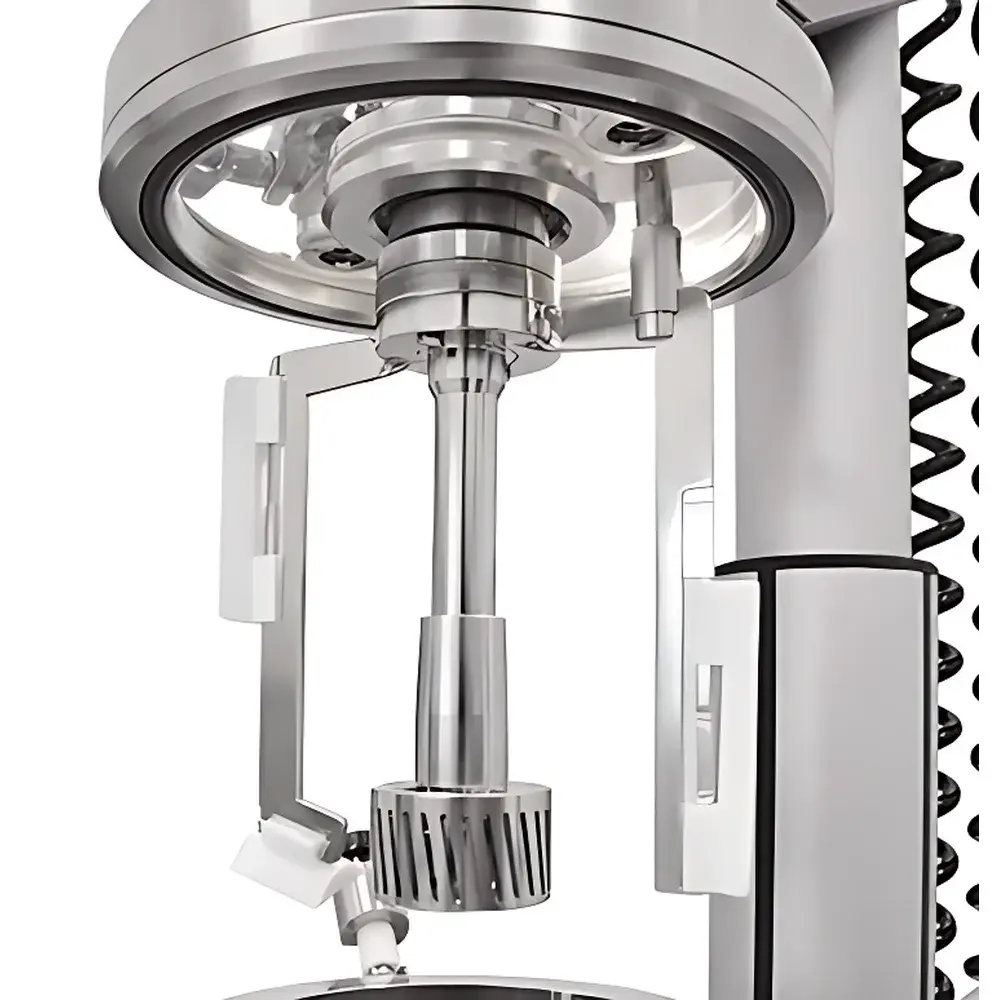
VMI Turbotest High-Shear Homogenizer
| Brand | VMI |
|---|---|
| Origin | France |
| Model | Turbotest |
| Instrument Type | Probe-type Rotor-Stator Homogenizer |
| Power | 440 W DC |
| Speed Range | 50–3300 rpm |
| Processing Volume | 50–3300 mL (200 mL–20 L typical operational range) |
| Dimensions (W×D×H) | 998×447×430 mm |
| Max. Beaker Diameter | 300 mm |
| Max. Beaker Height | 300 mm |
| Safety Compliance | 2006/42/EC Machinery Directive |
| Construction | 316L Stainless Steel Shaft, ABS/PMMA Housing |
| Voltage | 100–240 V AC, 50/60 Hz |
| Interface Options | RS-232 or USB data logging port (optional) |
| Temperature Monitoring | Optional digital PT100 probe |
Overview
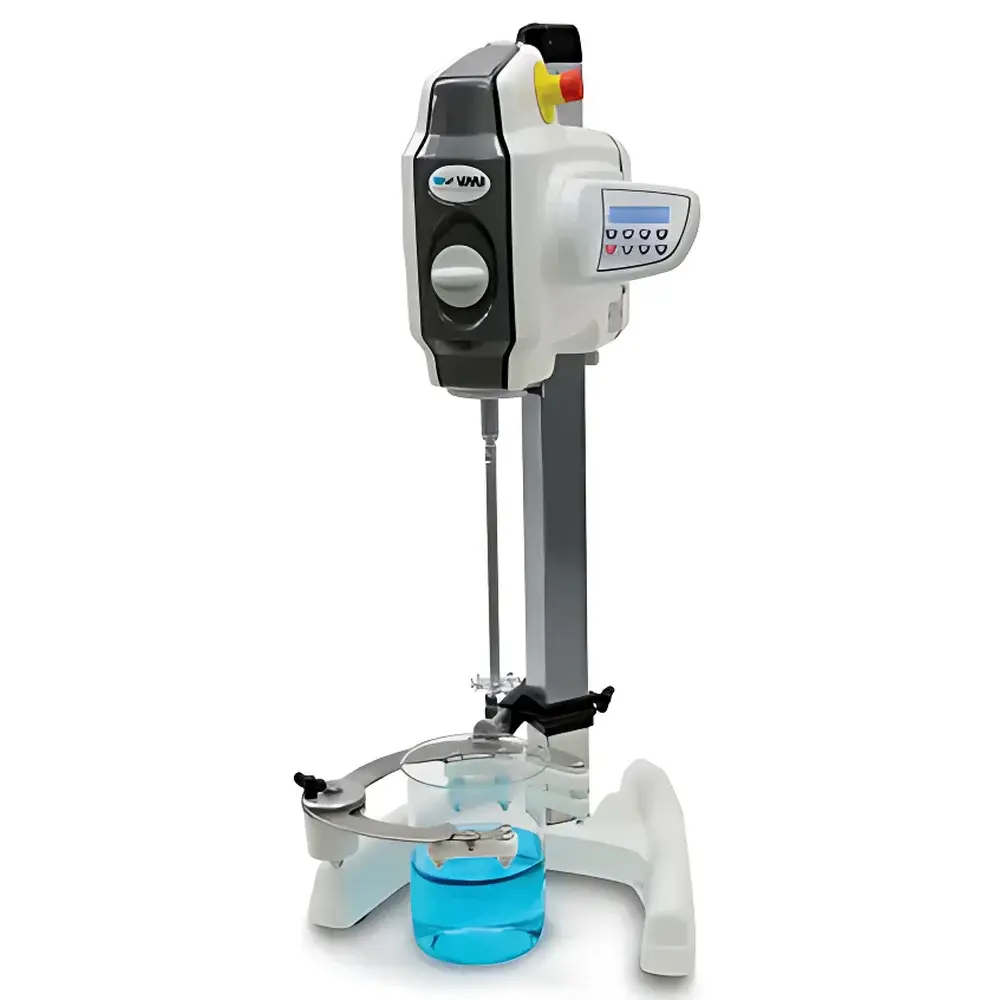
The VMI Turbotest High-Shear Homogenizer is a precision-engineered laboratory-scale rotor-stator system designed for reproducible dispersion, emulsification, homogenization, and suspension of complex liquid and semi-viscous formulations. Operating on the principle of controlled hydrodynamic cavitation and intense shear generation within a defined gap between rotating and stationary elements, the Turbotest delivers consistent energy input across variable sample volumes—from 50 mL benchtop vials to 20 L jacketed reactors. Its 440 W brushless DC motor enables precise speed regulation from 50 to 3300 rpm, ensuring compatibility with both low-viscosity aqueous systems and high-yield polymer dispersions. The device is not a generic mixer but a calibrated process tool engineered for method transferability, regulatory traceability, and repeatable scale-up pathways in formulation development labs.
Key Features
- Intelligent LCD interface displaying real-time rotational speed, elapsed time, and torque output—enabling process monitoring and endpoint detection.
- Automated multi-step program sequencing with up to 5 user-defined cycles, supporting reproducible protocols for complex emulsification workflows (e.g., phase inversion, hot/cold homogenization).
- Ergonomic single-lever height adjustment with counterbalance mechanism and automatic position locking—reducing operator fatigue and minimizing mechanical misalignment risks.
- Patented beaker clamping system accommodating vessels from 50 mm to 300 mm diameter and 100–300 mm height; quick-release design supports rapid vessel interchange without recalibration.
- Dual-safety interlock architecture compliant with EU Machinery Directive 2006/42/EC: motor inhibition when no vessel is detected or when the probe exceeds safe vertical travel limits.
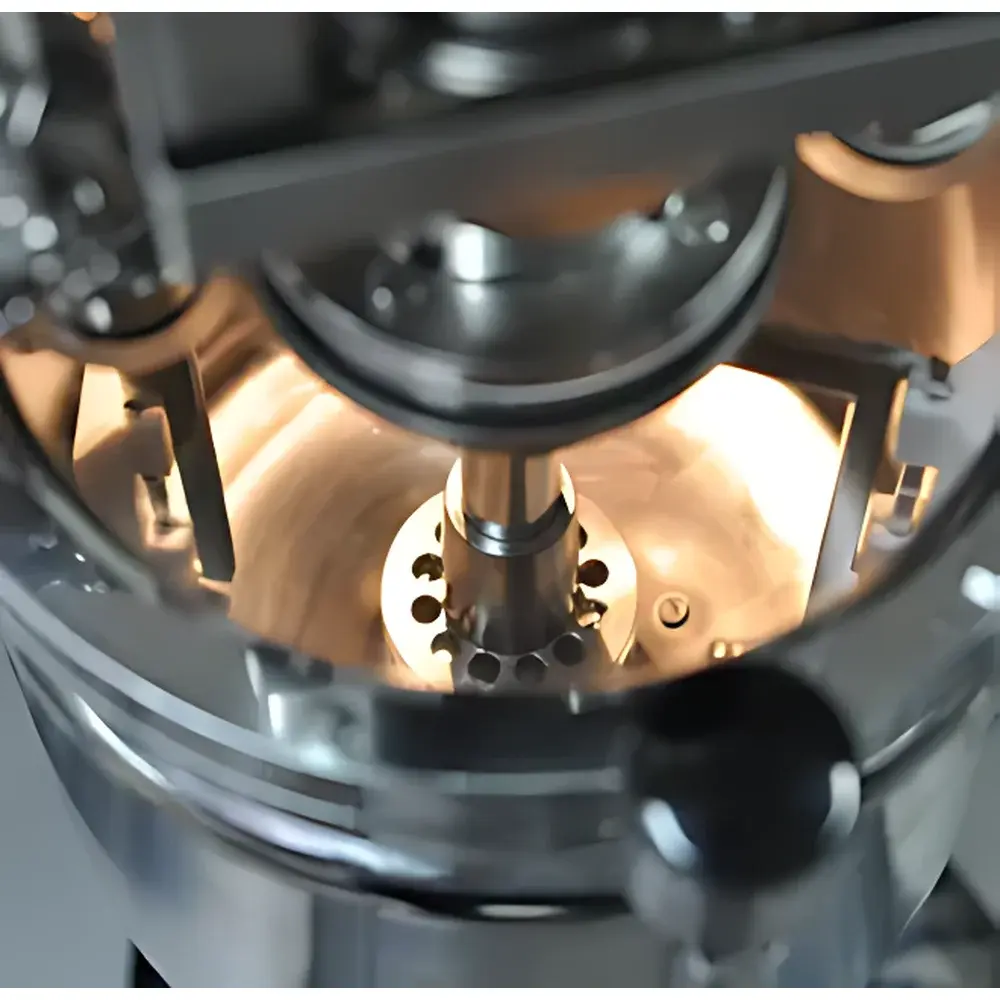
- Modular rotor-stator assembly platform supporting over 20 interchangeable heads—including centrifugal anti-agglomeration, dual-directional three-blade, planetary, and high-efficiency emulsifying geometries—each optimized for specific rheological regimes.
- Removable PMMA/ABS housing and stainless steel (316L) shaft facilitate full-access cleaning and meet GLP-aligned maintenance requirements.
Sample Compatibility & Compliance
The Turbotest accommodates heterogeneous samples ranging from nanosuspensions (<200 nm particle size post-processing) to viscous pastes (up to 50,000 mPa·s). It is routinely deployed in pharmaceutical preformulation (e.g., nanoemulsion development per USP <729>), cosmetic emulsion stability testing (ISO 16128), and food-grade colloidal dispersion (Codex Alimentarius Annex IV). All electrical and mechanical subsystems conform to CE marking requirements under Directive 2006/42/EC. Optional digital temperature probe integration allows synchronized thermal profiling during shear-intensive operations—a critical capability for thermosensitive biologics or lipid nanoparticle synthesis. The unit’s construction materials comply with FDA-recommended non-reactive surfaces for GMP-relevant environments.
Software & Data Management
While the base Turbotest operates via embedded firmware, optional RS-232 or USB interfaces enable direct connection to laboratory information management systems (LIMS) or PC-based acquisition software. Logged parameters include timestamped speed profiles, torque transients, and cycle completion status—supporting audit-ready documentation per FDA 21 CFR Part 11 when paired with validated third-party software. The system supports export of CSV-formatted datasets for statistical process control (SPC) analysis and comparative benchmarking across batches. Firmware updates are delivered via secure encrypted protocol to maintain integrity of calibration-critical control algorithms.
Applications
- Pharmaceutical: Lipid nanoparticle (LNP) formulation, microemulsion screening, protein aggregation suppression during buffer exchange.
- Biotechnology: Cell lysate homogenization prior to chromatographic purification; viral vector dispersion in transfection-grade media.
- Materials Science: Carbon nanotube dispersion in polymer matrices; graphene oxide exfoliation in aqueous surfactant systems.
- Food & Beverage: Stable oil-in-water emulsions (e.g., plant-based dairy analogs); viscosity-controlled sauce homogenization.
- Academic Research: Shear-thinning behavior characterization; kinetic studies of coalescence inhibition in Pickering emulsions.
FAQ
What is the minimum recommended sample volume for reliable homogenization?
For optimal rotor-stator interaction and cavitation efficiency, the minimum working volume is 50 mL with appropriate probe geometry (e.g., small-diameter micro-tip). Below this, vortex formation and air entrainment may compromise reproducibility.
Can the Turbotest be integrated into automated lab platforms?
Yes—via optional TTL-triggered start/stop signals and serial command protocol (ASCII-based), enabling synchronization with robotic liquid handlers or environmental chambers.
Is validation documentation available for GMP environments?
VMI provides IQ/OQ templates aligned with ISO/IEC 17025 and ASTM E2500-07; full PQ support requires site-specific performance qualification under user-defined acceptance criteria.
How often does the rotor-stator require recalibration?
No periodic recalibration is required—the system relies on fixed mechanical geometry and factory-trimmed motor control electronics; however, annual verification of speed accuracy (±1 rpm) and torque linearity is recommended.
Does the device support continuous operation mode?
It is rated for intermittent duty (max. 30 min continuous at >2500 rpm); extended runs require active cooling of the motor housing and periodic torque monitoring to prevent thermal drift.



