
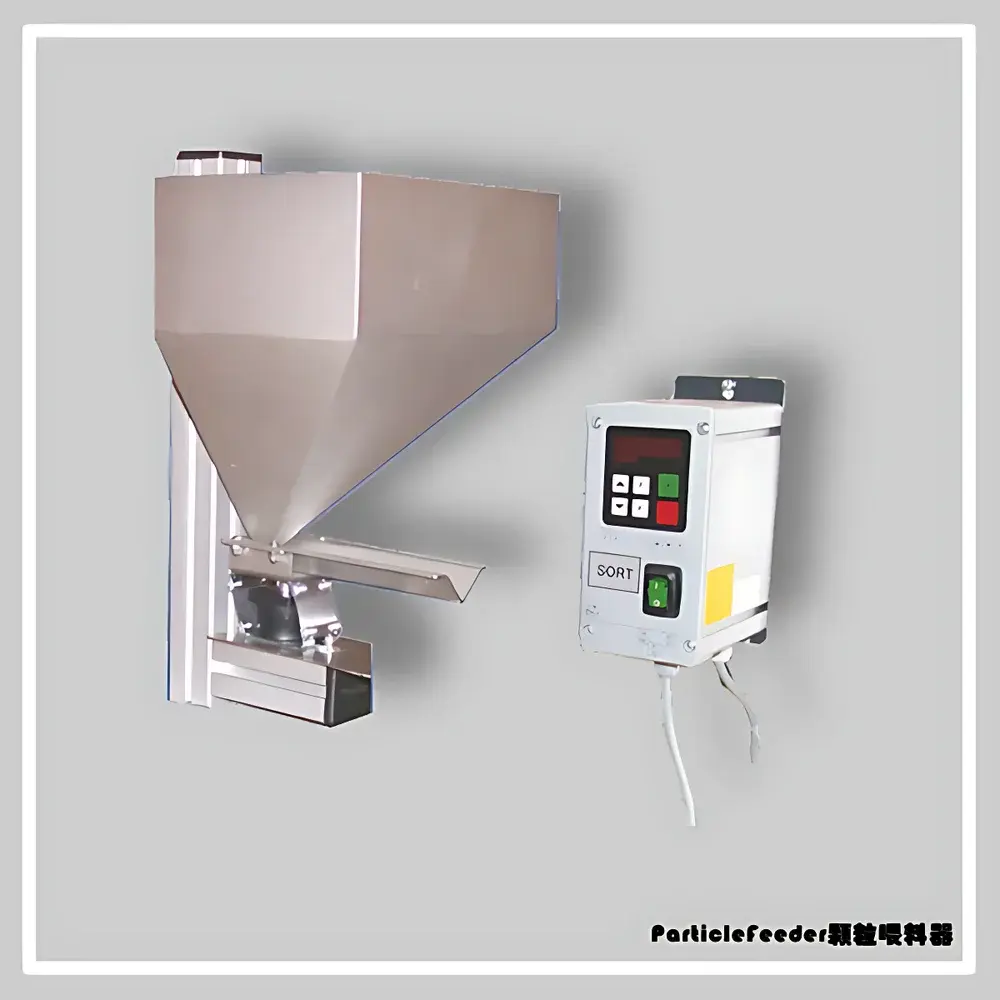
Volstaedt Particle Feeder
| Brand | Volstaedt |
|---|---|
| Origin | Germany |
| Model | Particle Feeder |
| Power Supply | 110–240 V, 50/60 Hz |
| Protection Rating | IP54 |
| Feed Rate Control Range | 0–200,000 particles/min |
| Particle Size Range | 40 µm – 1.5 mm |
| Feed Slot Length | 160 mm |
| Dimensions (W × D × H) | 350 × 200 × 250 mm |
| Hopper Volume | ~3.5 L |
| Operating Temperature | 0–45 °C |
| Weight | ~2.4 kg |
| Control Interface | RS232, 0–10 V DC analog input, potentiometer |
| status signals | “Feeder Empty”, “Feeder Full” |
| Feed Resolution | 255-step digital control |
Overview
The Volstaedt Particle Feeder is a precision-engineered vibratory particle dispensing system designed for the controlled, continuous delivery of discrete solid particles in laboratory and industrial quality control environments. It operates on electromagnetic vibratory actuation—where a microcontroller-regulated electromagnetic drive induces precisely modulated oscillations in a stainless-steel feed trough. This principle ensures deterministic particle motion without mechanical contact or rotating parts, eliminating wear-related drift and enabling high reproducibility across extended operation cycles. Unlike gravity-fed or screw-based feeders, the Volstaedt design decouples feed rate from ambient power frequency, voltage fluctuations, mounting angle, or hopper load—making it uniquely suited for integration into automated metrology platforms such as the ContSieve particle size analyzer, ShapeSorter 4.1 morphological classifier, and DiaHeat-R thermal stability tester. Its core function is to deliver statistically representative particle streams for downstream optical, laser-diffraction, or image-based analysis systems where consistent inter-particle spacing and velocity are critical for measurement integrity.
Key Features
- Electromagnetic vibratory drive with closed-loop laser slit sensor feedback for real-time flow stabilization and long-term rate consistency
- Digital feed rate control via RS232 interface (ASCII protocol), 0–10 V DC analog input, or front-panel potentiometer—enabling seamless integration into PLC or PC-based automation architectures
- 255-step resolution feed rate adjustment, supporting fine-tuned optimization for diverse particle geometries (spherical, angular, elongated) and densities
- IP54-rated enclosure for resistance against dust ingress and low-pressure water splashes—suitable for cleanroom-adjacent or production-floor deployment
- Dual discrete status outputs (“Feeder Empty”, “Feeder Full”) compliant with standard 24 V DC industrial logic levels, facilitating hardware-level interlock with upstream hoppers or downstream analyzers
- Compact footprint (350 × 200 × 250 mm) and lightweight construction (~2.4 kg), optimized for benchtop integration without structural reinforcement
Sample Compatibility & Compliance
The feeder accommodates particles ranging from 40 µm to 1.5 mm in nominal equivalent diameter—including synthetic diamond grit, ceramic abrasives, metal powders, pharmaceutical granules, and mineral aggregates. Performance remains stable across materials with varying flowability, surface roughness, and electrostatic charge characteristics—validated under ISO 4406 and ASTM D6378 test conditions for particulate metering repeatability. The device complies with EU Machinery Directive 2006/42/EC, EMC Directive 2014/30/EU, and Low Voltage Directive 2014/35/EU. While not intrinsically rated for hazardous areas, its non-sparking electromagnetic drive and absence of motors or brushes make it suitable for ATEX Zone 2 environments when installed per IEC 60079-14 guidelines. All firmware and control logic adhere to IEC 61508 SIL1 functional safety principles for predictable fault behavior.
Software & Data Management
The Volstaedt Particle Feeder supports bidirectional ASCII communication over RS232 (default: 9600 baud, 8N1). Host systems can query current feed rate, setpoint, hopper level status, and error flags (e.g., sensor obstruction, overtemperature). Firmware includes configurable watchdog timers and CRC-16 checksum validation for command integrity—ensuring robust operation in mission-critical GLP/GMP workflows. When integrated with Volstaedt’s proprietary ContSieve Suite or third-party LabVIEW/Python control frameworks, the feeder enables time-synchronized logging of particle count vs. analytical output (e.g., shape descriptors per frame), supporting FDA 21 CFR Part 11-compliant audit trails when paired with validated electronic record systems. No embedded storage or cloud connectivity is provided—data persistence resides entirely with the host controller, preserving data sovereignty and network segmentation requirements.
Applications
- Automated calibration of dynamic image analysis systems using traceable monodisperse reference particles
- Controlled feed for laser diffraction particle sizing (ISO 13320) where pulse-to-pulse inter-particle distance must exceed optical path length
- In-line particle morphology screening in pharmaceutical granulation QC, aligned with USP and Ph. Eur. 2.9.31
- Feed conditioning for triboelectric charge mapping of industrial powders under ASTM D7489
- High-throughput sorting validation in diamond recovery labs, where feed rate uniformity directly impacts shape classification accuracy in ShapeSorter 4.1
- Thermal stability testing (DiaHeat-R) requiring precise particle-on-demand delivery to minimize thermal mass perturbation
FAQ
What particle shapes and materials are compatible with this feeder?
The feeder handles spherical, cubic, flake-like, and irregularly shaped particles—from dense tungsten carbide grit to low-density polymer granules—provided they fall within the 40 µm–1.5 mm size envelope and possess sufficient rigidity to resist deformation during vibratory transport.
Is the feed rate linearly proportional to the analog voltage input?
Yes: 0–10 V DC maps linearly to 0–200,000 particles/min across the full 255-step control range, with factory-calibrated linearity deviation ≤ ±1.2% FS per NIST-traceable verification report.
Can the feeder operate continuously for 24/7 duty cycles?
Yes—rated for indefinite continuous operation at ambient temperatures ≤40 °C; thermal management relies on passive convection, with internal temperature rise limited to <15 K above ambient under max-load conditions.
Does the RS232 interface support Modbus RTU or other industrial protocols?
No—it uses a proprietary ASCII command set for simplicity and determinism; however, protocol converters (e.g., RS232-to-Modbus gateways) are commercially available and widely deployed in integrated systems.
How is hopper level detection implemented?
Via dual infrared photoelectric sensors positioned at upper and lower thresholds inside the 3.5 L hopper—immune to dust accumulation due to self-cleaning optical path geometry and adjustable sensitivity.



