
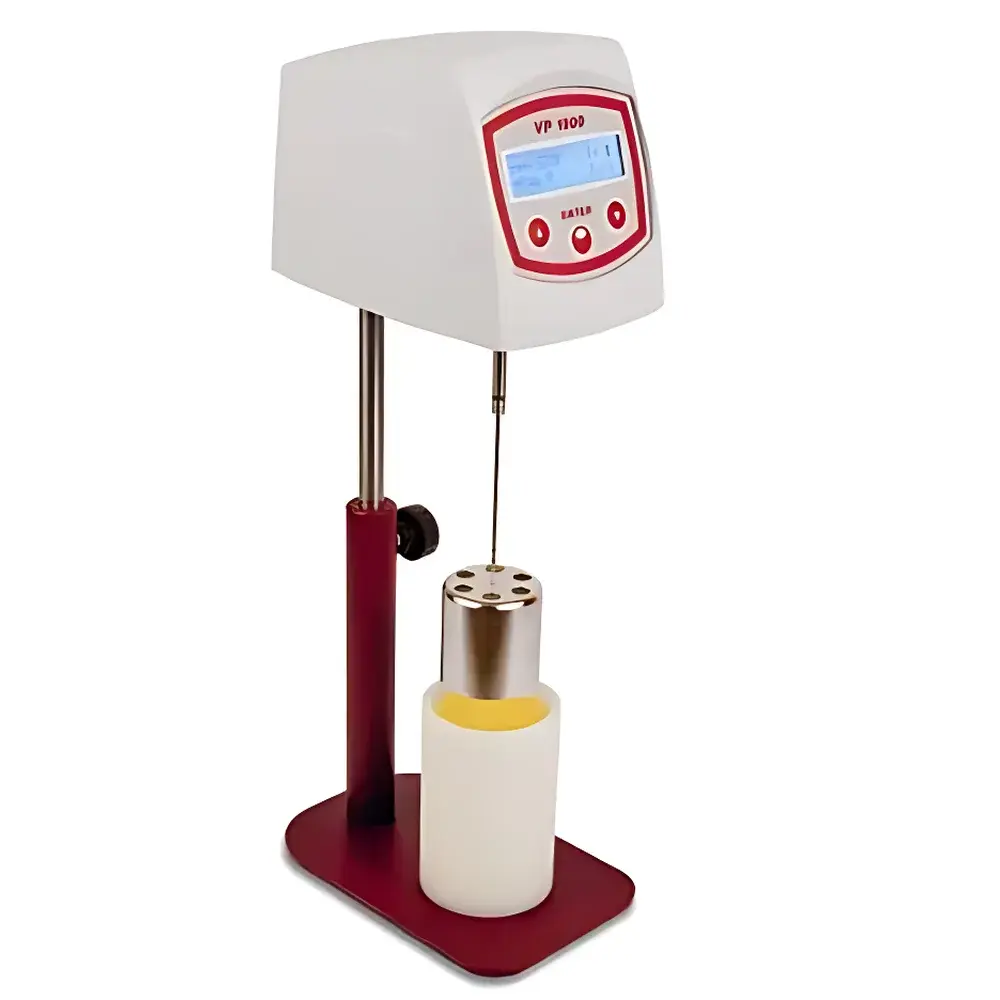
VP1000R Portable Rotational Viscometer for Lubricating & Hydraulic Oils – Manufactured in Spain
| Origin | Spain |
|---|---|
| Manufacturer Type | Authorized Distributor |
| Origin Category | Imported Instrument |
| Model | VP1000R |
| Pricing | Available Upon Request |
Overview
The VP1000R is a handheld, battery-powered rotational viscometer engineered specifically for field and workshop assessment of lubricating oils, hydraulic fluids, gear oils, and other mineral- or synthetic-based industrial lubricants. It operates on the principle of coaxial cylinder (Couette) flow, where torque generated by fluid resistance to a rotating spindle immersed in a defined sample volume is measured and converted into dynamic viscosity (mPa·s) or deciPascal-seconds (dPa·s). Unlike capillary or falling-ball methods, this design delivers rapid, temperature-stable readings without requiring thermal equilibration—critical for condition-based maintenance (CBM) programs in manufacturing, power generation, and mobile equipment fleets. Its compact architecture and IP20-rated enclosure support operation in non-laboratory environments while maintaining metrological integrity aligned with ISO 2555 and ASTM D2983 standards for kinematic-to-dynamic viscosity correlation.
Key Features
- Three standard precision-machined spindles (R1, R2, R3) enabling seamless coverage across a total dynamic viscosity range of 0.3–4000 dPa·s (300–4,000,000 mPa·s), accommodating SAE 5W to SAE 60 grades and high-viscosity hydraulic fluids.
- Battery-operated design with dual power options: four AA alkaline cells (6 V, 1.9 Ah) delivering up to 30 hours of continuous use, or optional NiMH rechargeable pack (VP-003) paired with 230 V AC charger (VP-002).
- Integrated backlit LCD display showing real-time viscosity values in both dPa·s and mPa·s units, with automatic unit conversion and on-screen battery status indicator.
- Fixed-speed rotation at 62.5 rpm—optimized to minimize shear-induced structural breakdown in shear-thinning lubricants while ensuring laminar flow conditions per ISO 3219.
- Robust transport case (included) with molded foam inserts, supporting drop-tested portability and protection during transit between service points, turbine rooms, or offshore platforms.
- Auto-power-off function activated after 10 minutes of inactivity, coupled with low-battery warning to prevent data loss during extended field sessions.
Sample Compatibility & Compliance
The VP1000R is validated for use with transparent to moderately opaque Newtonian and near-Newtonian lubricants—including mineral oils, PAOs, polyalkylene glycols (PAGs), and phosphate ester fire-resistant hydraulic fluids. Non-Newtonian samples (e.g., greases or multi-grade oils under high-shear conditions) require interpretation within defined shear-rate constraints. All measurements comply with traceability requirements when calibrated using certified reference oils (e.g., CAL-002 silicone oil series, NIST-traceable viscosity standards). The instrument meets CE marking directives for electromagnetic compatibility (EMC Directive 2014/30/EU) and low-voltage safety (LVD Directive 2014/35/EU). Its operational profile supports adherence to ISO 4406 (fluid cleanliness), ISO 5275 (viscometer calibration), and OEM-specific oil analysis protocols referenced in Caterpillar S.O.S., Komatsu KOMTRAX, and Siemens Energy Maintenance Guidelines.
Software & Data Management
While the VP1000R operates as a standalone, self-contained instrument without Bluetooth or USB connectivity, its measurement repeatability (±1% full-scale) and accuracy (±2% full-scale) ensure audit-ready data for paper-based or LIMS-integrated reporting workflows. Each reading is manually logged with timestamp, spindle ID, and unit—enabling trend analysis across oil drain intervals, machine health dashboards, or predictive maintenance databases. For laboratories requiring digital traceability, optional calibration certificates (traceable to national metrology institutes) and documented uncertainty budgets are available upon request. The device supports GLP-compliant recordkeeping when used in conjunction with controlled logbooks and versioned SOPs aligned with ISO/IEC 17025 clause 7.7.
Applications
- Routine in-service oil analysis for hydraulic systems in wind turbines, injection molding machines, and CNC machining centers.
- Preventive maintenance screening of engine crankcase oils in marine diesel propulsion and locomotive applications.
- Verification of new oil batches against supplier specifications prior to commissioning.
- Field validation of viscosity degradation following thermal stress, oxidation, or fuel dilution events.
- Supporting ISO 4406 particle count correlations where viscosity drift precedes filter clogging or pump wear onset.
- Training and competency assessment for maintenance technicians in industrial lubrication certification programs (e.g., MLT I/II, ISO 55001-aligned asset management).
FAQ
What viscosity units does the VP1000R display?
It displays dynamic viscosity in both deciPascal-seconds (dPa·s) and milliPascal-seconds (mPa·s), with automatic scaling based on selected spindle.
Can the VP1000R measure non-Newtonian oils?
It provides valid single-point dynamic viscosity values at 62.5 rpm; however, comprehensive rheological profiling (e.g., shear-thinning index, yield stress) requires a programmable rheometer with variable shear rate capability.
Is temperature compensation built-in?
No—the VP1000R assumes ambient temperature measurement (15–35 °C); for temperature-critical assessments, users must pre-condition samples per ASTM D445 or apply manual correction factors derived from oil-specific viscosity-temperature charts.
How often should calibration be performed?
Annual calibration is recommended; more frequent verification (e.g., quarterly) is advised in high-utilization environments or when trending critical assets, using certified reference oils such as CAL-002.
Does the instrument meet FDA or pharmaceutical industry requirements?
It is not designed for GMP-regulated pharmaceutical processing; however, its metrological performance supports general-purpose industrial fluid QA/QC in non-sterile manufacturing settings compliant with ISO 9001 clause 7.1.5.



