
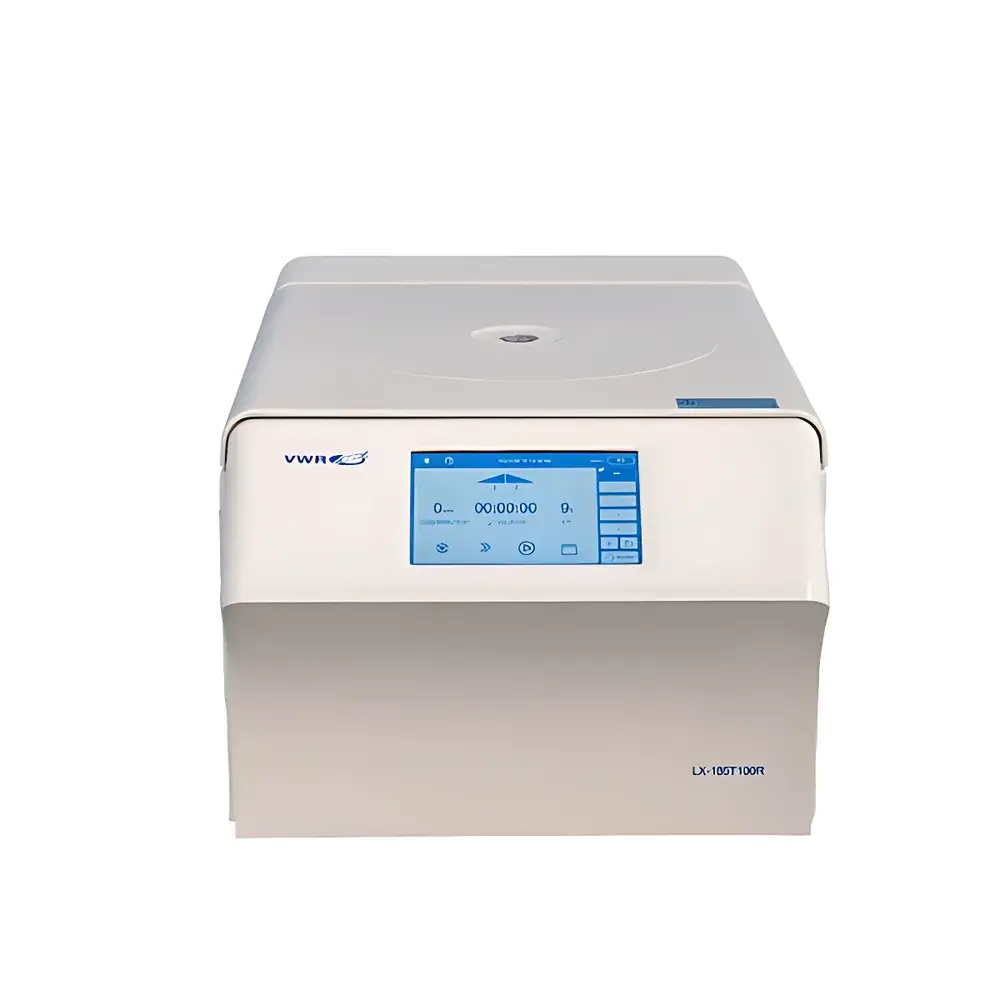
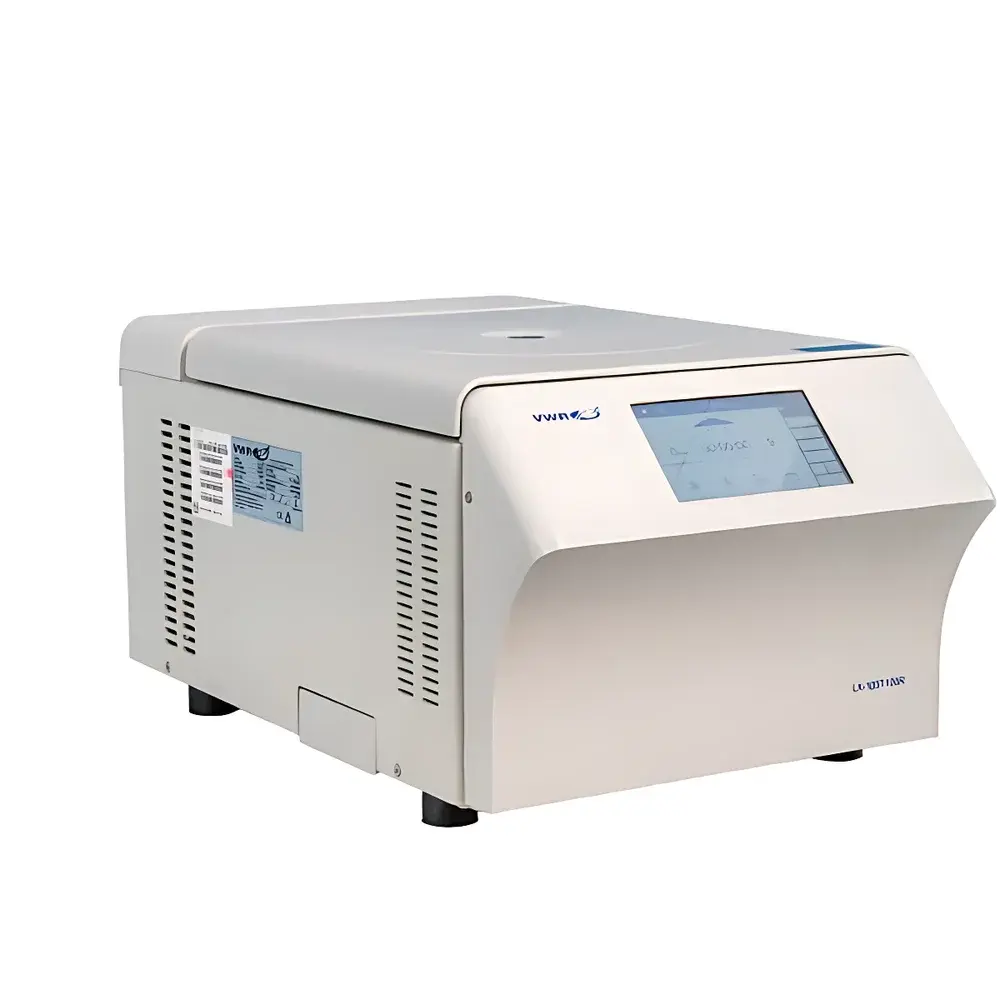
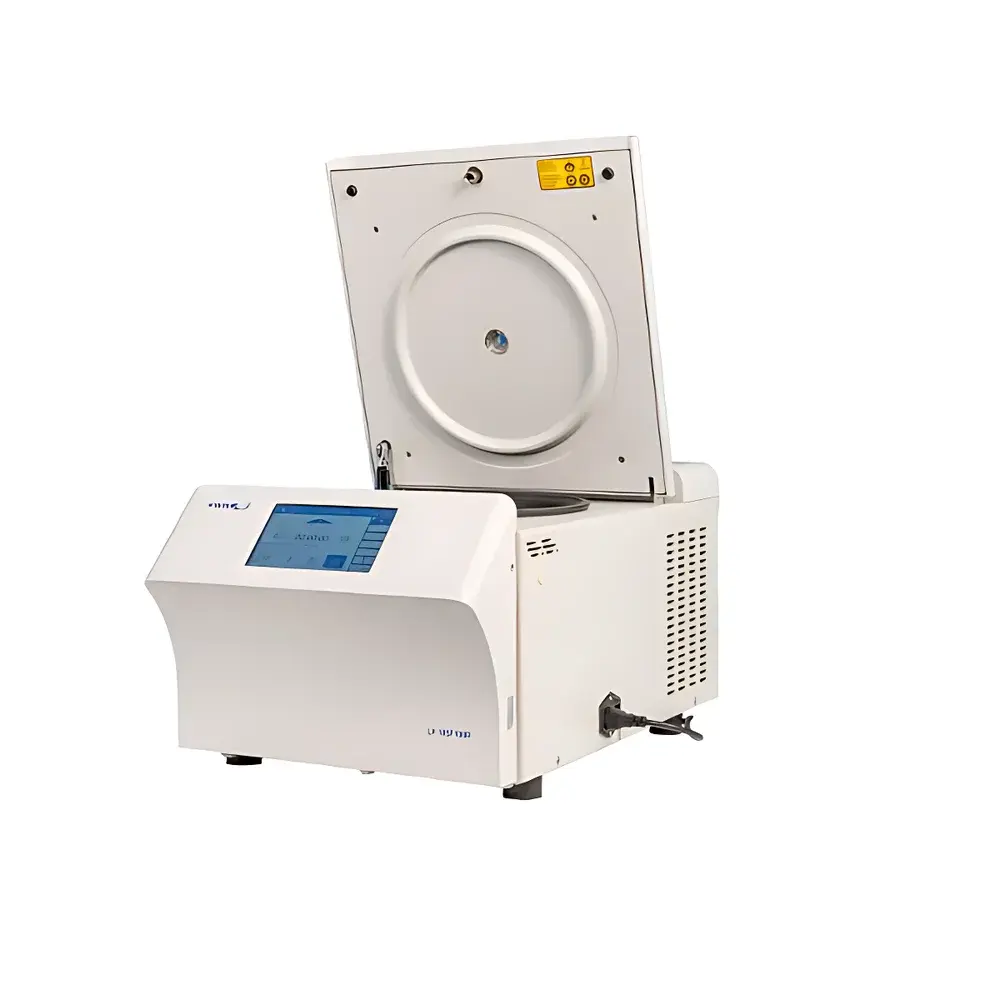
VWR LX-185T100R Benchtop High-Speed Refrigerated Centrifuge
| Brand | VWR |
|---|---|
| Origin | Shanghai, China |
| Model | LX-185T100R |
| Instrument Type | Benchtop Centrifuge |
| Speed Range | 500–18,500 rpm |
| Max RCF | 30,130 × g |
| Max Capacity | 6 × 100 mL |
| Noise Level | ≤52 dB(A) |
| Dimensions (W×D×H) | 420 × 680 × 330 mm |
| Rotor Configuration | Horizontal (Swinging-Bucket) |
| Cooling Range | -20 °C to +40 °C |
| Chamber Material | 316 Stainless Steel |
| Display | 7-inch Capacitive Touchscreen (Glove-Compatible) |
| Vibration Amplitude | <0.02 mm |
| Door Lock | Auto-Suction Damping Lock |
| Features | Pre-cooling Function, Integrated Drain Channel, Triple-Damping System |
| Application Scope | Cell, Bacterial, Viral, Protein, Nucleic Acid, and Blood Component Separation |
Overview
The VWR LX-185T100R is a high-performance benchtop refrigerated centrifuge engineered for precision separation of biological and biochemical samples under controlled thermal conditions. Utilizing a brushless frequency-controlled motor and optimized aerodynamic rotor design, it delivers stable rotational dynamics across its full speed range (500–18,500 rpm), generating up to 30,130 × g relative centrifugal force (RCF). Its refrigeration system maintains chamber temperatures from –20 °C to +40 °C with ±1 °C accuracy, enabling reproducible pelleting of thermolabile analytes—including plasmid DNA, viral particles, extracellular vesicles, and membrane proteins—without thermal denaturation or aggregation. Designed for routine use in biosafety level 2 (BSL-2) laboratories, the unit complies with IEC 61010-1:2010 safety standards for laboratory equipment and incorporates fail-safe thermal monitoring, automatic imbalance detection, and rotor recognition logic to prevent operational errors.
Key Features
- 7-inch glove-compatible capacitive touchscreen interface with intuitive icon-based navigation, real-time parameter visualization, and multi-language support (English, Spanish, German, French)
- Triple-damping mechanical suspension system ensuring vibration amplitude <0.02 mm at maximum speed—critical for maintaining sample integrity and minimizing instrument wear
- Auto-suction damping door lock mechanism providing secure closure, rapid opening response, and enhanced operator safety during high-speed operation
- 316 stainless steel centrifuge chamber with seamless welds and integrated drain channel for efficient decontamination and compliance with GLP cleaning validation protocols
- Pre-cooling function that achieves target temperature in ≤15 minutes (from ambient to –20 °C), reducing workflow delays between runs
- Noise emission ≤52 dB(A) at 1 m distance—achieved via acoustic insulation, balanced rotor dynamics, and low-turbulence airflow management
Sample Compatibility & Compliance
The LX-185T100R supports horizontal (swinging-bucket) rotors compatible with standard conical tubes (15 mL, 50 mL), centrifuge bottles (100 mL), and microtiter plate carriers. It is validated for use with common biological matrices including whole blood, PBMC suspensions, bacterial cultures (E. coli, Bacillus spp.), yeast lysates, and clarified cell culture supernatants. The unit meets ISO 13485 requirements for medical device-related laboratory processes and supports audit-ready documentation when operated within a 21 CFR Part 11–compliant software environment (via optional VWR Connect™ integration). All rotors are certified to ASTM F2656-21 for mechanical integrity and undergo annual recalibration traceable to NIST standards.
Software & Data Management
While the LX-185T100R operates autonomously via its embedded controller, optional VWR Connect™ software enables remote monitoring, method synchronization across multiple instruments, and export of run logs in CSV/Excel format. Each centrifugation cycle records timestamp, rotor ID, speed, RCF, temperature, duration, and error flags—supporting traceability for QA/QC audits and ISO/IEC 17025 accreditation. Audit trails are encrypted and tamper-evident; data retention policies align with institutional GLP/GMP data integrity guidelines (ALCOA+ principles).
Applications
- Isolation of peripheral blood mononuclear cells (PBMCs) using Ficoll-Paque density gradients
- Clarification of recombinant protein expression lysates prior to chromatographic purification
- Concentration and recovery of lentiviral or AAV vectors for gene therapy workflows
- Routine preparation of serum/plasma from clinical specimens under CLIA-certified conditions
- Separation of subcellular fractions (mitochondria, nuclei, lysosomes) via differential centrifugation protocols
- Processing environmental water samples for bacterial enumeration and pathogen concentration
FAQ
What rotor configurations are supported by the LX-185T100R?
The instrument is configured exclusively for horizontal (swinging-bucket) rotors; compatible models include the 6×100 mL bucket rotor (standard), 12×15 mL, and 4×50 mL variants—all certified for maximum rated speeds.
Does the centrifuge support automatic rotor identification?
Yes—each rotor is equipped with an RFID tag that communicates type, max speed, and calibration status to the control system upon insertion, preventing unsafe parameter selection.
Can pre-cooling be scheduled remotely?
Pre-cooling must be initiated manually via the touchscreen or local software; remote scheduling requires integration with VWR Connect™ and a networked lab infrastructure.
Is the unit suitable for continuous operation in a cold room?
The LX-185T100R is rated for ambient operating temperatures of 10–32 °C and 30–80% non-condensing humidity; extended use below 10 °C may affect compressor efficiency and is not recommended without environmental conditioning.
How often does the refrigeration system require maintenance?
Annual preventive maintenance—including refrigerant pressure verification, condenser coil inspection, and thermal sensor calibration—is recommended to ensure consistent cooling performance and regulatory compliance.



