
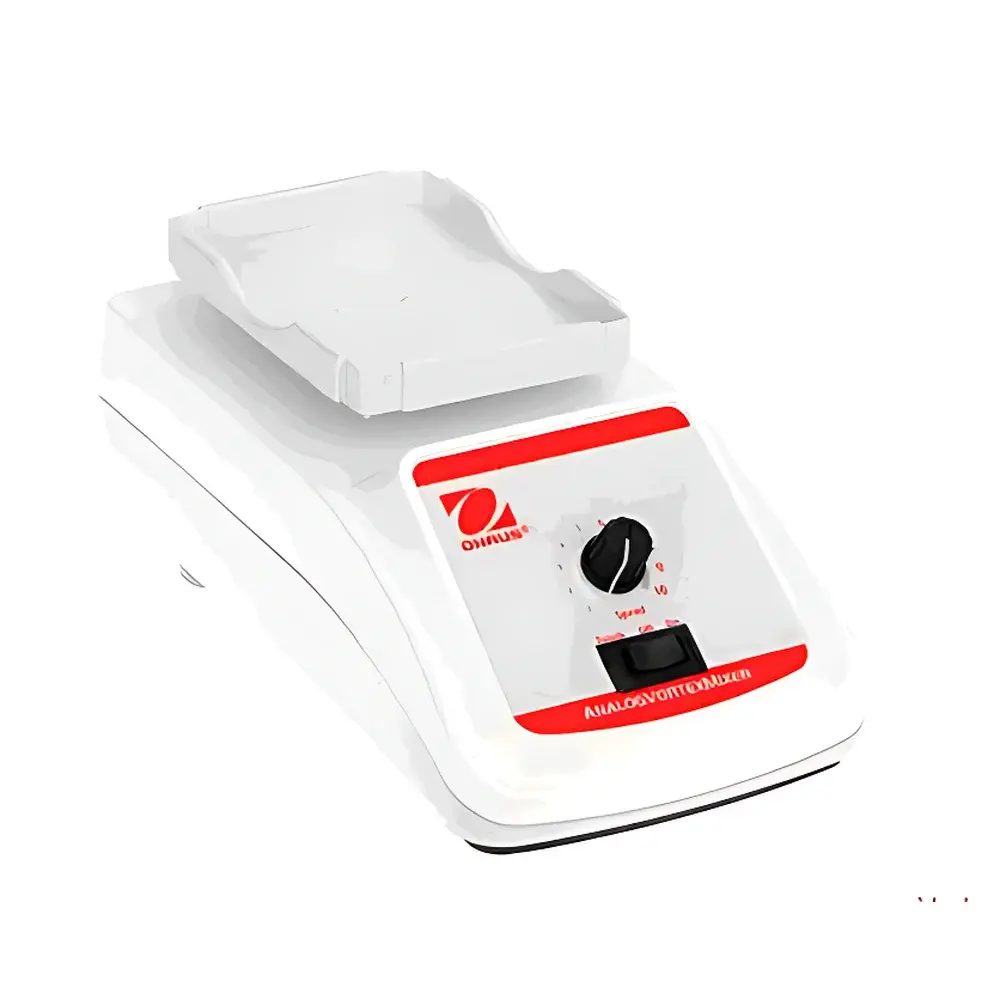
VXMPAL Microplate Vortex Mixer
| Origin | USA |
|---|---|
| Manufacturer Type | Authorized Distributor |
| Origin Category | Imported |
| Model | VXMPAL |
| Instrument Type | Mixing & Homogenization Equipment |
| Timer Range | 1–999 min |
| Oscillation Frequency | Orbital Mode: 300–2500 rpm |
| Touch-Activated Mode | 300–3500 rpm |
| Temperature Control Range | 4°C–40°C, 20%–85% RH (non-condensing) |
| Orbit Diameter | 3.5 mm |
| Capacity | Dual Microplate (96-well or 384-well compatible) |
| Dimensions (W×D×H) | 11.4 cm × 26.7 cm × 13.7 cm |
| Net Weight | 5.3 kg |
| Power Supply | 230 V, 0.13 A, 50/60 Hz |
| Power Consumption | 30 W |
| Safety Certifications | CE, TÜV |
| Enclosure Material | Cycoloy® polycarbonate alloy |
| Control Interface | Analog knobs (speed/time), independent LED display for simultaneous rpm and timer readout |
| Operating Environment | 4°C–40°C, 20%–85% RH, non-condensing |
Overview
The VXMPAL Microplate Vortex Mixer is an engineered orbital shaker designed specifically for high-throughput microplate processing in molecular biology, immunoassay, and cell culture laboratories. Utilizing a precisely balanced eccentric drive mechanism, it generates consistent 3.5 mm orbital motion to induce uniform vortexing across all wells of standard 96-well and 384-well plates—without splashing, cross-contamination, or well-to-well variability. Unlike generic benchtop shakers, the VXMPAL integrates dual operational modes: a stable orbital mode (300–2500 rpm) optimized for ELISA plate washing, PCR master mix homogenization, and enzymatic digestions; and a responsive touch-activated mode (300–3500 rpm) enabling rapid transient mixing during sensitive steps such as lysis buffer addition or antibody incubation. Its thermally regulated chamber maintains temperature stability between 4°C and 40°C, supporting cold-sensitive assays (e.g., protein-protein interaction studies) and ambient-to-warm incubation protocols (e.g., bacterial transformation recovery), all within a non-condensing humidity envelope (20–85% RH).
Key Features
- Independent dual-parameter LED display showing real-time rpm and remaining time—critical for GLP-compliant documentation and protocol reproducibility
- Analog control architecture with tactile rotary knobs for speed and timer adjustment, eliminating touchscreen calibration drift and ensuring long-term operational consistency
- Cycoloy® polymer housing—chemical-resistant, impact-damped, and autoclavable surface-compatible for routine decontamination in BSL-2 environments
- Dual-plate capacity with precision-machined microplate adapters accommodating ANSI/SLAS-standard footprint plates (including skirted, semi-skirted, and low-profile variants)
- Low-noise brushless DC motor with dynamic load compensation—maintains set rpm ±3 rpm across full plate-loading conditions (0–2 plates)
- CE- and TÜV-certified electrical architecture compliant with IEC 61010-1 safety requirements for laboratory equipment
Sample Compatibility & Compliance
The VXMPAL supports all common microplate formats used in life science workflows: 96-well flat-bottom, U/V-bottom, PCR plates, and 384-well assay plates—including those with adhesive seals or foil lids. It accommodates both aqueous and viscous samples (up to 300 mPa·s viscosity at 25°C) without loss of orbital fidelity. The device meets ISO 13485-aligned manufacturing controls for in vitro diagnostic (IVD) support instrumentation and complies with ASTM D4064 for orbital shaker performance verification. For regulated environments, its analog control interface inherently satisfies FDA 21 CFR Part 11 requirements for audit-trail-free operation where electronic signatures are not mandated—making it suitable for QC labs operating under GMP Annex 11 or ISO/IEC 17025 frameworks.
Software & Data Management
As a stand-alone analog instrument, the VXMPAL does not incorporate embedded firmware or network connectivity—intentionally minimizing cybersecurity exposure and eliminating software validation overhead. All operational parameters (speed, duration, temperature setpoint) are manually entered and retained via mechanical memory in the control circuitry, ensuring deterministic behavior across power cycles. Time and rpm values displayed on the LED screen are traceable to NIST-traceable calibration standards via optional factory service documentation. For labs requiring integration into LIMS or ELN systems, external digital timers or programmable relay controllers may be interfaced via the unit’s dry-contact trigger output (available upon request).
Applications
- ELISA plate washing and conjugate incubation with uniform agitation to reduce background noise and improve signal-to-noise ratio
- Pre-PCR thermal cycling preparation: homogenizing master mixes, resuspending lyophilized enzymes, and equilibrating reaction components
- Cell lysis optimization for suspension and adherent cultures—paired with detergent-based or mechanical lysis buffers
- Antibody-antigen binding kinetics studies requiring precise temporal control over mixing intervals
- High-throughput compound solubility screening in 384-well format under controlled temperature conditions
- Microbial growth curve analysis with intermittent agitation to prevent sedimentation in static culture assays
FAQ
Does the VXMPAL support refrigerated operation down to 4°C?
Yes—the integrated Peltier-based cooling/heating system maintains stable setpoints from 4°C to 40°C with ±0.8°C accuracy across the full operating range.
Can it accommodate deep-well plates or PCR strips?
The standard adapter supports only ANSI/SLAS-compliant microplates (96- and 384-well). Deep-well plates require optional custom fixtures; PCR strips are not supported due to mechanical coupling constraints.
Is the unit compatible with CO₂ incubators or glove boxes?
No—the VXMPAL is rated for ambient lab use only (IP20 enclosure); it is not sealed for humidified or pressurized enclosures.
What maintenance is required for long-term reliability?
Annual inspection of motor coupling integrity and recalibration of temperature sensor against NIST-traceable reference probes is recommended; no lubrication or filter replacement is needed.
How is compliance verified for ISO 17025 accreditation?
Certificate of Conformance (CoC) and factory calibration report—including rpm linearity, timer accuracy, and temperature uniformity data across the chamber—are provided with each unit.



