
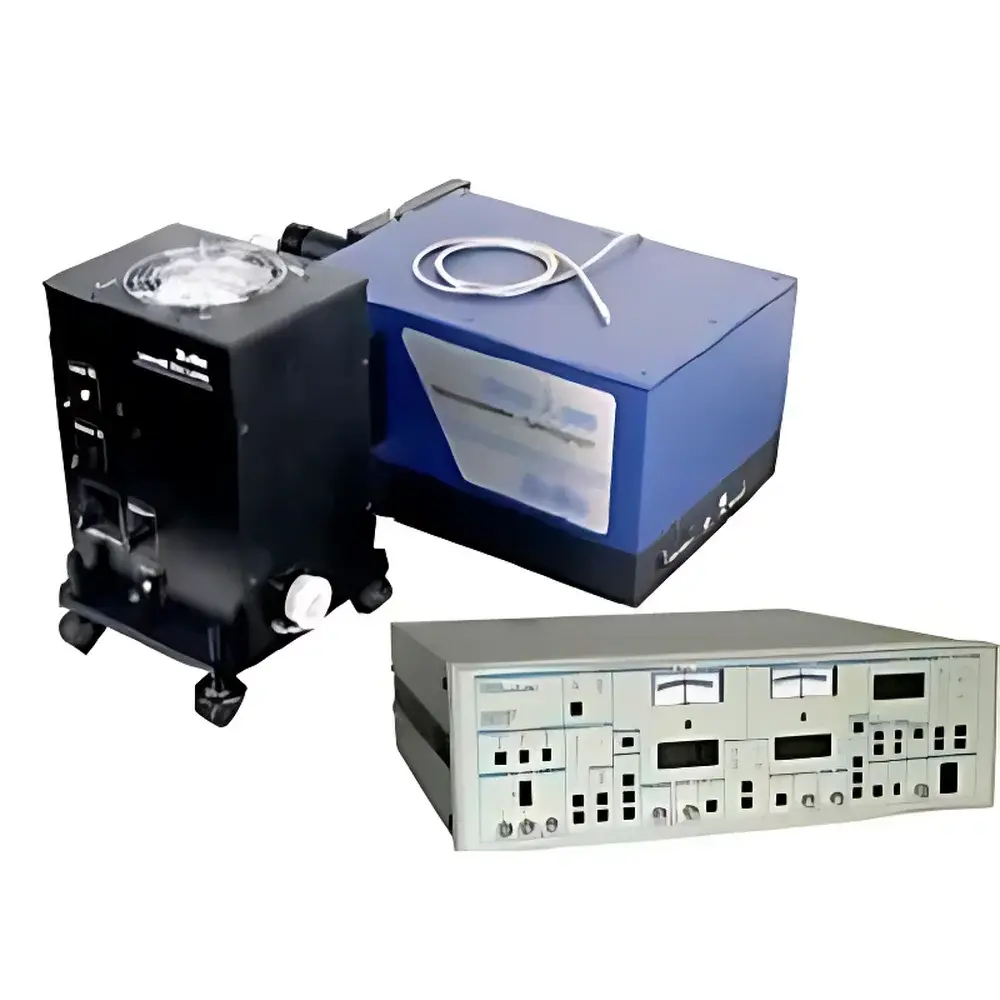
WAD-SPV530 Surface Photovoltage Spectroscopy System
| Origin | Shanghai, China |
|---|---|
| Manufacturer Type | Authorized Distributor |
| Origin Category | Domestic (PRC) |
| Light Source | 500 W Xenon Arc Lamp (Stability ≤ 0.5%) |
| Monochromator Focal Length | 300 mm |
| Relative Aperture | f/3.9 |
| Spectral Bandwidth | 0.1–16 nm |
| Spectral Range | 200–1100 nm (Optimal: 330–1000 nm) |
| Monochromator Interface | USB 2.0 |
| Lock-in Amplifier | Stanford Research Systems SR510 |
| Optical Chopper | Stanford Research Systems SR540 |
| Fiber Bundle | 1 m length, 1 mm core diameter |
| Dark Chamber | Dual-axis (horizontal/vertical) sample mounting |
| Software | Integrated wavelength-sweep and SPV signal acquisition control |
Overview
The WAD-SPV530 Surface Photovoltage Spectroscopy (SPV) System is a precision optical instrumentation platform engineered for non-destructive, high-sensitivity characterization of surface electronic states in semiconductors, photocatalysts, thin-film heterojunctions, and nanostructured materials. Based on the photovoltage effect—where incident monochromatic light induces charge separation at surface/interface regions—the system measures the resulting transient or steady-state voltage change under modulated illumination. This technique provides quantitative insight into surface band bending, defect energy levels, carrier recombination kinetics, and interfacial charge transfer efficiency—without physical contact, sputtering, or vacuum requirements. With detection sensitivity approaching 108 elementary charges per cm2, SPV spectroscopy surpasses X-ray photoelectron spectroscopy (XPS) and Auger electron spectroscopy (AES) by several orders of magnitude in surface-specific electronic probing, while preserving sample integrity and topography.
Key Features
- High-stability 500 W xenon arc lamp with active thermal regulation and power feedback control, delivering long-term irradiance stability ≤ 0.5% RMS over 8-hour operation—critical for minimizing spectral baseline drift in low-signal SPV measurements.
- 300 mm focal length Czerny–Turner monochromator featuring f/3.9 relative aperture and motorized grating drive; enables rapid, repeatable wavelength scanning from 200 to 1100 nm with selectable spectral resolution (0.1–16 nm bandwidth) via interchangeable gratings.
- Integrated lock-in detection architecture using the Stanford Research Systems SR510 dual-phase lock-in amplifier and SR540 optical chopper (4 Hz–3.7 kHz modulation range), ensuring optimal signal-to-noise ratio (SNR) for weak photovoltage signals buried in thermal and 1/f noise.
- 1 mm core diameter, 1 m long UV-VIS-NIR optimized fiber bundle with SMA 905 connectors, enabling flexible light delivery into a fully shielded dark chamber while maintaining >85% transmission across 330–1000 nm.
- Biaxial dark chamber design supports horizontal or vertical sample orientation—accommodating solid wafers, pressed powder pellets, colloidal films on conductive substrates, and liquid-phase electrochemical cells with transparent electrodes.
- Native USB 2.0 interface for monochromator control and synchronized data acquisition; software implements real-time wavelength calibration, auto-zero referencing, and multi-cycle averaging to enhance measurement reproducibility.
Sample Compatibility & Compliance
The WAD-SPV530 is compatible with a broad class of optoelectronic and catalytic materials, including but not limited to Si, GaAs, TiO2, g-C3N4, perovskite thin films, quantum dot assemblies, and metal–organic frameworks (MOFs). Sample mounting requires only ohmic or Schottky contact to a low-noise preamplifier input; no vacuum or cryogenic infrastructure is required. The system adheres to fundamental principles outlined in ASTM E2737 (Standard Practice for Characterization of Semiconductor Interfaces) and supports experimental protocols aligned with ISO/IEC 17025-compliant laboratories when paired with documented calibration procedures for lamp intensity, monochromator wavelength accuracy, and lock-in gain linearity.
Software & Data Management
The proprietary acquisition software provides full instrument orchestration: automated wavelength sweep initiation, synchronous lock-in reference phase locking, time-resolved SPV decay capture, and real-time spectral plotting. Raw data are exported in ASCII or HDF5 format—including metadata such as lamp intensity monitor readings, monochromator grating position, chopper frequency, and amplifier time constants—for traceable post-processing in MATLAB, Python (NumPy/SciPy), or OriginLab. Audit trails for parameter changes and user login events can be enabled to support GLP/GMP environments; while the software itself does not implement FDA 21 CFR Part 11 electronic signature functionality, it interfaces seamlessly with third-party LIMS platforms via TCP/IP or OPC UA protocols.
Applications
- Quantification of surface state density and trap energy distribution in silicon solar cell passivation layers.
- In situ monitoring of interfacial charge separation dynamics in Z-scheme photocatalytic systems under simulated solar illumination.
- Correlation of SPV spectral onset with flat-band potential shifts in dye-sensitized and perovskite-based photoelectrodes.
- Identification of defect-related sub-bandgap transitions in wide-bandgap oxides used in UV photodetectors.
- Comparative evaluation of surface modification efficacy (e.g., ALD coatings, plasma treatment) on carrier lifetime and surface recombination velocity.
FAQ
What is the minimum detectable surface charge density for the WAD-SPV530 system?
The theoretical detection limit is approximately 1 × 10⁸ elementary charges per cm2, assuming optimal sample contact resistance (< 10 kΩ), ambient temperature operation, and 100 s signal averaging.
Can the system be upgraded to support time-resolved SPV measurements?
Yes—by integrating an external pulsed laser source (e.g., OPO system with ns–ps pulse width) and replacing the SR510 with the SRS SR830 or Zurich Instruments HF2LI, the platform supports transient SPV decay analysis down to microsecond resolution.
Is the software compatible with third-party lock-in amplifiers?
The native driver supports only SRS SR510/SR830 and Zurich Instruments MFLI/HF2LI models; integration with other brands requires custom LabVIEW or Python API development using vendor-provided SDKs.
What calibration standards are recommended for wavelength and intensity verification?
NIST-traceable Hg–Ar and Ne emission lamps are recommended for wavelength calibration; a calibrated silicon photodiode (e.g., NIST SRM 2500) is advised for absolute irradiance normalization across the 330–1000 nm range.
Does the dark chamber meet electromagnetic interference (EMI) shielding specifications?
The chamber features 60 dB attenuation from 10 kHz to 1 GHz per IEEE Std 299–2006, achieved via continuous copper-clad aluminum construction and RF-tight SMA feedthroughs for all electrical connections.





