
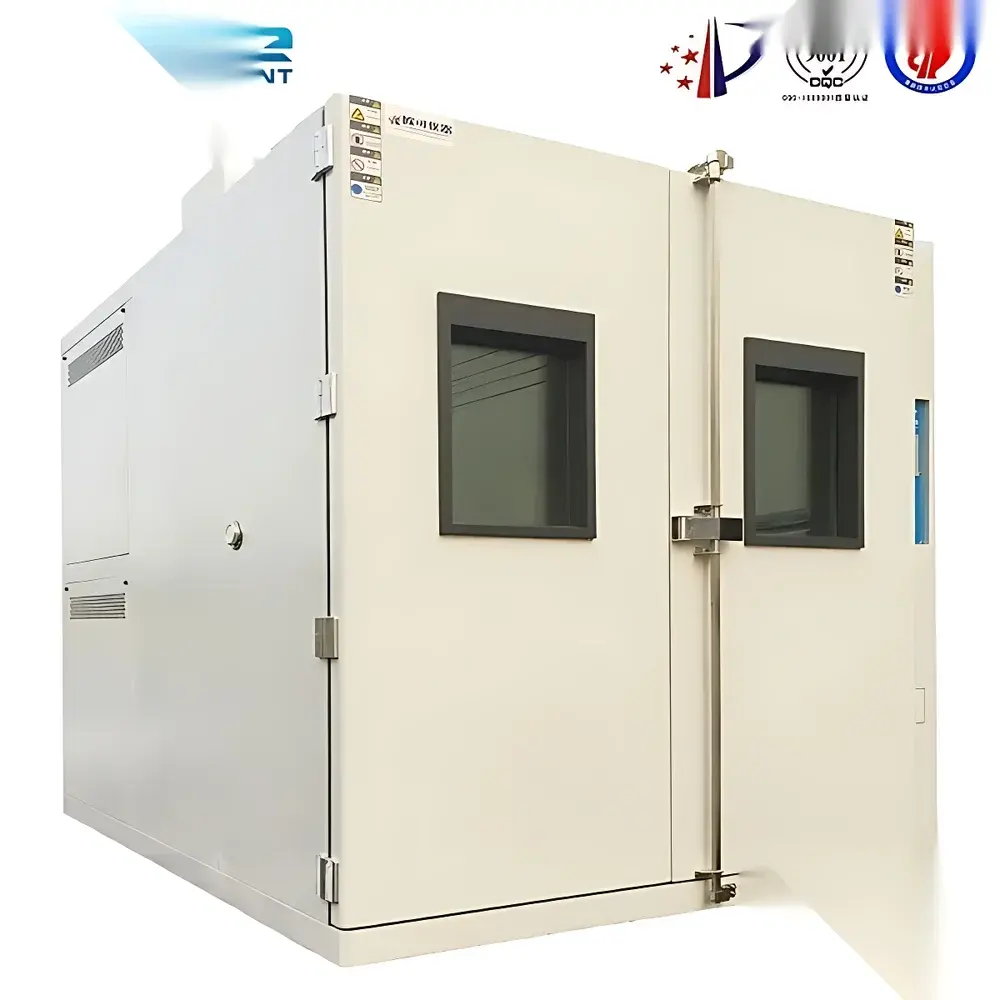
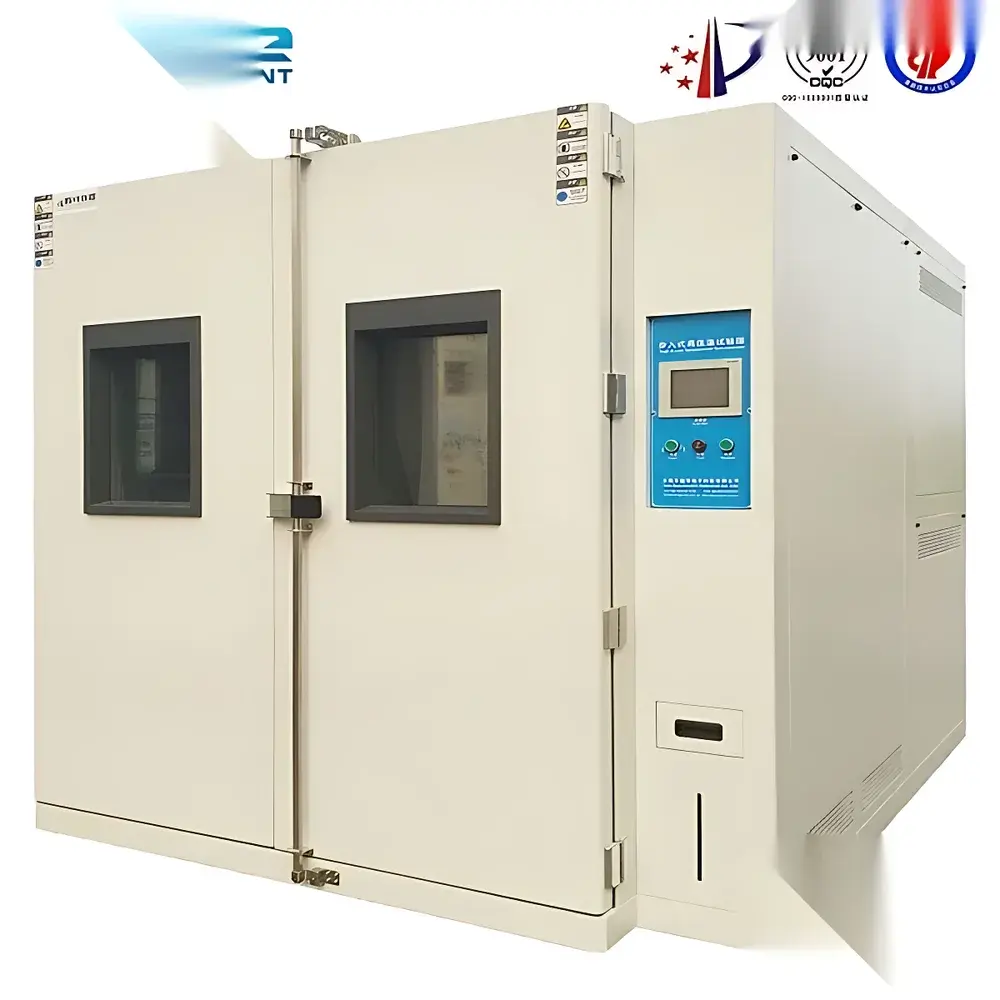
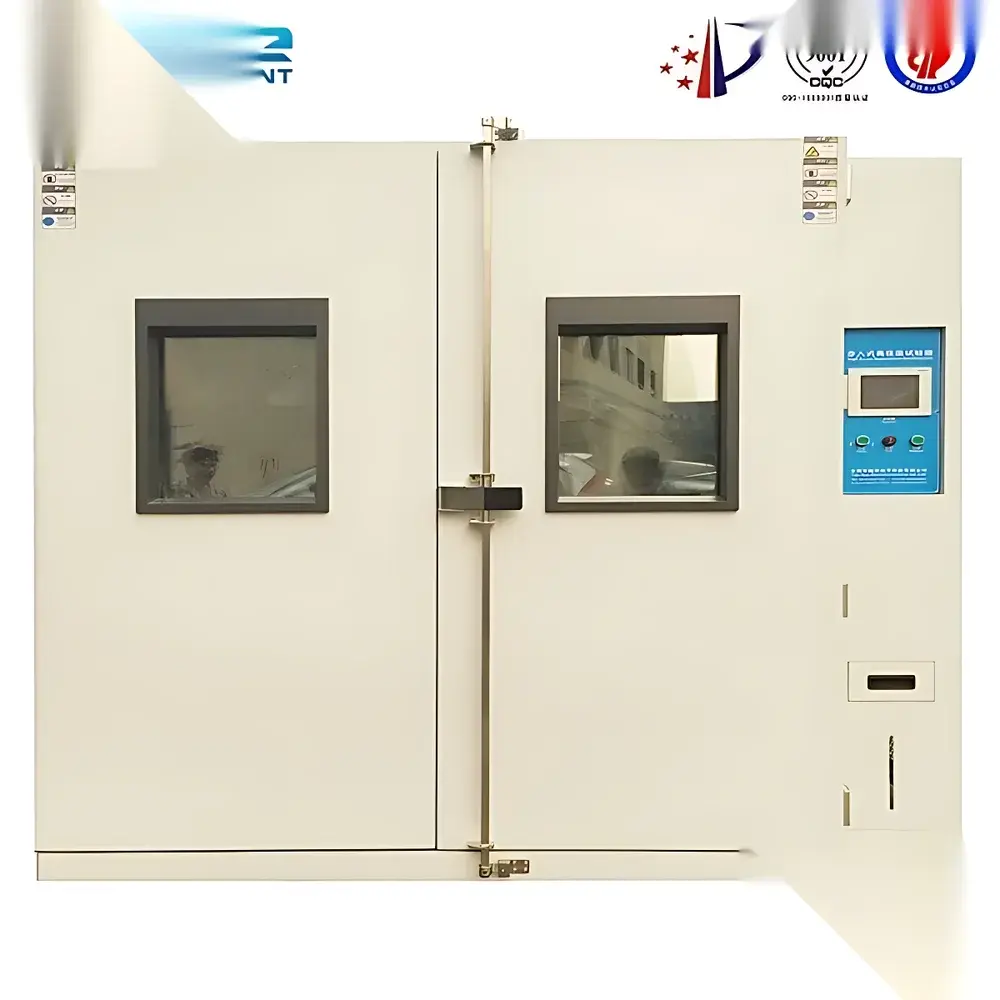
Walk-In Environmental Chamber for Temperature and Humidity Cycling
| Brand | OEM / Custom Brand |
|---|---|
| Origin | Imported |
| Manufacturer Type | Authorized Distributor |
| Temperature Range | -70 °C to +150 °C |
| Humidity Range | 30–98 %RH |
| Temperature Uniformity | ±0.5 °C |
| Temperature Deviation | ≤2 °C |
| Humidity Deviation | +2 to –3 %RH |
| Ramp Rate | 0.7–1.0 °C/min |
| Control Accuracy | ±0.1 °C (PID, 0.1-class) |
| Display | Korean-made TFT Touchscreen LCD |
| Interface | RS485/RS232, Ethernet (optional) |
| Programming Capacity | Up to 1000 segments, 999 cycles |
| Compliance | Designed per IEC 60068-2, ISO 16750-4, ASTM D4332, MIL-STD-810H (environmental conditioning) |
Overview
The Walk-In Environmental Chamber for Temperature and Humidity Cycling is a large-volume, floor-standing climatic test system engineered for precise simulation of dynamic thermal and hygrothermal stress profiles across industrial, automotive, aerospace, and electronics reliability testing applications. Utilizing a dual-refrigeration cascade system with independent heating, cooling, humidification, and dehumidification circuits, the chamber delivers stable, repeatable environmental conditions over extended durations. Its core measurement and control architecture relies on high-stability PT100 sensors, digitally tuned PID algorithms with auto-tuning capability, and a Korean-sourced 7-inch TFT touchscreen controller compliant with IEC 61000-4 electromagnetic immunity standards. Unlike benchtop chambers, this walk-in design accommodates full-size prototypes—such as EV battery modules, avionics enclosures, or HVAC components—enabling real-world thermal management validation under programmable cycling or steady-state operation.
Key Features
- Spacious interior (standard configurations: 2–10 m³ volume) with stainless-steel inner chamber and insulated double-wall construction (150 mm polyurethane foam, ≥0.022 W/m·K thermal conductivity)
- Independent multi-stage refrigeration system (cascade low-temp stage + single-stage main stage) enabling reliable operation down to –70 °C without liquid nitrogen assist
- Dual-mode humidity control: steam generator (ultrasonic optional) for humidification; refrigerated coil + hot-gas bypass for dehumidification
- High-precision control interface: 0.1 °C resolution, ±0.1 °C setpoint accuracy, real-time deviation monitoring with alarm thresholds configurable per test segment
- Programmable logic: supports complex multi-segment profiles (ramp-hold-soak cycles), user-defined rate limits, and conditional branching (e.g., trigger data logging upon reaching target RH)
- Robust mechanical design: vibration-isolated compressor mounts, reinforced structural frame, and maintenance-access panels for rapid service of refrigerant circuits and humidifier tanks
Sample Compatibility & Compliance
The chamber accommodates samples up to 2.4 m in height and 1.8 m in width, with customizable internal shelving, cable ports (IP65-rated), and power feedthroughs (up to 32 A, 400 VAC). It meets essential requirements for environmental stress screening (ESS) and qualification testing per ISO 16750-4 (road vehicles), ASTM D4332 (conditioning of plastics), and IEC 60068-2-1/-2/-30 (cold, dry heat, damp heat cyclic). Optional validation packages include IQ/OQ documentation templates aligned with GLP and GMP environments, and traceable calibration certificates (NIST-traceable PT100 sensors and RH transmitters). The system’s electrical safety conforms to IEC 61010-1; EMC performance complies with EN 61326-1.
Software & Data Management
Standard controller firmware supports Modbus RTU/TCP and Ethernet/IP protocols for integration into centralized lab management systems (LIMS) or MES platforms. Optional PC-based software enables remote monitoring, real-time graphing (multi-channel temperature/humidity/pressure), automated report generation (PDF/CSV), and audit-trail-enabled user access logs compliant with FDA 21 CFR Part 11 requirements. All data—including setpoints, actual values, alarms, and system status—is timestamped and stored internally (≥30 days at 1-second intervals) with backup via USB or network export. Configuration files are encrypted and version-controlled to prevent unauthorized profile modification.
Applications
- Automotive component validation: battery thermal runaway propagation studies, ECU cold-start performance, headlamp condensation resistance
- Aerospace: avionics box thermal shock endurance, composite material moisture absorption/desorption kinetics
- Electronics: accelerated life testing of PCBAs under temperature-humidity bias (THB), solder joint fatigue simulation
- Medical device packaging: ISO 11607-1 stability assessment of sterile barrier systems under cyclic humidity
- Material science: polymer crystallinity evolution tracking via in-situ DSC-compatible mounting options (requires optional sensor integration)
FAQ
What ambient conditions are required for proper chamber installation?
Ambient temperature must be maintained between 15 °C and 35 °C; relative humidity ≤85 %RH. Adequate ventilation, level flooring, minimum 600 mm clearance on all sides, and dedicated grounding (<10 Ω) are mandatory for thermal and electrical safety compliance.
Can the chamber operate continuously at –70 °C with 10 %RH?
Yes—continuous operation at extreme low-temperature/low-humidity conditions is supported via active dehumidification and cascade refrigeration. However, sustained sub-zero RH requires periodic defrost cycle scheduling to maintain sensor accuracy and prevent ice accumulation on humidity sensors.
Is remote diagnostics and firmware update capability available?
Standard Ethernet connectivity enables secure remote login (SSH/VNC) for diagnostic log retrieval and parameter adjustment. Firmware updates are delivered via signed binary packages with checksum verification to ensure integrity and regulatory compliance.
Does the system support third-party data acquisition hardware integration?
Yes—via analog voltage/current inputs (0–10 V, 4–20 mA) and digital I/O terminals, enabling synchronized acquisition of external sensor data (e.g., strain gauges, current probes) alongside chamber environmental parameters.



