
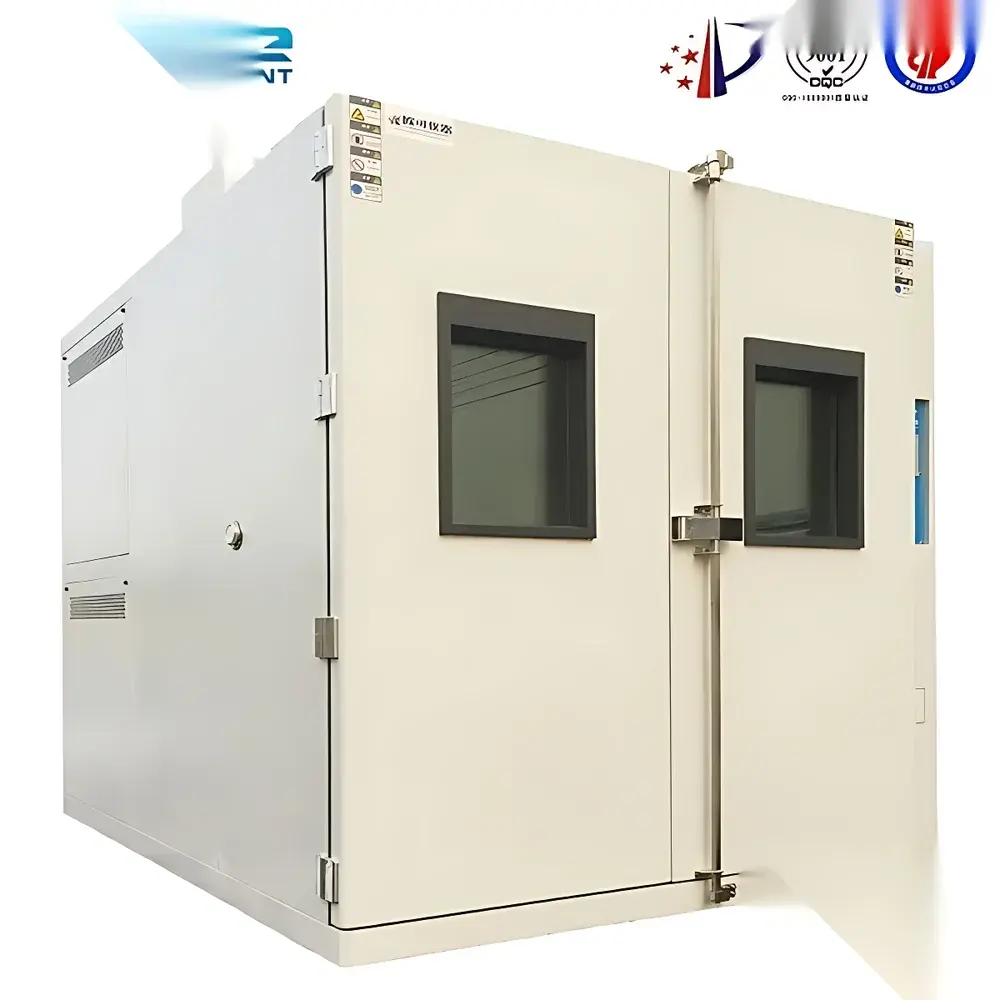
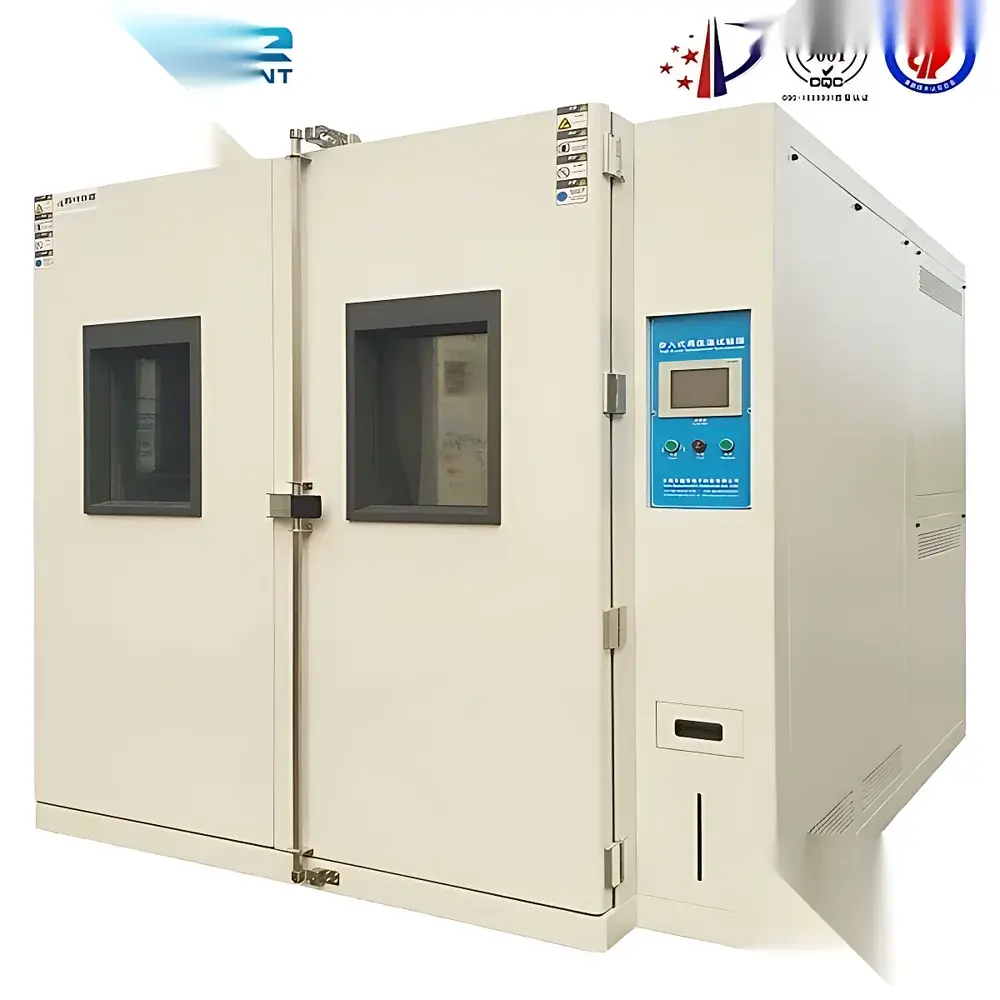
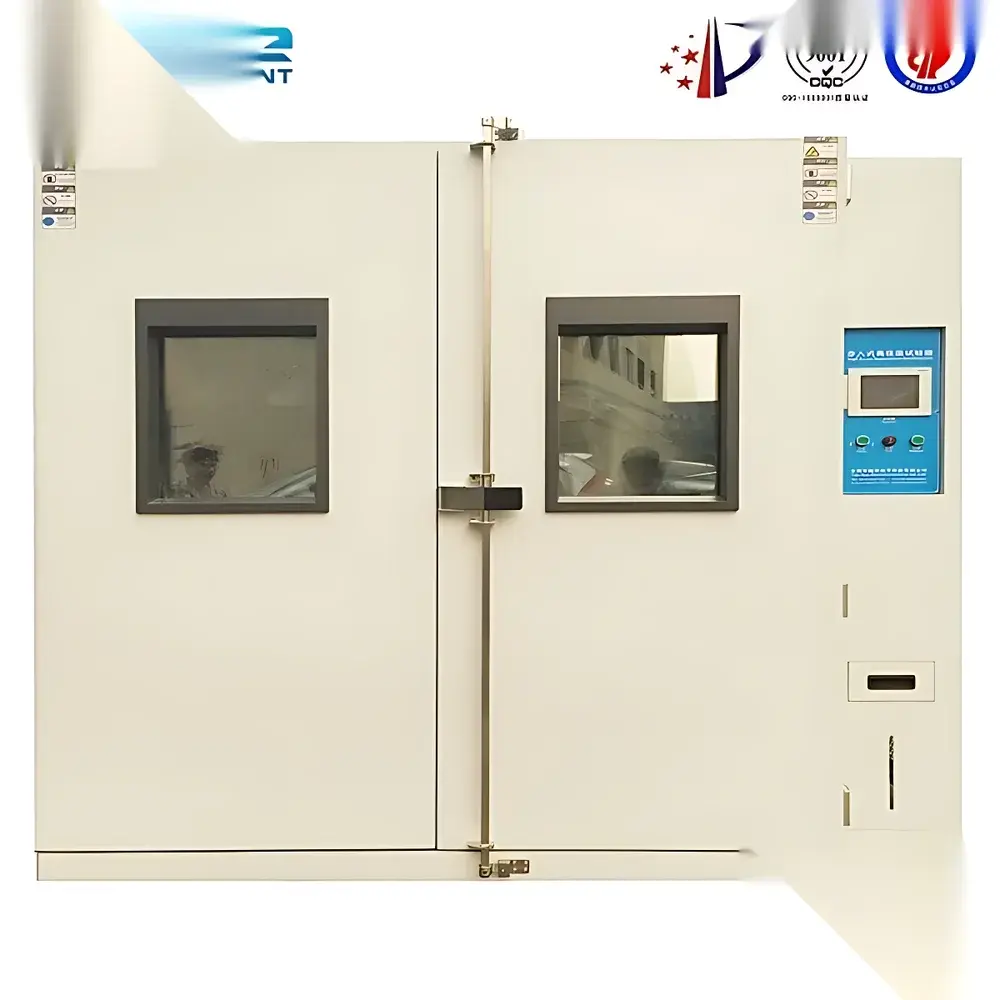
Walk-in Environmental Stability Chamber
| Origin | Imported |
|---|---|
| Manufacturer Type | Authorized Distributor |
| Price | USD 11,200 (FOB) |
Overview
The Walk-in Environmental Stability Chamber is a large-scale, floor-standing climatic test chamber engineered for long-term stability testing of pharmaceutical products, medical devices, electronic components, and industrial materials under precisely controlled temperature and humidity conditions. Designed in accordance with the fundamental principles of psychrometric control and forced-air convection, the chamber maintains uniform environmental conditions across its entire internal volume through a fully integrated air handling unit (AHU), high-efficiency insulation architecture, and microprocessor-based feedback regulation. Unlike benchtop chambers, this walk-in system supports simultaneous conditioning of multiple full-size product batches or large-format equipment—enabling real-world accelerated aging, stability protocol execution (e.g., ICH Q1A–Q1E), and compliance-driven storage validation per regulatory requirements.
Key Features
- Structural frame fabricated from 6# channel steel grid foundation, rated for static load capacity of 200 kg/cm²—ensuring dimensional integrity under continuous operational load including personnel, shelving, and test specimens.
- Modular six-panel enclosure with dual access doors (1500 mm × 1600 mm each); external cladding: pre-painted color-coated steel; internal lining: galvanized steel sheet; core insulation: rigid polyurethane foam (density ≥40 kg/m³, thermal conductivity ≤0.022 W/m·K).
- Dedicated air conditioning cabinet housing centrifugal circulation fan, PID-controlled electric heating elements, refrigerant-based cooling coil, and precision humidification/dehumidification subsystems—including stainless-steel steam generator and chilled-water condensation drain.
- Control system based on RKC (Japan) high-accuracy digital PID controller with SSR output modules; temperature resolution: 0.01°C; humidity resolution: 0.1% RH; setpoint accuracy: ±0.1°C / ±1.0% RH (at 25°C/60% RH typical operating point).
- PT100 Class A platinum resistance sensors (IEC 60751) mounted at multiple spatial locations to support uniformity mapping and gradient compensation algorithms.
- Touchscreen HMI interface with intuitive menu navigation, real-time trend display, multi-segment programmable profiles, and built-in alarm history log (timestamped event records).
- Standard RS-232 and optional RS-485 communication ports compliant with Modbus RTU protocol—enabling integration into centralized laboratory management systems (LIMS) or SCADA platforms for remote monitoring, data archival, and automated report generation.
Sample Compatibility & Compliance
This chamber accommodates diverse sample configurations—including palletized pharmaceutical cartons, stacked electronics enclosures, automotive ECUs, and sterile packaging trays—without compromising airflow uniformity or sensor representativeness. Internal dimensions support standard ISO pallet (1200 mm × 1000 mm) placement with ≥800 mm clearance around all sides for laminar recirculation. The system meets mechanical and performance criteria specified in GB/T 10586–2018 (Environmental Testing Equipment – Humidity and Temperature Test Chambers), GB/T 10592–2008 (Specifications for Low-Temperature Test Chambers), and aligns with core functional equivalency to ISO 16750-4, IEC 60068-2-30, and ASTM E145–22 (Standard Specification for Gravity-Convection and Forced-Ventilation Ovens). While not certified to FDA 21 CFR Part 11 out-of-the-box, the control firmware supports audit trail configuration, electronic signature enablement, and data export in CSV/PDF formats—facilitating GxP-compliant validation under GLP or GDP frameworks.
Software & Data Management
The embedded controller provides native data logging at user-selectable intervals (1 s to 60 min), storing up to 10,000 hours of timestamped temperature/humidity readings internally. Export is supported via USB flash drive or serial interface in comma-separated values (CSV) format—compatible with Excel, MATLAB, JMP, and statistical process control (SPC) software. Optional PC-based software enables graphical profile design, real-time multi-chamber supervision, deviation alerting (email/SMS via gateway), and automatic PDF report compilation—including metadata such as operator ID, calibration status, and environmental deviation summaries. All logged data includes immutable timestamps traceable to internal RTC (real-time clock) synchronized during power-up.
Applications
- ICH-guided stability studies (long-term, accelerated, intermediate conditions) for drug substances and products.
- Real-time shelf-life determination of biologics, vaccines, and diagnostic reagents under defined温湿度 regimes.
- Pre-shipment conditioning of aerospace composites and avionics hardware prior to environmental stress screening (ESS).
- Validation of cold chain logistics packaging performance under simulated transit profiles.
- Reliability assessment of lithium-ion battery modules under combined thermal-hygrometric stress.
- Material compatibility testing of adhesives, sealants, and polymer films exposed to cyclic humidity loading.
FAQ
What is the standard internal volume range for this walk-in chamber model?
Standard configurations span 5 m³ to 50 m³; custom volumetric layouts are available upon engineering review.
Does the system include factory calibration documentation?
Yes—each unit ships with NIST-traceable calibration certificates for PT100 sensors and humidity transducers, valid for 12 months from date of shipment.
Can the chamber operate continuously for 30+ days without maintenance?
Yes—designed for unattended 24/7 operation with redundant safety cutoffs, self-diagnostic routines, and low-maintenance refrigeration architecture.
Is dehumidification achieved via refrigerant cooling or desiccant?
Primary dehumidification uses direct-expansion refrigeration; optional desiccant wheel module is available for sub-20% RH operation.
How is temperature uniformity verified across the working volume?
Uniformity is validated per ISO 16750-4 Annex D using nine-point sensor mapping; typical results show ≤±0.5°C spatial deviation at steady state.



