
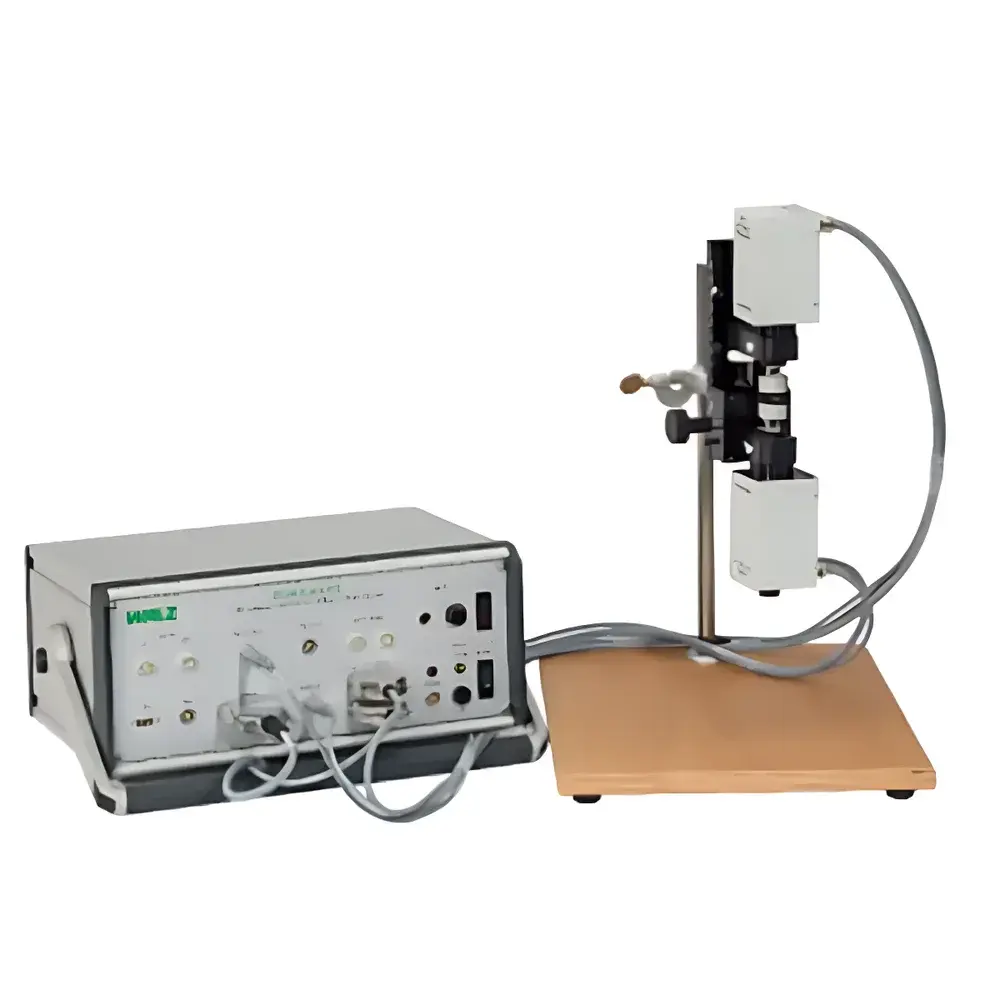
WALZ DUAL-KLAS-NIR Quad-Channel Dynamic LED Array Near-Infrared Spectrophotometer
| Brand | WALZ |
|---|---|
| Origin | Germany |
| Model | DUAL-KLAS-NIR |
| Detection Wavelength Pairs | 780–820 nm, 820–870 nm, 840–965 nm, 870–965 nm |
| Fluorescence Excitation | 460 nm & 540 nm (modulated PAM) |
| Optional Modules | P515/535 (ΔpH & ΔΨ), NADPH/9-AA (NADP⁺ reduction), 3010-DUAL leaf chamber for GFS-3000 integration |
| Measurement Bandwidth | 1–400 kHz |
| Application | In vivo real-time redox kinetics of PSI (P700), plastocyanin (PC), ferredoxin (Fd), and Chl a fluorescence |
Overview
The WALZ DUAL-KLAS-NIR is a research-grade quad-channel dynamic LED array near-infrared spectrophotometer engineered for high-temporal-resolution, non-invasive monitoring of redox dynamics across multiple components of the photosynthetic electron transport chain in intact leaves, isolated thylakoids, chloroplasts, or algal suspensions. Unlike conventional dual-wavelength systems, the DUAL-KLAS-NIR employs four precisely calibrated wavelength pairs in the near-infrared region (780–965 nm) to deconvolve overlapping absorbance changes associated with photooxidation and photoreduction of P700 (PSI reaction center), plastocyanin (PC), and ferredoxin (Fd). This capability enables simultaneous, kinetically resolved quantification of donor-side (PC → P700) and acceptor-side (P700 → Fd) electron transfer events—addressing a long-standing analytical limitation in photosynthesis research. The instrument integrates modulated chlorophyll a fluorescence detection at 460 nm and 540 nm, allowing depth-resolved assessment of energy conversion efficiency in epidermal versus mesophyll layers. Its solid-state LED architecture—featuring 635 nm actinic light, 740 nm far-red light, and saturating single/multi-turnover flashes—ensures stable, low-heat illumination compatible with long-term physiological assays under controlled environmental conditions.
Key Features
- Quad-channel NIR detection using four independent wavelength pairs (780–820 nm, 820–870 nm, 840–965 nm, 870–965 nm) for unambiguous spectral deconvolution of P700⁺, PC⁺, and Fdox signals.
- Dual-wavelength (460 nm & 540 nm) pulse-amplitude modulated (PAM) chlorophyll fluorescence excitation for layered analysis of photosynthetic efficiency across leaf tissue depth.
- On-board microcontroller-driven LED system delivering precise, programmable actinic illumination (635 nm), far-red background (740 nm), and saturating flash protocols without mechanical shutter delay.
- High-bandwidth signal acquisition (1–400 kHz) supporting both steady-state Fo assessment and sub-millisecond resolution of fast fluorescence transients (e.g., OJIP rise kinetics, QA⁻ reoxidation, polyphasic relaxation).
- Optomechanical design fully compatible with the WALZ 3010-DUAL leaf chamber, enabling seamless integration with the GFS-3000 portable photosynthesis system for concurrent measurement of CO₂ assimilation and redox-coupled electron fluxes.
- Firmware-level synchronization of NIR absorbance, fluorescence, and gas exchange data streams ensures temporal alignment within ±10 µs—critical for kinetic modeling of linear vs. cyclic electron flow partitioning.
Sample Compatibility & Compliance
The DUAL-KLAS-NIR supports measurements on intact higher plant leaves (e.g., Arabidopsis thaliana, Zea mays, Oryza sativa), mosses, ferns, macroalgae, and cyanobacterial cultures. It accommodates isolated chloroplasts, thylakoid membranes, and purified photosystem preparations when mounted in quartz cuvettes or custom sample holders. All optical paths comply with ISO 17025 traceability requirements for photometric calibration, and spectral response is validated against NIST-traceable standards. The system meets GLP-compliant data integrity standards through hardware-enforced audit trails, electronic signatures, and immutable raw-data archiving—fully compatible with FDA 21 CFR Part 11 and EU Annex 11 regulatory frameworks when deployed in regulated plant physiology or crop biotechnology studies.
Software & Data Management
Acquisition and analysis are performed via WALZ’s KLAS-NIR Control Software—a modular, scriptable platform built on LabVIEW Real-Time architecture. The interface provides preconfigured measurement protocols (e.g., slow induction curves, rapid light curves, dark relaxation series) as well as full scripting capability using Python-based macro language for custom kinetic experiments (e.g., state transitions, fluctuating light regimes, or multi-step redox perturbations). All raw time-series data—including absorbance differentials (ΔA), fluorescence yield (F), and derived parameters (P700⁺/PC⁺ ratio, Fdox/P700⁺ kinetics)—are stored in HDF5 format with embedded metadata (instrument settings, environmental logs, user annotations). Export options include CSV, MATLAB .mat, and direct import into third-party modeling environments (e.g., COPASI, GNU Octave) for kinetic parameter fitting and ODE-based simulation of electron transport networks.
Applications
- Quantitative dissection of PSI donor- and acceptor-side limitations under abiotic stress (drought, high light, nutrient deficiency) and genetic perturbation (knockout/knockdown lines, CRISPR edits).
- Functional characterization of PSI assembly intermediates and redox-regulated protein–protein interactions (e.g., PC–P700 binding affinity, Fd–FNR docking kinetics).
- Elucidation of alternative electron pathways—including cyclic electron flow (CEF), chlororespiratory electron sinks, and flavodiiron protein (FLV)-mediated O₂-dependent electron drainage.
- Integration with metabolomics and transcriptomics datasets to link redox signaling states (e.g., PC/P700 redox poise) to gene expression patterns and metabolic flux distributions.
- Development and validation of next-generation photosynthetic models incorporating dynamic PSI redox buffering capacity and its impact on ATP/NADPH balancing.
- Applied research in crop improvement, synthetic biology (e.g., artificial electron carriers), and biohybrid energy systems (e.g., biophotovoltaics).
FAQ
What distinguishes DUAL-KLAS-NIR from DUAL-PAM-100?
The DUAL-KLAS-NIR adds two additional NIR wavelength pairs beyond the standard P700/PC detection of DUAL-PAM-100, enabling quantitative resolution of ferredoxin redox state and direct assessment of PSI acceptor-side functionality.
Can DUAL-KLAS-NIR operate independently of GFS-3000?
Yes—the instrument functions as a standalone spectrophotometer; the 3010-DUAL chamber is an optional accessory for integrated gas exchange studies.
Is spectral deconvolution performed in real time or post-acquisition?
Deconvolution algorithms run in real time during acquisition, but raw wavelength-pair traces are preserved for offline reprocessing with updated reference spectra or refined baseline correction.
Does the system support temperature-controlled sample stages?
While the base unit does not include active thermal control, it is fully compatible with third-party Peltier-cooled leaf clips and cuvette holders (e.g., WALZ TL-1000) for regulated temperature experiments.
How is data traceability ensured for publication-quality reporting?
Each dataset includes embedded instrument firmware version, calibration certificate ID, LED drive current logs, and environmental sensor timestamps—enabling full experimental reproducibility per Nature Portfolio and Plant Physiology journal guidelines.





