
Walz DUAL-PAM/F Fiber-Optic Dual-Channel PAM-100 Photosynthesis Analyzer
| Origin | Germany |
|---|---|
| Distribution Model | Authorized Distributor |
| Import Status | Imported |
| Model | DUAL-PAM/F |
| Pricing | Upon Request |
Overview
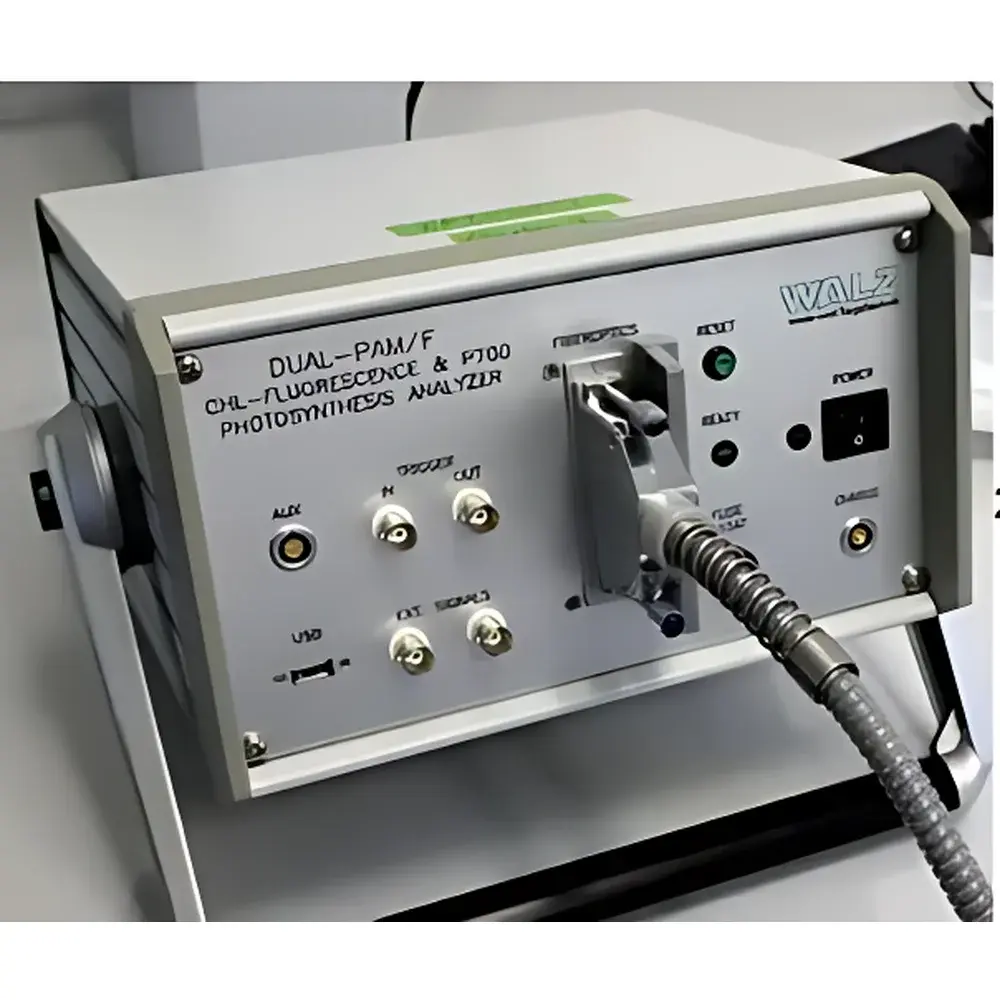
The Walz DUAL-PAM/F is a fiber-optic dual-channel pulse-amplitude modulated (PAM) photosynthesis analyzer engineered for high-fidelity, simultaneous in vivo quantification of Photosystem II (PSII) and Photosystem I (PSI) photochemical activity in intact plant tissues. Building upon the foundational DUAL-PAM-100 platform—commercialized in 2006 following Prof. Ulrich Schreiber’s pioneering work that earned the inaugural ISPR Innovation Award—the DUAL-PAM/F represents a field-deployable evolution of the original benchtop system. Its core innovation lies in the integration of all excitation sources and detection optics into a compact main unit, with optical signal transmission fully mediated by high-transmission multimode fibers. This architecture eliminates external probe heads (e.g., DUAL-DB/DUAL-DR), enabling robust, vibration-tolerant operation under uncontrolled environmental conditions—including variable temperature, humidity, wind, and ambient light—while preserving the nanosecond-level temporal resolution and spectral fidelity required for kinetic analysis of chlorophyll a fluorescence (680–740 nm) and P700+ absorption changes at 830/870 nm. The instrument operates on the principle of saturation pulse analysis combined with actinic illumination protocols, delivering quantitative metrics of linear electron transport rates (ETR), quantum yields, redox state dynamics, and non-photochemical quenching across both photosystems.
Key Features
- Fiber-optic signal delivery: Enables decoupling of measurement head from electronics unit—ideal for canopy-level, understory, or rugged terrain deployment without signal degradation.
- Synchronous dual-system acquisition: Simultaneous real-time recording of PSII chlorophyll fluorescence kinetics and PSI P700+ absorbance changes with sub-millisecond time resolution.
- Configurable excitation sources: Dual-wavelength LED-based P700 measuring light (830 nm & 870 nm); PSII measuring light options at 460 nm (blue) or 620 nm (red); high-intensity actinic LEDs (635 nm red, up to 2000 µmol m−2 s−1; 460 nm blue, up to 700 µmol m−2 s−1).
- Precision flash systems: Adjustable single-turnover (ST) saturating flashes (5–50 µs, up to 200,000 µmol m−2 s−1) and multi-turnover (MT) flashes (1–1000 ms, up to 20,000 µmol m−2 s−1) for controlled photochemical induction.
- Comprehensive parameter suite: Calculates standardized PSII parameters (Fo, Fm, Fv/Fm, Y(II), qP, qL, NPQ, ETR(II)) and PSI parameters (P700, Pm, Y(I), Y(ND), Y(NA), ETR(I)) in accordance with consensus nomenclature (Klughammer & Schreiber, 2008; Kramer et al., 2004).
- Modular hardware design: Compatible with optional accessories including leaf clips, cuvette adapters, underwater probes (via fiber extension), and temperature-controlled sample holders.
Sample Compatibility & Compliance
The DUAL-PAM/F accommodates a broad range of photosynthetic samples without physical modification: intact leaves (dicots, monocots, conifers), mosses, lichens, algae suspensions, cyanobacterial biofilms, and detached thalli. Its non-invasive, contactless optical configuration ensures minimal perturbation during repeated measurements over diurnal cycles or stress time courses. Instrument firmware and data acquisition protocols adhere to internationally recognized standards for photosynthetic research, including ISO 10211 (optical measurement of plant physiological parameters), ASTM E2912 (standard guide for chlorophyll fluorescence instrumentation), and principles aligned with GLP-compliant experimental design. While not certified as medical or clinical equipment, its traceable calibration routines and audit-ready data export support regulatory submissions requiring reproducible biophysical characterization of photosynthetic performance (e.g., OECD TG 202 for aquatic plant toxicity testing).
Software & Data Management
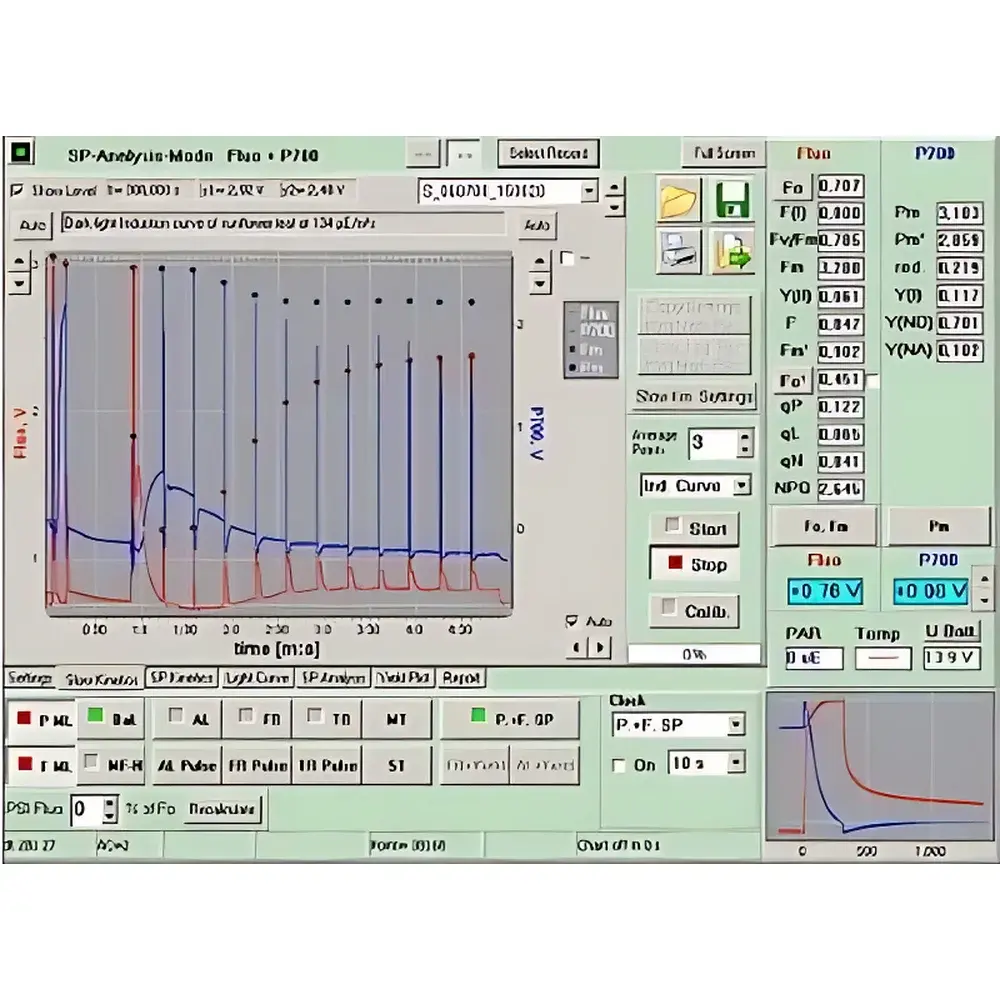
Controlled via Walz’s proprietary WinControl-3 software, the DUAL-PAM/F supports fully programmable measurement protocols—including rapid light curves (RLCs), induction kinetics, dark relaxation series, and multiphase quenching analysis—with real-time visualization and on-the-fly parameter calculation. All raw intensity traces and derived parameters are timestamped and stored in open-format .txt and .csv files compliant with FAIR (Findable, Accessible, Interoperable, Reusable) data principles. Software includes built-in tools for batch processing, spectral correction (for fiber transmission loss), and cross-platform compatibility with MATLAB, Python (via pandas/numpy), and R for advanced statistical modeling. Audit trails record operator ID, protocol version, calibration timestamps, and hardware configuration—supporting compliance with FDA 21 CFR Part 11 requirements when deployed in regulated environments such as crop trait validation labs or phytotoxicity screening facilities.
Applications
The DUAL-PAM/F serves as a primary tool in mechanistic photosynthesis research, ecological physiology, and applied plant science. It enables direct interrogation of intersystem electron partitioning, cyclic vs. linear electron flow around PSI, plastoquinone pool redox status, and photoprotective capacity under abiotic stressors (drought, chilling, high light, nutrient deficiency). Field applications include comparative studies across natural gradients (e.g., forest understory vs. canopy), agronomic evaluation of cultivar resilience, monitoring of invasive species acclimation, and assessment of ecosystem-level photosynthetic efficiency in response to climate variables. Its portability and reliability have made it indispensable in >200 peer-reviewed publications spanning plant physiology, forestry, marine botany, and crop science—particularly where spatial heterogeneity or logistical constraints preclude laboratory-based analysis.
FAQ
Can the DUAL-PAM/F be used underwater?
Yes—when paired with waterproof fiber-optic probes and appropriate sample chambers, it supports submerged measurements of macroalgae, seagrasses, and phytoplankton cultures.
Does it require daily recalibration?
No—factory-calibrated detectors and stable LED output ensure long-term signal consistency; periodic verification using standard reference filters (e.g., NIST-traceable neutral density filters) is recommended every 6 months.
Is remote operation supported?
WinControl-3 permits networked control via Ethernet; optional GPS synchronization allows georeferenced data logging in mobile survey configurations.
What sample preparation is needed?
None beyond standard dark adaptation (typically 20–30 min); measurements are performed on intact, hydrated tissue without clipping, staining, or sectioning.
How is data integrity ensured during extended field deployments?
Internal solid-state storage (32 GB) provides redundant backup; power management supports >8 hours continuous operation on external Li-ion battery packs, with automatic low-power hibernation triggered by voltage thresholds.
Related Products




