
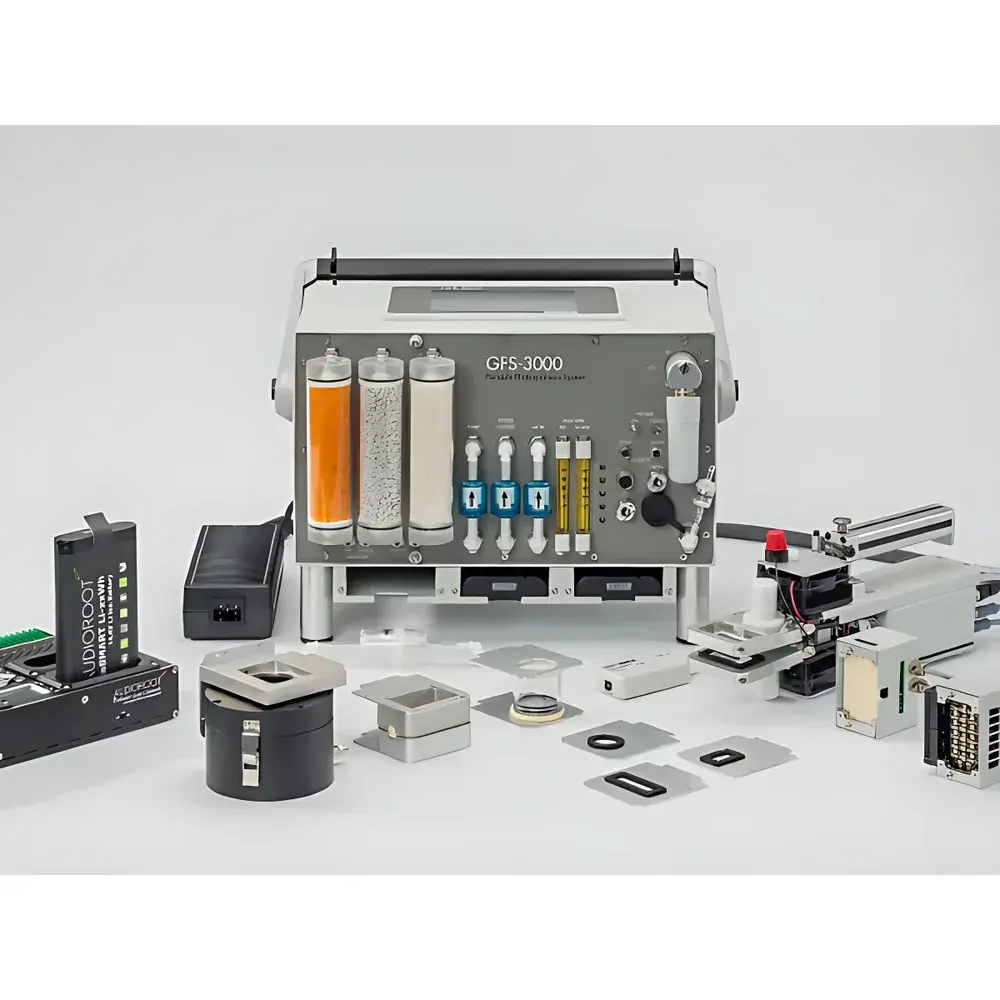
WALZ GFS-3000 Portable Photosynthesis and Chlorophyll Fluorescence Measurement System
| Brand | WALZ |
|---|---|
| Origin | Germany |
| Model | GFS-3000 |
| CO₂ Analyzer Range | 0–5000 ppm (resolution: 0.01 ppm) |
| H₂O Analyzer Range | 0–75,000 ppm (resolution: 0.01 ppm) |
| CO₂ Noise (absolute mode) | < 0.2 µmol mol⁻¹ |
| H₂O Noise (absolute mode) | < 30 µmol mol⁻¹ |
| Pressure Range | 60–110 kPa (accuracy: ±0.1%) |
| Flow Rate | 0–1500 µmol s⁻¹ (accuracy: ±1%) |
| PAR Sensors | 3-channel (ambient, leaf adaxial, leaf abaxial) |
| range | 0–2500 µmol m⁻² s⁻¹ |
| LED Light Source | Red (650 nm, 92%) + Blue (470 nm, 8%) |
| Leaf Area Options | 1–12.5 cm² (standard: 8 cm²) |
| Leaf Chamber Volume | 40 mL |
| Operating Temperature | −5 °C to +45 °C |
| Leaf Temperature Measurement | −10 °C to +50 °C (±0.2 °C) |
| Chamber Temperature Control | 3 modes (ambient-following, fixed chamber temp, fixed leaf temp) |
| range | −10 °C to +50 °C |
| Power Supply | 14.4 V / 6.7 Ah rechargeable eSMART battery (96 Wh) |
| Max Power Consumption | 5 W |
Overview
The WALZ GFS-3000 Portable Photosynthesis and Chlorophyll Fluorescence Measurement System is an integrated, field-deployable instrument engineered for simultaneous, real-time quantification of gas exchange and chlorophyll fluorescence parameters in intact, living plant tissues. It operates on the principle of infrared gas analysis (IRGA) for high-precision, dual-channel CO₂ and H₂O concentration measurement, combined with modulated chlorophyll fluorescence detection via optional accessories (e.g., 3057-FL, MINI-PAM, DUAL-PAM-100). Its modular architecture enables rigorous physiological phenotyping under controlled or ambient conditions—supporting both steady-state and dynamic response curve generation (A/Ci, A/PAR, induction kinetics). Designed for reproducible ecophysiological research, the GFS-3000 conforms to core metrological requirements outlined in ISO 17025 for analytical instrumentation and supports traceable calibration protocols aligned with ASTM E2913 (Standard Practice for Calibration of Photosynthetic Gas Exchange Systems).
Key Features
- True dual-probe IRGA system: Two independent, temperature-stabilized CO₂ and H₂O analyzers deliver sub-ppm resolution and low noise (<0.2 ppm CO₂, <30 ppm H₂O), ensuring high signal-to-noise ratio across environmental gradients.
- Tripartite PAR sensing architecture: Integrated ambient, adaxial, and abaxial quantum sensors enable bidirectional light capture assessment—critical for modeling canopy-level photosynthesis and evaluating shade-adapted species.
- Four-point thermal monitoring: Simultaneous measurement of leaf temperature (Tleaf, thermocouple), chamber temperature (Tcuv, Pt-100), ambient temperature (Tamb, Pt-100), and upper chamber temperature (Ttop, Pt-100) provides full thermal context for stomatal conductance and biochemical modeling.
- Programmable red-blue LED light source: 24 red (650 nm) and 2 blue (470 nm) LEDs deliver spectrally defined irradiance (0–2000 µmol m⁻² s⁻¹) with ±20% uniformity across standard 8 cm² leaf area—optimized for PSII excitation while minimizing non-photochemical artifacts.
- Modular chamber system: Interchangeable chambers—including standard flat-leaf, cylindrical (for bryophytes/soil), needle-leaf, and whole-plant Arabidopsis chambers—share identical optical interfaces, enabling seamless integration with imaging-PAM systems (MINI-/MAXI-IMAGING-PAM).
- Embedded Windows-based control interface: 10 × 13 cm color touchscreen with 7-level backlighting, sunlight-readable display, and glove-compatible operation—designed for robust field use without external computing hardware.
Sample Compatibility & Compliance
The GFS-3000 accommodates diverse biological samples—from single leaves (1–12.5 cm² surface area) to intact potted plants (e.g., Arabidopsis in 55–70 mm diameter pots) and non-vascular specimens (lichens, mosses) via specialized chambers. Its gas-tight, PTFE-sealed design meets ISO 17025 validation criteria for measurement integrity under variable humidity (0–100% RH, non-condensing) and pressure (60–110 kPa). All firmware and data logging routines comply with ALCOA+ principles (Attributable, Legible, Contemporaneous, Original, Accurate, Complete, Consistent, Enduring, Available) and support audit trails required for GLP-compliant studies. While not FDA 21 CFR Part 11 certified out-of-the-box, raw data export (CSV, XML) and metadata tagging facilitate integration into validated LIMS environments.
Software & Data Management
Data acquisition and experimental control are managed through WALZ’s proprietary WinControl 3 software, which supports scripting of complex multi-step protocols—including automated light-response curves, CO₂ response series, dark-adapted fluorescence induction, and synchronized multi-instrument triggers (e.g., GFS-3000 ↔ DUAL-PAM-100 ↔ KLAS-100). All measurements are time-stamped with GPS-synchronized UTC timestamps (optional module). Raw sensor outputs (CO₂abs, H₂Osam, flow, Tleaf, PARtop, etc.) are stored with full metadata (calibration history, chamber ID, operator tag). Export formats include CSV (for MATLAB/Python analysis), Excel-compatible .xls, and native .wcd files compatible with WALZ’s post-processing suite (e.g., FluorCam, GasExCalc). Software updates follow IEC 62304 Class B medical device software lifecycle standards—ensuring deterministic behavior in long-term field deployments.
Applications
The GFS-3000 serves as a foundational platform for mechanistic plant physiology research across academic, agricultural, and ecological domains. Its primary applications include: (1) drought and heat stress phenotyping—quantifying stomatal limitation vs. mesophyll conductance using A/Ci curves and Jmax/Vcmax modeling; (2) photoprotective capacity assessment—via concurrent NPQ, Y(II), Y(NO), and Zea dynamics when coupled with P515/535 modules; (3) C₃/C₄ comparative physiology—leveraging precise intercellular CO₂ (Ci) estimation and bundle sheath leakiness indices; (4) crop breeding programs—high-throughput screening of water-use efficiency (WUE = A/E) and intrinsic WUE (iWUE = A/gs) under field-realistic conditions; and (5) ecosystem-scale scaling—validating eddy-covariance models with ground-truth leaf-level gas exchange data. Published studies utilizing this platform appear in Plant Physiology, New Phytologist, and Journal of Experimental Botany, particularly in work on stomatal memory, cyclic electron flow regulation, and xerophyte adaptation.
FAQ
Can the GFS-3000 operate independently without external computers?
Yes—the embedded Windows OS and touchscreen interface allow fully autonomous operation, including protocol execution, real-time graphing, and onboard data storage (16 GB internal SSD). No laptop or tablet is required for basic measurements.
What fluorescence accessories are compatible with the GFS-3000?
It supports four primary configurations: (1) 3057-FL (artificial-light-only fluorescence), (2) 3050-F (ambient + artificial light), (3) MINI-PAM (ultra-portable, standalone-capable), and (4) DUAL-PAM-100 (full PSI/PSII dual-oxidation state analysis). All synchronize via TTL trigger signals and shared timebase.
Is the system suitable for low-light or high-humidity tropical environments?
Yes—its operating range (−5 °C to +45 °C) and active humidity control (0–100% RH, non-condensing) ensure stable performance in rainforest understories or greenhouse trials. The dual-H₂O analyzers maintain accuracy even at saturation levels where conventional single-probe systems drift.
How is calibration maintained during extended field campaigns?
Zero calibration uses N₂ scrubbed of CO₂/H₂O; span calibration employs certified gas mixtures (e.g., 350/500/1000 ppm CO₂ in synthetic air). WALZ recommends daily zero checks and weekly span verification—procedures documented in the ISO/IEC 17025-aligned calibration manual.
Does the system support regulatory compliance for contract research?
While not pre-certified for FDA or EPA submissions, its data structure, audit trail capability, and adherence to ISO 17025 metrological practices make it suitable for GLP-compliant studies when operated under a validated SOP framework. Full traceability of raw sensor values is retained in all exported datasets.





