
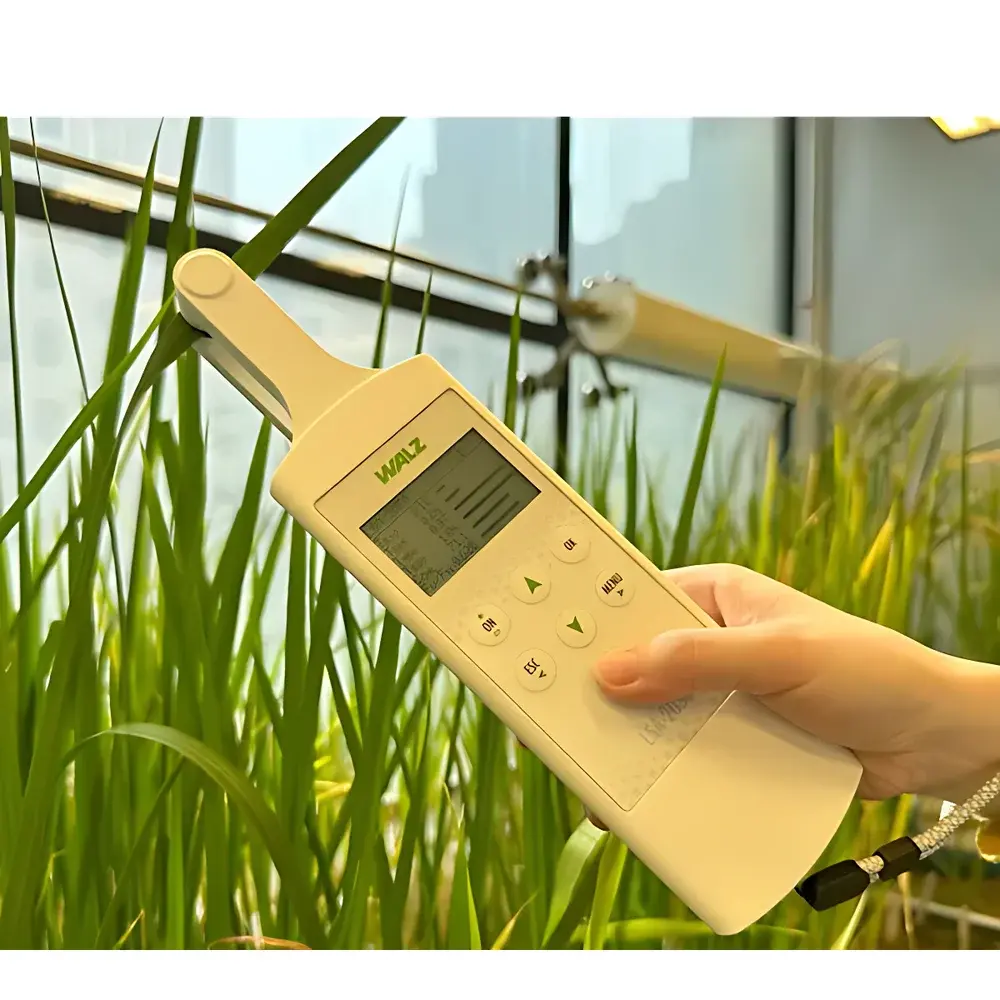
WALZ LSA-2050 Multi-Parameter Polyphenol & Chlorophyll Fluorescence Meter
| Brand | WALZ |
|---|---|
| Origin | Germany |
| Model | LSA-2050 |
| Measurement Principles | Dual-wavelength UV/Vis-induced fluorescence, pulse-amplitude modulated (PAM) chlorophyll fluorescence, epidermal transmittance-based pigment quantification |
| Key Parameters | Fv/Fm, Fo, Fm, Cchl (nmol/cm² & µg/cm²), Q310 (UV-B), Q365 (UV-A), Q450 (blue), Q530 (green), NBI, AFLAV, AANTH, GPS coordinates (lat/lon), altitude, solar azimuth & elevation angles, leaf azimuth & inclination, incident light angle (cosine-corrected) |
Overview
The WALZ LSA-2050 Multi-Parameter Polyphenol & Chlorophyll Fluorescence Meter is a field-deployable, handheld optical instrument engineered for non-invasive, real-time assessment of plant physiological status across multiple biochemical and biophysical dimensions. It integrates three complementary optical methodologies: (1) pulse-amplitude modulated (PAM) chlorophyll fluorescence imaging to quantify photosystem II (PSII) photochemical efficiency (Fv/Fm), (2) epidermal transmittance spectroscopy at defined UV and visible wavelengths (310 nm, 365 nm, 450 nm, 530 nm, and 650 nm reference) to infer concentrations of UV-absorbing phenolics (flavonoids, anthocyanins) and photoprotective carotenoids, and (3) dual-channel reflectance-based nitrogen balance index (NBI) calculation as the ratio of chlorophyll content to UV-absorbing phenolic compounds. The device operates on the principle that epidermal flavonoid and anthocyanin accumulation alters leaf spectral transmittance—particularly in the UV-B and green regions—while chlorophyll content governs red-light absorption and fluorescence yield. This enables simultaneous, co-located quantification of primary photosynthetic function and secondary metabolic investment under abiotic or biotic stress.
Key Features
- Integrated PAM fluorometry with dark-adapted Fv/Fm measurement capability for PSII integrity assessment under drought, heat, cold, or nutrient stress
- Multi-spectral epidermal transmittance profiling at 310 nm (UV-B), 365 nm (UV-A), 450 nm (blue), and 530 nm (green), referenced against 650 nm (red) for robust pigment-specific signal isolation
- Nitrogen Balance Index (NBI) computation in real time, supporting precision nitrogen management in agronomic and horticultural trials
- Onboard high-sensitivity GPS receiver (WAAS-enabled) delivering georeferenced measurements with ≤3 m horizontal accuracy
- Inertial measurement unit (IMU) comprising 3-axis accelerometer, gyroscope, and magnetometer for precise leaf inclination angle (±0.5°) and azimuth determination
- Automated solar geometry calculation—including solar zenith, azimuth, and leaf-surface incident angle (with cosine correction)—for irradiance-normalized physiological interpretation
- Modular optical head with interchangeable apertures (6 mm diameter option for small leaves) ensuring consistent measurement area across species and ontogenetic stages
- Factory-calibrated against HPLC-quantified chlorophyll a + b across four reference species (wheat, sunflower, maize, tobacco) grown under five controlled cultivation regimes
Sample Compatibility & Compliance
The LSA-2050 is validated for use on intact, living leaves of herbaceous and woody angiosperms and gymnosperms, including but not limited to crop species (e.g., Zea mays, Triticum aestivum, Vitis vinifera), model plants (Arabidopsis thaliana), and fruit pericarps (e.g., apple, grape berry skin). Its non-destructive design complies with ISO 17025-accredited laboratory practice requirements for in vivo plant phenotyping. While not a regulated medical or diagnostic device, its measurement protocols align with widely adopted physiological standards: Fv/Fm methodology follows Schreiber et al. (1986); UV shielding quantification adheres to Bilger et al. (1997); flavonoid and anthocyanin estimation implements Cerovic et al. (2012, 2015); and NBI derivation conforms to established agronomic indices used in EU-funded projects (e.g., EU FP7 “PHENOME” and H2020 “EPPN2020”). Data acquisition meets GLP traceability requirements via embedded timestamping, sensor metadata logging, and optional encrypted SD card storage.
Software & Data Management
Data are recorded internally and exported via USB-C to WALZ’s proprietary Dualex Studio software (Windows-compatible), which supports batch processing, spatial mapping (via integrated GPS), and statistical comparison across treatment groups. All raw signals—including analog fluorescence waveforms, transmittance ratios, IMU orientation quaternions, and solar geometry vectors—are stored in open-format CSV files compliant with FAIR data principles. The software includes built-in calibration verification tools, outlier detection based on leaf thickness and surface heterogeneity metrics, and export options compatible with R (phytomorph, plantecophys), Python (pandas, xarray), and MATLAB for advanced modeling. Audit trails—including operator ID, firmware version, calibration date, and environmental context tags—are automatically appended per measurement, satisfying documentation requirements under ISO/IEC 17025 and FDA 21 CFR Part 11 when deployed in regulated research environments.
Applications
- Field-based screening of UV radiation tolerance in breeding programs targeting enhanced photoprotection
- Longitudinal monitoring of nitrogen use efficiency (NUE) in cereals and legumes under variable fertilization regimes
- Non-destructive assessment of fruit ripening dynamics via anthocyanin accumulation kinetics in berry skins
- Ecophysiological studies of alpine, desert, or urban tree species exposed to elevated UV-B flux
- Validation of remote sensing indices (e.g., PRI, ANTH) using ground-truthed, spectrally resolved fluorescence and transmittance data
- Controlled-environment stress phenotyping—drought, salinity, heavy metal exposure—with concurrent PSII efficiency and phenylpropanoid pathway activation metrics
- Education and training in plant ecophysiology labs where multi-parameter integration reinforces mechanistic understanding of carbon–nutrient–light interactions
FAQ
Does the LSA-2050 require dark adaptation prior to Fv/Fm measurement?
Yes. Accurate Fv/Fm requires ≥20 minutes of dark adaptation to fully oxidize the plastoquinone pool. An optional aluminum foil dark-adaptation bag (included in accessory kit) ensures complete light exclusion during field deployment.
How is NBI interpreted across species?
NBI is species- and cultivar-specific due to differential allocation of nitrogen to chlorophyll versus phenolic biosynthesis. Users must establish baseline NBI ranges under optimal nutrition for each genotype before deploying it as a decision-support tool for nitrogen top-dressing.
Can the LSA-2050 measure detached leaves or cut stems?
No. The instrument is designed exclusively for in situ, attached-leaf measurements. Detached tissue exhibits rapid changes in turgor, stomatal conductance, and metabolic activity that invalidate physiological interpretation of fluorescence and transmittance signals.
What is the spectral resolution of the UV/Vis channels?
The LSA-2050 uses narrow-band LEDs with full-width half-maximum (FWHM) bandwidths of ±5 nm for Q310, Q365, Q450, and Q530, and a 650 nm reference LED with ±10 nm FWHM, optimized for maximal separation of flavonoid, anthocyanin, and carotenoid absorption signatures.
Is firmware upgradable in the field?
Yes. Firmware updates are delivered via USB-C connection using Dualex Studio software and include algorithm refinements, new calibration models, and expanded GPS satellite constellation support (GPS, GLONASS, Galileo).
Related Products




