
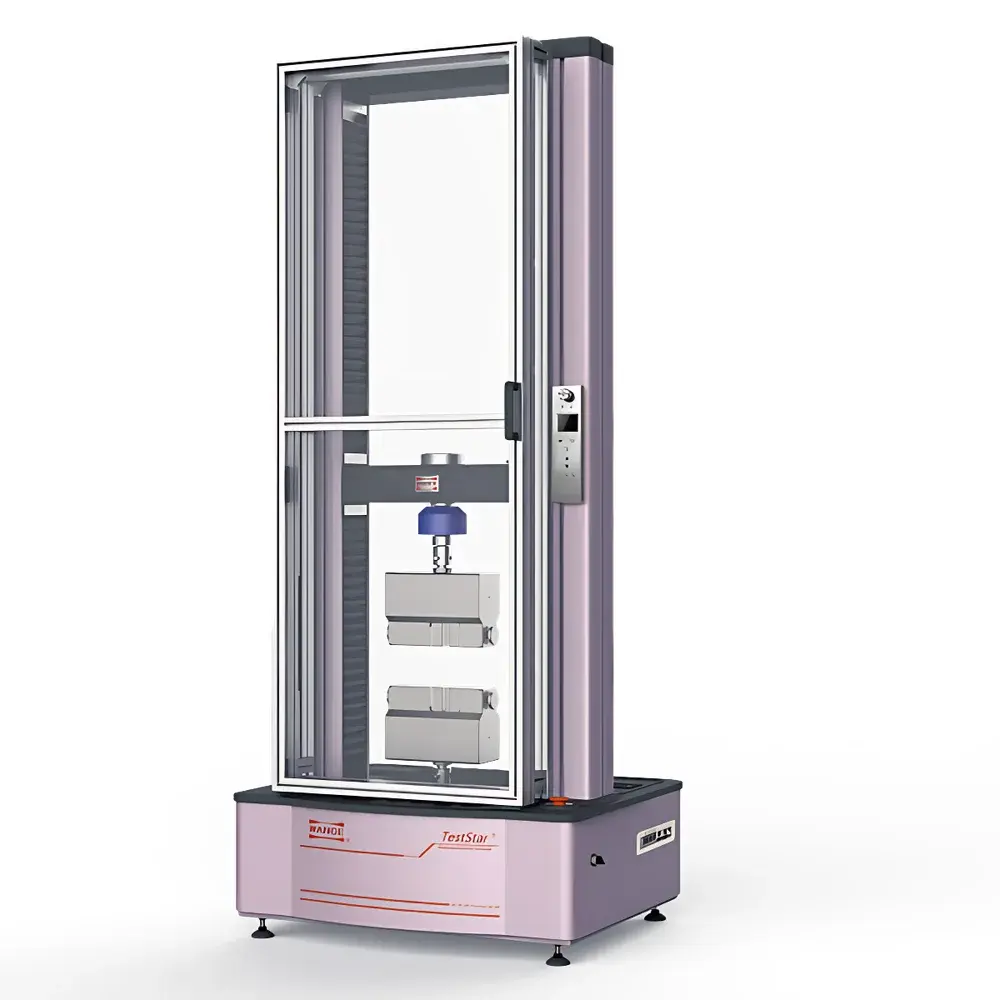
WANCE TSE-C Series Microcomputer-Controlled Electronic Universal Testing Machine (5 kN – 50 kN)
| Brand | WANCE |
|---|---|
| Origin | Guangdong, China |
| Manufacturer Type | Authorized Distributor |
| Country of Origin | China |
| Model | TSE-C |
| Instrument Type | Electronic Universal Testing Machine |
| Force Capacity Range | 5 kN, 10 kN, 25 kN, 50 kN |
| Accuracy Class | 0.5 |
| Force Measurement Range | 0.4–100% FS |
| Force Indication Error | ±0.5% |
| Force Resolution | 1/500,000 FS |
| Crosshead Speed Range | 0.005–500 mm/min |
| Speed Accuracy | ±0.50% |
| Displacement Resolution | 0.058 µm |
| Strain Measurement Range | 0.2–100% FS |
| Strain Indication Error | ±0.5% of set value |
| Strain Resolution | 1/500,000 FS |
| Force Control Rate Range | 0.005–5% FS/s |
| Force Control Accuracy | ±1% of set value |
| Effective Test Width | 420 mm |
| Effective Test Height | 1050 mm (extendable per request) |
| Dimensions (W×D×H) | 800 × 680 × 1840 mm |
| Power Supply | AC 380 V ±10%, 50 Hz, 1.3 kW |
| Weight | ~400 kg |
Overview
The WANCE TSE-C Series Microcomputer-Controlled Electronic Universal Testing Machine is an electromechanical force-testing platform engineered for precision mechanical property characterization under tension, compression, bending, shear, peel, and tear loading conditions. Based on closed-loop servo-controlled actuation via high-rigidity dual-column frames and preloaded precision ball screws, the system delivers exceptional linearity, minimal deflection (<0.02 mm under full load), and long-term repeatability across its full force range (5 kN to 50 kN). Its modular architecture supports interchangeable load cells—from 50 N up to 50 kN—enabling traceable measurement of specimens ranging from sub-millimeter biomedical sutures to structural composite coupons. The machine complies with core international metrological and functional standards including ISO 7500-1 (static calibration), ASTM E4 (force verification), and ISO 5893 (tensile testing machines), while also meeting the requirements of GB/T 16491, GB/T 2611, JJG 139, and JJG 475 for domestic regulatory acceptance in China.
Key Features
- High-stiffness dual-column frame with hardened steel uprights and reinforced base plate, optimized for minimal frame compliance during high-force testing.
- Precision ground and preloaded ball screw drive system coupled with a brushless AC servo motor, ensuring smooth crosshead motion and consistent speed control from 0.005 mm/min to 500 mm/min.
- Class 0.5 force accuracy per ISO 7500-1, with force resolution down to 1 part in 500,000 of full scale and displacement resolution of 0.058 µm.
- Integrated digital signal conditioning electronics with real-time 10 kHz sampling, enabling robust noise suppression and stable closed-loop control under dynamic or creep-loading conditions.
- Modular load cell interface supporting automatic recognition and calibration coefficient upload; compatible with standard S-type, planar, and low-profile transducers.
- Expandable test space: standard vertical clearance of 1050 mm (custom extensions available); 420 mm effective test width accommodates wide-sheet or multi-specimen fixtures.
Sample Compatibility & Compliance
The TSE-C platform supports a broad spectrum of material forms—including monofilaments, thin films, elastomeric sheets, orthopedic implants, woven textiles, paperboard stacks, thermoplastic welds, and miniature metallic components—through a comprehensive portfolio of standardized and application-specific grips and fixtures. All mechanical attachments are designed to minimize stress concentration and slippage, with pneumatic, wedge, hydraulic, and manual options available. The system meets essential regulatory prerequisites for quality-controlled environments: it supports audit-ready data logging compliant with GLP and GMP principles; raw force-displacement traces are timestamped and digitally signed within TestPilot software. While not inherently 21 CFR Part 11 compliant out-of-the-box, the software architecture allows integration with third-party electronic signature and audit-trail modules for regulated medical device or pharmaceutical validation workflows.
Software & Data Management
TestPilot v4.x is the native control and analysis suite for the TSE-C series, built on a deterministic real-time kernel with dual-mode operation (manual jog + automated test sequence). It provides intuitive graphical configuration of test methods—including ramp-hold, cyclic fatigue, stress relaxation, and multi-step protocols—with drag-and-drop parameter assignment. All test data—including raw sensor outputs, calculated engineering stress/strain, modulus, yield point, elongation at break, and secant modulus—are exported in CSV, XML, or PDF report formats. Raw binary files (.tdf) preserve full 10 kHz acquisition fidelity for post-hoc reanalysis. Calibration records, operator ID, environmental metadata (optional via external sensors), and instrument configuration snapshots are embedded in each dataset, satisfying traceability requirements per ISO/IEC 17025 Clause 7.7.
Applications
- Medical device R&D: tensile strength of absorbable suture materials (ASTM D2256), burst pressure of balloon catheters (ISO 10555-4), and compression stiffness of spinal cage implants (ASTM F2624).
- Polymers & packaging: puncture resistance of food-grade films (ASTM D5748), peel adhesion of laminated pouches (ASTM D903), and flexural modulus of injection-molded housings (ISO 178).
- Textiles & composites: breaking strength of aramid fibers (ISO 5079), interlaminar shear strength of CFRP panels (ASTM D2344), and seam slippage in technical fabrics (ISO 13936-2).
- Electronics & micro-components: bond pull strength of wire-bonded IC leads (MIL-STD-883 Method 2011), flexural fatigue of flexible printed circuits (IPC-TM-650 2.6.22), and compression resilience of conductive elastomer gaskets.
- Academic & standards laboratories: method development for novel biomaterials, round-robin inter-laboratory comparisons, and certification testing per national metrology institute protocols.
FAQ
What load cell options are supported by the TSE-C series?
The system accepts industry-standard analog load cells with ±10 V output and TEDS compatibility (IEEE 1451.4). Available factory-calibrated ranges include 50 N, 100 N, 500 N, 1 kN, 5 kN, 10 kN, 25 kN, and 50 kN.
Can the TSE-C be integrated into an existing LIMS or MES environment?
Yes—via OPC UA server add-on or custom REST API middleware, enabling bidirectional data exchange with laboratory information management systems and manufacturing execution platforms.
Is thermal chamber compatibility available?
Standard environmental chambers (−70 °C to +300 °C) with through-port load train interfaces can be mechanically and electrically integrated upon request; chamber mounting brackets and cable management kits are supplied.
Does the system support high-speed dynamic testing?
While optimized for quasi-static and slow-cycle applications (≤5 Hz), optional high-bandwidth amplifiers and real-time FPGA modules enable controlled sinusoidal or triangular waveforms up to 50 Hz with phase-locked feedback.
How is calibration traceability maintained?
Each load cell includes a NIST-traceable calibration certificate; system-level verification is performed using certified deadweight standards per ISO 7500-1, with documentation archived in TestPilot’s secure calibration log.



