
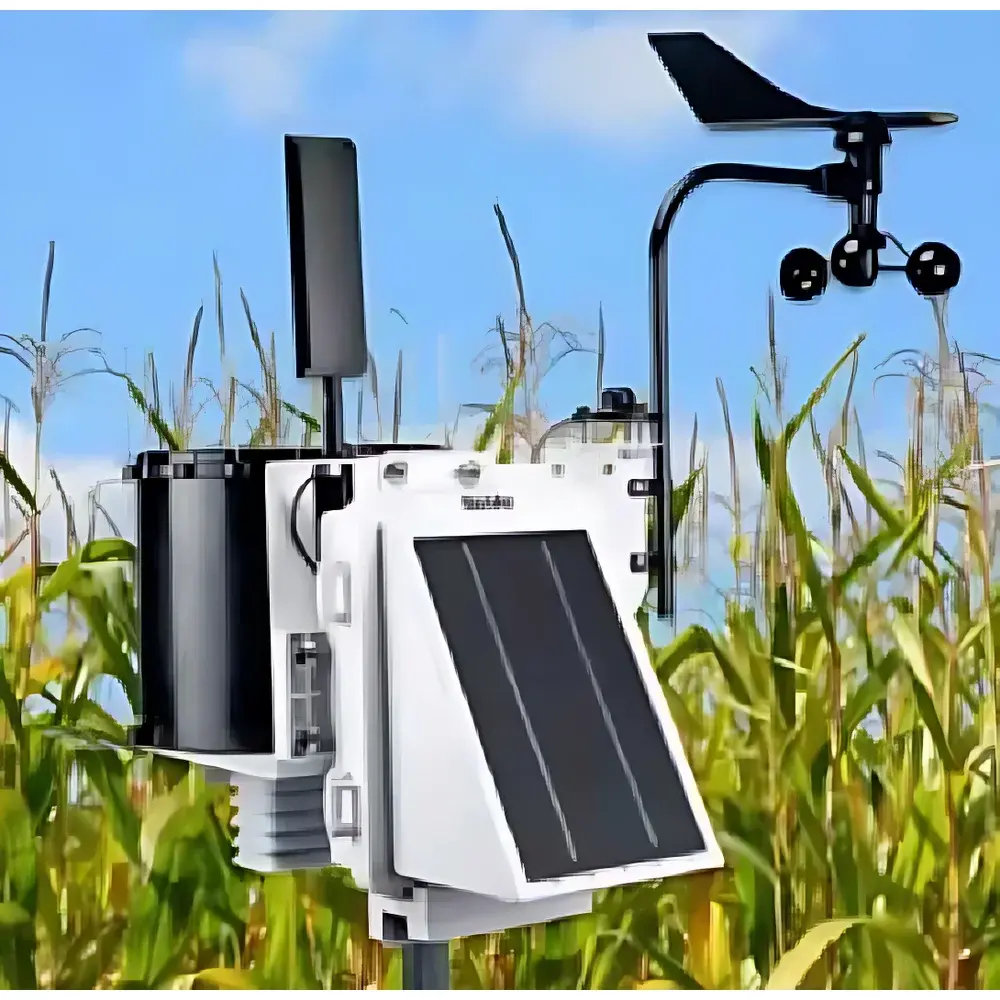
WatchDog 3000 Series Wireless Weather Station
| Brand | Active Spectrum |
|---|---|
| Origin | USA |
| Model | WatchDog 3000 |
| Communication | Cellular + Bluetooth |
| Power | Integrated Solar Charging System |
| Enclosure Rating | NEMA-4 / IP66 |
| Data Logging | Built-in Non-Volatile Memory |
| External Sensor Ports | Up to 2 |
| Compliance | FCC Part 15, IC RSS-210, RoHS |
Overview
The WatchDog 3000 Series Wireless Weather Station is a field-deployable environmental monitoring platform engineered for long-term, unattended operation in agricultural, horticultural, and ecological research settings. Utilizing a dual-mode communication architecture—integrated cellular modem (LTE-M/NB-IoT compatible) and Bluetooth 5.0—the system enables both remote cloud synchronization via SpecConnect™ and local configuration and diagnostics via mobile device. Designed around a modular sensor architecture and powered by an integrated solar-charging system with deep-cycle lithium battery backup, the WatchDog 3000 operates autonomously across diverse climatic zones without grid dependency. Its measurement principle relies on calibrated analog and digital transducers compliant with WMO-recommended practices for in-situ atmospheric parameter acquisition, including thermistor-based air temperature, capacitive relative humidity, tipping-bucket precipitation, ultrasonic or cup-and-vane wind sensing, and silicon photodiode-based pyranometry.
Key Features
- Dual-band wireless connectivity: Cellular (global LTE-M/NB-IoT support) for persistent cloud telemetry and Bluetooth 5.0 for on-site commissioning, firmware updates, and real-time status verification.
- Integrated solar power management: Monocrystalline PV panel with MPPT charge controller and 12 V/7 Ah rechargeable lithium iron phosphate (LiFePO₄) battery ensures >12 months of continuous operation under typical insolation conditions (≥3 kWh/m²/day).
- Ruggedized enclosure: NEMA-4/IP66-rated polycarbonate housing with UV-stabilized gaskets and stainless-steel mounting hardware guarantees operational integrity in high-humidity, dust-laden, and freeze-thaw environments.
- Modular sensor architecture: Standardized 4–20 mA / 0–5 V analog and SDI-12 digital interfaces support up to two external sensors (e.g., soil moisture, leaf wetness, CO₂, or PAR), enabling application-specific expansion without hardware modification.
- Embedded data logger: 16 MB non-volatile flash memory retains >1 year of 15-minute interval measurements (configurable from 1 minute to 24 hours) with timestamped records and cyclic overwrite protection.
- Firmware-over-the-air (FOTA) capability: Secure, signed firmware updates delivered via SpecConnect™ cloud platform ensure long-term maintainability and regulatory alignment.
Sample Compatibility & Compliance
The WatchDog 3000 Series is validated for outdoor deployment in USDA Plant Hardiness Zones 3–11 and complies with international electromagnetic compatibility and safety standards including FCC Part 15 Subpart B (Class B), Industry Canada RSS-210 Issue 5, and EU Directive 2014/53/EU (RED). All internal sensors meet WMO Guide to Instruments and Methods of Observation (CIMO Guide, 2022 edition) accuracy tolerances for Class II meteorological stations. The system supports audit-ready data export in CSV and NetCDF formats, with optional metadata tagging for ISO 17025-compliant calibration traceability when paired with NIST-traceable field reference sensors.
Software & Data Management
Data is transmitted to the SpecConnect™ cloud platform—a secure, TLS 1.3-encrypted SaaS environment hosted on AWS GovCloud infrastructure. Users access time-series visualizations, configurable alert thresholds (email/SMS), automated report generation (PDF/Excel), and API-driven integration with third-party platforms including FarmOS, Climate FieldView™, and AgriWebb. The system implements role-based access control (RBAC), full audit logging per ISO/IEC 27001 Annex A.9.4.2, and optional 21 CFR Part 11 compliance packages—including electronic signatures, audit trails, and data integrity validation—for regulated agricultural trials and GLP-aligned phenotyping studies.
Applications
- Agricultural irrigation scheduling via real-time ET₀ and crop-specific Kc modeling using ASCE-Penman-Monteith inputs.
- Frost risk forecasting and automated alarm triggering for orchard and vineyard protection systems.
- Pest and disease modeling (e.g., Botrytis, fire blight) using accumulated degree-hour and leaf wetness duration metrics.
- Soil erosion assessment through rainfall intensity-duration-frequency (IDF) analysis and runoff potential indexing.
- Long-term climate trend monitoring in protected natural areas, aligning with NOAA’s CoCoRaHS and USCRN protocols.
- Validation of mesoscale weather model outputs (e.g., HRRR, NAM) at sub-kilometer resolution for precision agriculture decision support.
FAQ
What cellular networks does the WatchDog 3000 support?
The device ships with globally certified LTE-M and NB-IoT modems; carrier configuration is performed during initial activation via SpecConnect™ portal and supports AT&T, Verizon, T-Mobile (USA), Vodafone, Deutsche Telekom, and Telstra (Oceania) out-of-the-box.
Can the system operate without cellular coverage?
Yes—Bluetooth remains fully functional for local data retrieval and configuration; recorded data persists in non-volatile memory until connectivity resumes, with automatic backlog transmission upon reconnection.
Is calibration documentation provided with each unit?
Each factory-calibrated sensor module includes a certificate of conformance referencing NIST-traceable standards; optional ISO/IEC 17025-accredited calibration certificates are available upon request.
How is data security enforced during transmission and storage?
All cellular and Bluetooth communications use AES-256 encryption; cloud storage employs server-side encryption (SSE-S3) and strict IAM policies; no raw credentials are stored on-device.
What is the expected service life of the solar charging system?
The monocrystalline panel is rated for 25-year linear power output warranty; the LiFePO₄ battery is specified for 2,000+ cycles at 80% depth-of-discharge, translating to ≥7 years of field service under typical agronomic duty cycles.







