
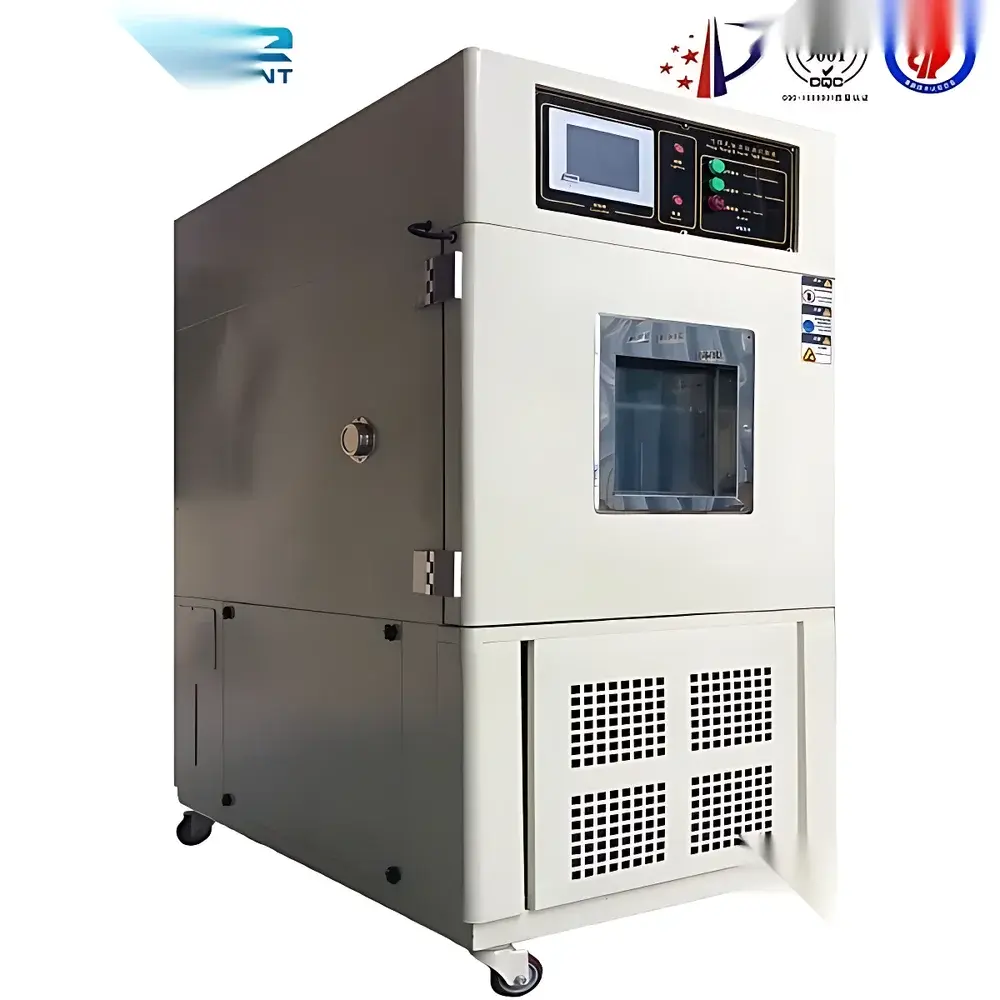
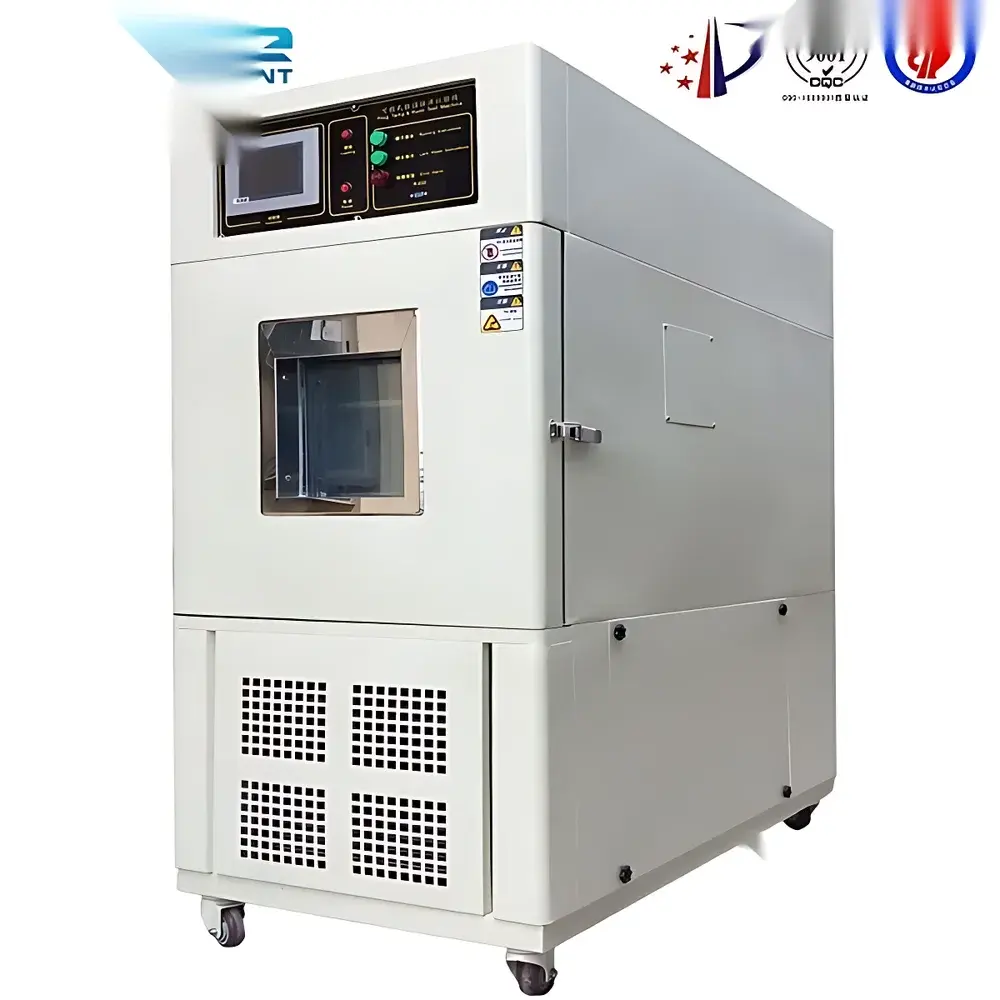
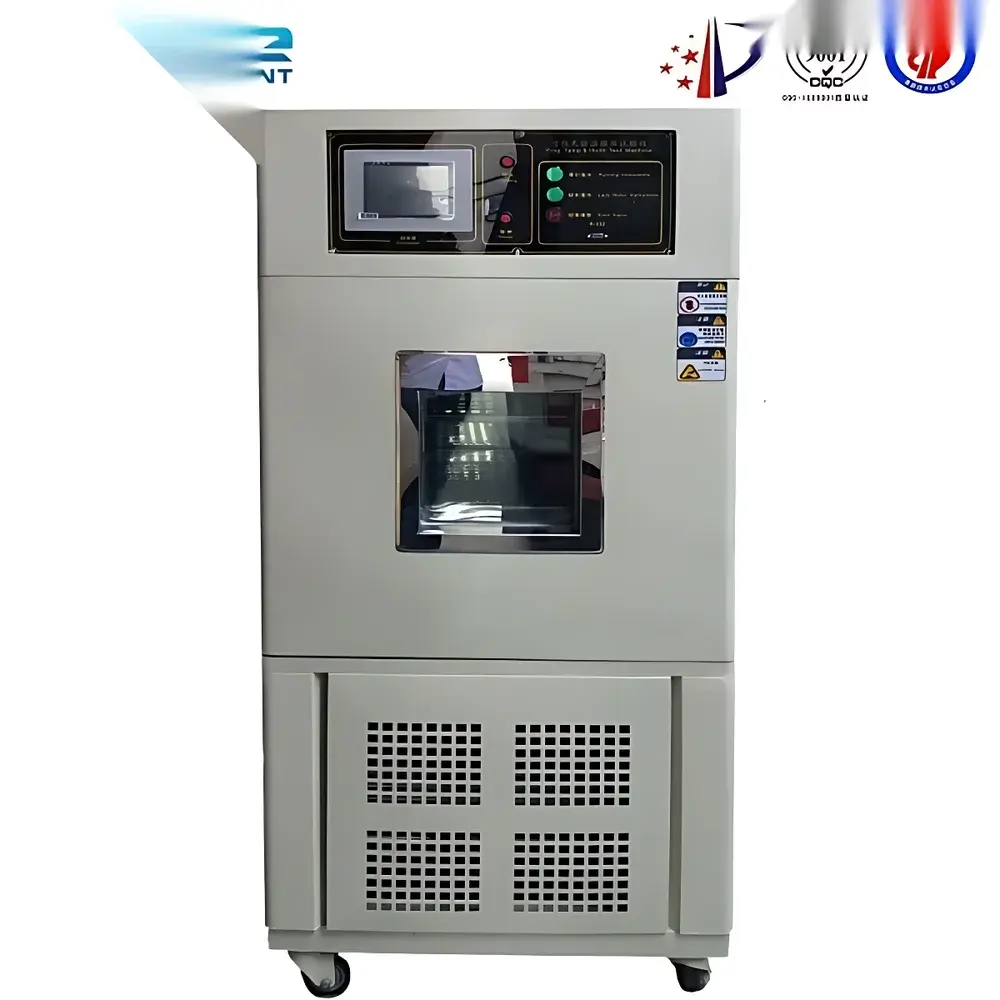
Water-Cooled Temperature and Humidity Controlled Environmental Test Chamber
| Brand | OEM / Custom-Built |
|---|---|
| Origin | Imported |
| Manufacturer Type | Authorized Distributor |
| Temperature Range | –40 °C to +150 °C (optional down to –120 °C) |
| Humidity Range | 30–98% RH (optional 5–98% RH) |
| Temperature Resolution | 0.01 °C |
| Humidity Resolution | 0.1% RH |
| Temperature Uniformity | ±2 °C |
| Temperature Fluctuation | ±0.5 °C |
| Humidity Deviation | ±2.5% RH |
| Cooling Rate | 0.7–1.0 °C/min |
| Heating Rate | 2.0–3.0 °C/min |
| Control System | TEMI880 Color LCD Touchscreen Controller |
| Power Supply | 380 V ±5%, 50 Hz, 3P+N+G |
| Cooling Water Requirements | 10–28 °C, 0.1–0.3 MPa |
| Internal Chamber Material | SUS304 Stainless Steel |
| External Casing | SUS304 Stainless Steel or Powder-Coated A3 Steel |
Overview
The Water-Cooled Temperature and Humidity Controlled Environmental Test Chamber is an engineered precision system designed for rigorous environmental simulation in accordance with international standards for reliability testing of electronic components, automotive parts, aerospace materials, and medical devices. Unlike air-cooled chambers, this unit employs a closed-loop water-cooling circuit to achieve stable, high-capacity thermal load dissipation—enabling consistent performance across extended test cycles, especially under extreme low-temperature conditions (down to –120 °C with optional configuration). Its operational principle integrates PID-controlled refrigeration (cascade or single-stage, depending on temperature range), steam-humidification via stainless steel immersion heaters, and dehumidification through refrigerant-based condensation or desiccant-assisted systems. The chamber meets the foundational metrological requirements defined in IEC 60068-3-5, ISO 16750-4, and ASTM D4332 for environmental conditioning, and supports validation protocols required for GLP-compliant laboratories.
Key Features
- Stainless steel internal chamber (SUS304) ensures corrosion resistance, ease of cleaning, and long-term dimensional stability under repeated thermal cycling.
- Water-cooled condensing unit enables continuous operation at ultra-low temperatures (–70 °C and below) without compressor overload or ambient dependency—critical for accelerated life testing.
- TEMI880 color LCD touchscreen controller provides intuitive programming of multi-step temperature/humidity profiles, real-time data logging, alarm management, and USB export of test records.
- Precision humidity generation via saturated steam injection and calibrated RH sensors (capacitive type, traceable to NIST standards) ensures repeatability within ±2.5% RH across 30–98% RH range.
- Thermal uniformity validated per IEC 60068-3-5: temperature deviation ≤ ±2 °C and fluctuation ≤ ±0.5 °C at any point in working volume (tested at no-load, 25 °C ambient).
- Configurable power input (standard 380 V/3P+N+G; optional 220 V single-phase) and integrated water pressure/temperature monitoring for cooling circuit integrity assurance.
Sample Compatibility & Compliance
This chamber accommodates diverse sample configurations—including PCB assemblies, polymer enclosures, battery modules, and packaged pharmaceuticals—within customizable internal volumes (standard to walk-in sizes). All structural and control subsystems comply with CE marking directives (2014/30/EU EMC, 2014/35/EU LVD) and are designed for integration into ISO/IEC 17025-accredited test facilities. Calibration procedures align with ISO/IEC 17025:2017 Clause 6.5, and the system supports documented traceability to national standards (e.g., NPL, PTB, or NIST). It satisfies the environmental stress screening (ESS) requirements of MIL-STD-810H Method 502.7 (Temperature), Method 507.6 (Humidity), and Method 511.7 (Salt Fog + Temperature Cycling), as well as automotive OEM specifications such as GMW14872 and Ford CETP 00.00-L-467.
Software & Data Management
The TEMI880 controller firmware includes built-in audit trail functionality compliant with FDA 21 CFR Part 11 Annex 11 requirements—supporting user-level access control, electronic signatures, and immutable event logs for temperature/humidity setpoints, deviations, alarms, and system status changes. Test data (time-stamped temperature/RH readings at 1-second intervals) can be exported in CSV format for post-processing in MATLAB, JMP, or statistical process control (SPC) platforms. Optional Ethernet or RS485 interfaces enable remote monitoring via SCADA or LabVIEW-based enterprise test management systems. All calibration certificates and uncertainty budgets are supplied with delivery, and periodic verification services follow ISO/IEC 17025-mandated intervals.
Applications
- Accelerated aging of lithium-ion batteries under combined thermal and humid conditions (per UN 38.3, UL 1642).
- Reliability qualification of avionics hardware per DO-160G Section 4 (Temperature) and Section 10 (Humidity).
- Stability testing of Class II and III medical devices per ISO 11607-1 and ICH Q1A(R2) guidelines.
- Material compatibility assessment for automotive interior trim under cyclic humidity exposure (SAE J2412).
- Validation of packaging barrier performance for moisture-sensitive pharmaceuticals (USP ).
- Environmental stress screening (ESS) of military-grade electronics prior to field deployment.
FAQ
What is the minimum achievable temperature with standard configuration?
Standard units reach –40 °C; –70 °C and –120 °C variants require cascade refrigeration and are available as factory-configured options.
Is the chamber suitable for GMP-regulated environments?
Yes—when equipped with 21 CFR Part 11-compliant software, IQ/OQ documentation packages, and third-party validation support, it meets core GMP Annex 15 requirements for equipment qualification.
How does water-cooling improve test repeatability compared to air-cooled systems?
Water-cooling stabilizes condenser head pressure independent of ambient fluctuations, reducing thermal drift during prolonged sub-zero holds and improving ramp rate consistency across multiple test cycles.
Can humidity be controlled independently of temperature?
Yes—the TEMI880 controller supports decoupled or coupled control modes, enabling isothermal humidity ramps, dew-point tracking, or complex multi-segment profiles per IEC 60068-2-78.
What maintenance is required for the water-cooling circuit?
Annual inspection of water filter integrity, pH and conductivity checks of coolant (deionized water/glycol mix), and verification of flow rate against manufacturer-specified minimums (≥2.5 L/min at 0.2 MPa).



