
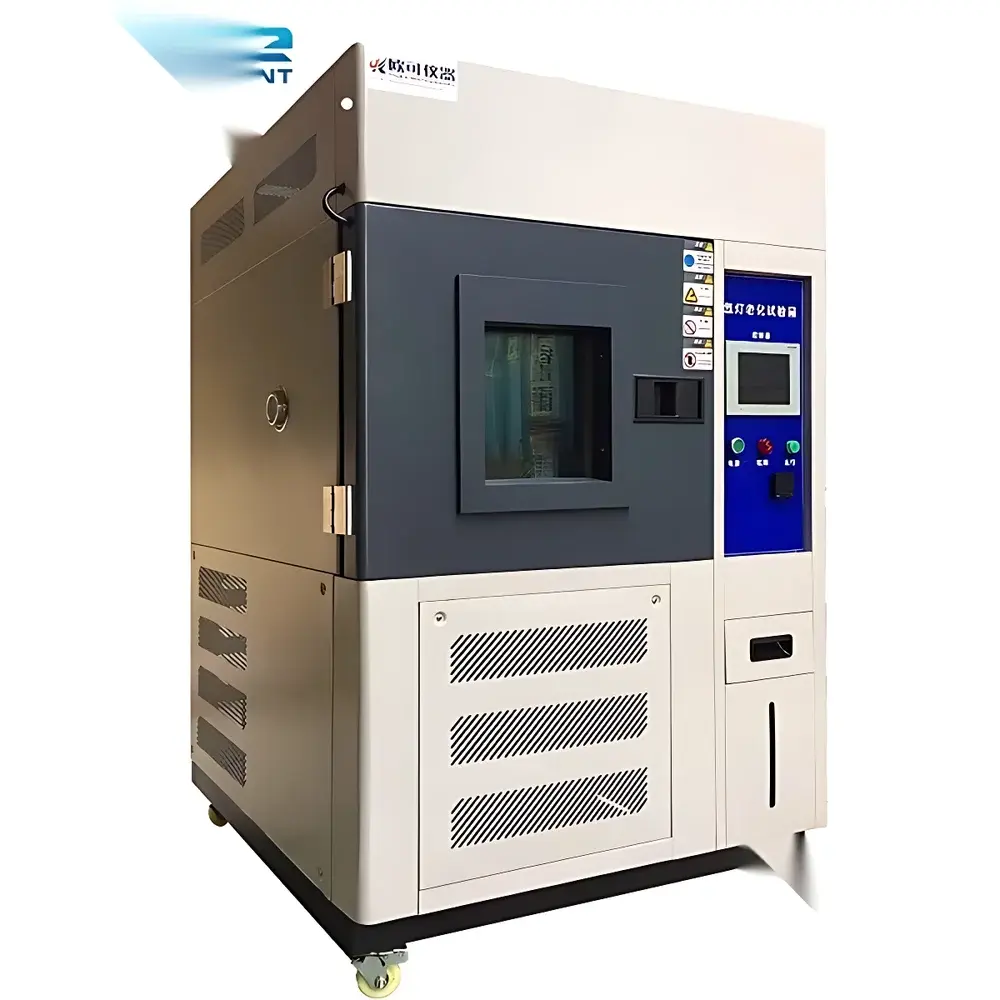
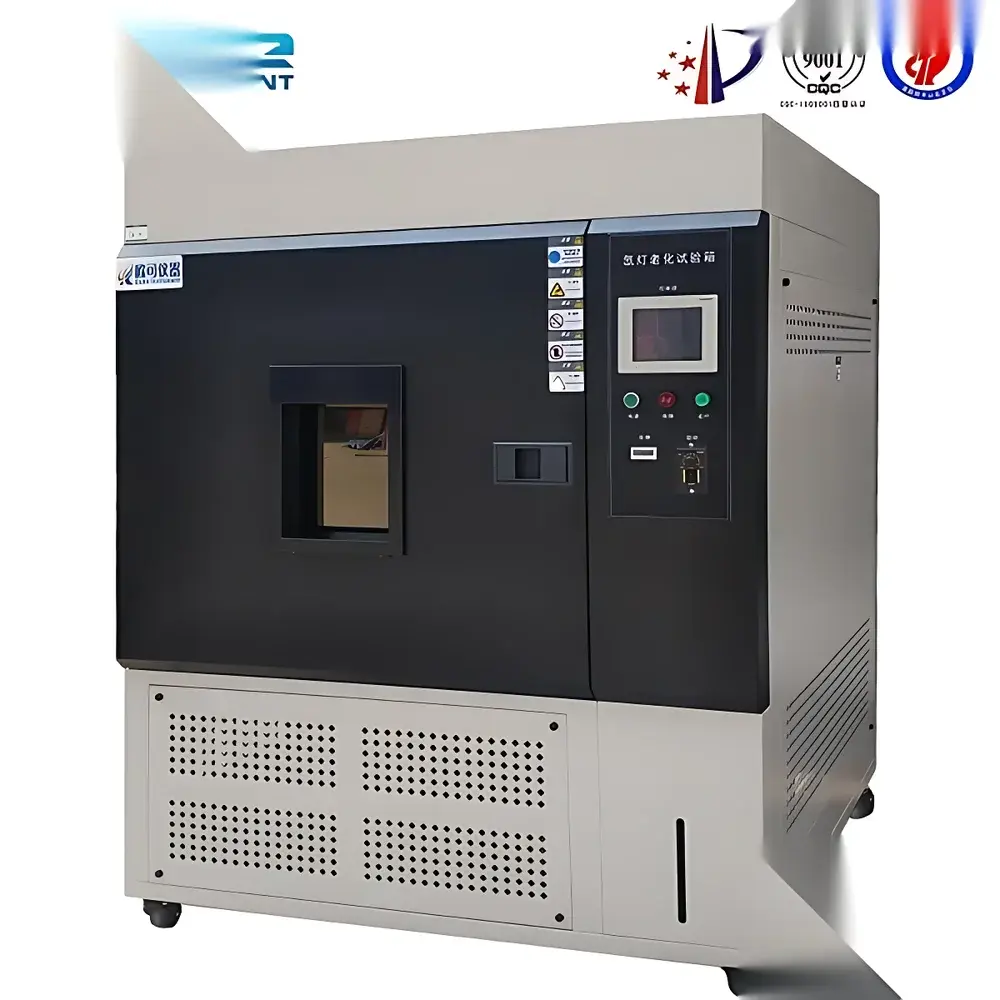
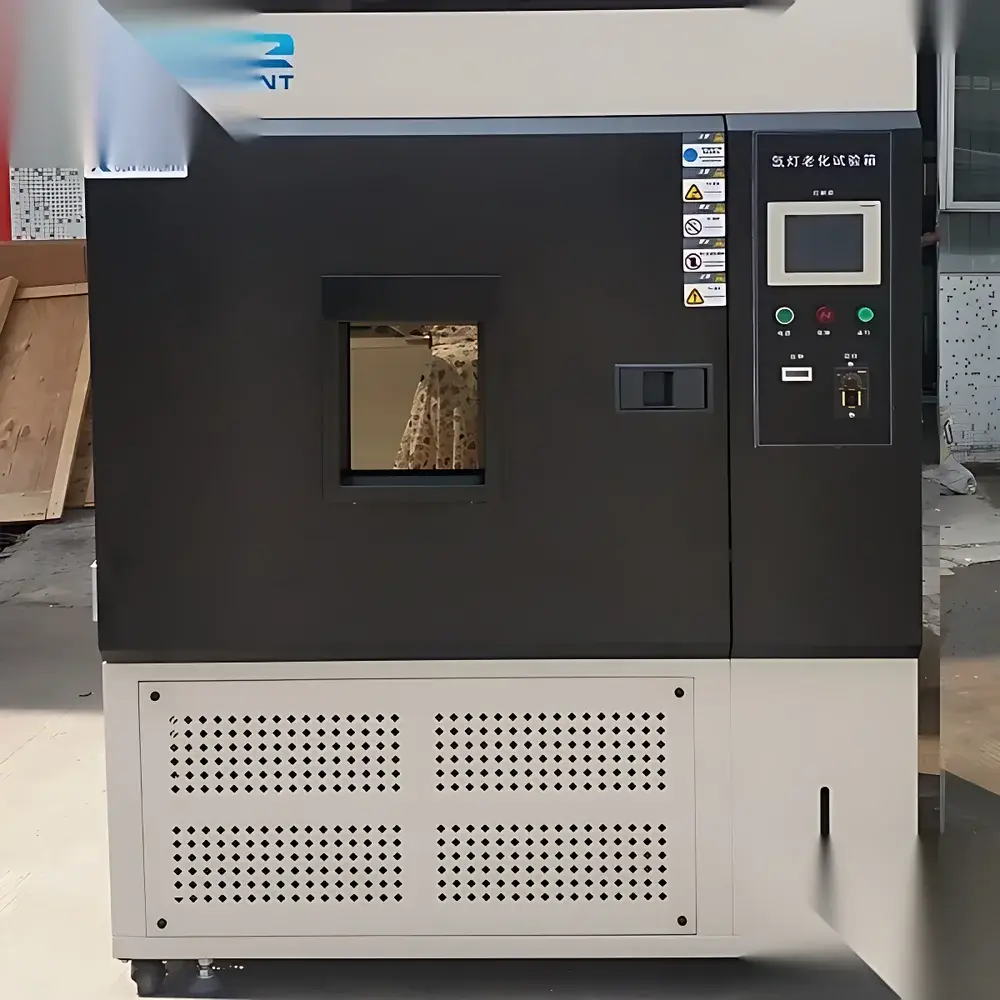
Water-Cooled Xenon Arc Weathering Test Chamber
| Key | Cooling Method: Water-cooled |
|---|---|
| Light Source | Full-spectrum xenon arc lamp |
| Radiation Range | 300–800 nm (550 W/m² ±10%) / 300–1200 nm (1000 W/m² ±10%) |
| Black Panel Temperature Range | 40–85°C |
| Chamber Temperature Range | 0–150°C |
| Humidity Range | 20–75% RH (light cycle), 20–98% RH (dark cycle) |
| Humidity Control Accuracy | ±2.0% RH |
| Temperature Control Accuracy | ±0.5°C |
| Temperature Uniformity | ±2.0°C |
| Humidity Uniformity | ±3.0% RH |
| Spray Duration | 1–999 min (intermittent or continuous) |
| Spray Pressure | 70–127 kPa |
| Sample Mounting | Dual-layer flat mesh rack or 500 mm diameter rotating turntable (0–3 rpm) |
| Lamp Power | 1.8 kW / 2.5 kW / 6 kW |
| Lamp Lifetime | ~1500 h |
| Construction | Interior: SUS304 stainless steel |
| Exterior | SUS34 stainless steel or powder-coated steel |
| Power Supply | AC 380 V ±5%, 50 Hz ±0.5 Hz |
| Compliance Standards | GB/T 8427, GB/T 16422-2, GB/T 8430, ISO 4892-2, GB/T 14576, ASTM D529, GB/T 15102-2006, GB/T 15104-2006 |
Overview
The Water-Cooled Xenon Arc Weathering Test Chamber is an engineered environmental simulation system designed to replicate the damaging effects of sunlight, moisture, and heat on polymeric, textile, coating, and composite materials. Utilizing a full-spectrum xenon arc lamp—whose spectral output closely matches natural solar irradiance from 290 nm to 2500 nm—the chamber enables accelerated weathering evaluation under controlled, repeatable conditions. Unlike air-cooled systems, the water-cooling mechanism ensures stable lamp operation at high irradiance levels (up to 1000 W/m² across 300–1200 nm), minimizing thermal drift and extending lamp service life. The chamber integrates synchronized light/dark cycles, programmable humidity profiles, black panel temperature monitoring, and calibrated radiant flux control—enabling compliance with internationally recognized exposure protocols for colorfastness, gloss retention, cracking, chalking, and mechanical degradation assessment.
Key Features
- Full-Spectrum Xenon Arc Illumination: High-intensity, spectrally stabilized xenon lamps deliver UV, visible, and near-IR radiation aligned with CIE daylight standard D65 and ISO 4892-2 requirements.
- Integrated Water-Cooling System: Maintains consistent lamp envelope temperature and spectral stability during extended exposures—critical for reproducible radiometric output and long-term calibration integrity.
- Programmable Environmental Profiles: Independent control of chamber temperature (0–150°C), black panel temperature (40–85°C), relative humidity (20–98% RH), and irradiance intensity enables precise emulation of diverse climatic conditions—including tropical, desert, and temperate exposure scenarios.
- Multi-Mode Moisture Simulation: Includes both continuous and intermittent spray cycles (1–999 min duration) with regulated pressure (70–127 kPa), supporting rain, dew, and condensation protocols per ASTM G154 and ISO 4892-2.
- Flexible Sample Handling: Configurable mounting options include dual-layer flat mesh racks for planar specimens or a 500 mm diameter rotating turntable (0–3 rpm) to ensure uniform irradiation exposure across irregularly shaped or multi-angle test pieces.
- Robust Construction & Operational Simplicity: Entire chamber interior fabricated from electropolished SUS304 stainless steel; exterior options include stainless steel or powder-coated carbon steel. Designed for minimal routine maintenance and straightforward installation in standard laboratory environments.
Sample Compatibility & Compliance
This chamber accommodates a broad range of material classes—including textiles, automotive coatings, architectural plastics, rubber compounds, outdoor signage, LED enclosures, and synthetic leather—without requiring sample pre-conditioning beyond standard conditioning per ISO 139 or ASTM D618. Its operational parameters meet the technical requirements of major international standards: GB/T 8427 (textile colorfastness to light), GB/T 16422-2 and ISO 4892-2 (plastics exposure methods), ASTM D529 (rubber weathering), and GB/T 14576 (photostability of pigments). All irradiance sensors are traceable to NIST or equivalent national metrology institutes, and chamber validation follows ISO 17025-aligned procedures for temperature/humidity uniformity, spectral irradiance distribution, and temporal stability.
Software & Data Management
The chamber operates via an embedded industrial-grade controller with intuitive touchscreen interface, supporting up to 100 user-defined test programs with segmented light/dark/humidity/spray phases. Real-time data logging records black panel temperature, chamber temperature, relative humidity, irradiance (W/m²), elapsed time, and spray status at configurable intervals (1–60 sec). Exported CSV files are compatible with LIMS integration and statistical analysis platforms (e.g., JMP, Minitab). Optional Ethernet/RS485 connectivity enables remote monitoring and centralized fleet management. Audit trail functionality complies with GLP and ISO/IEC 17025 documentation requirements, capturing operator ID, parameter changes, alarm events, and calibration history.
Applications
- Evaluation of photostability and color shift in automotive interior trim under simulated South Florida exposure conditions.
- Accelerated aging of architectural sealants per ASTM C1135 to assess adhesion loss and surface cracking.
- Lightfastness qualification of pigment dispersions used in exterior-grade paints per ISO 105-B02.
- UV resistance validation of polymer films for agricultural mulch applications.
- Correlation studies between xenon arc exposure and real-world field performance using Arrhenius-based acceleration models.
- Pre-qualification testing of OLED display encapsulation layers against combined UV/humidity stress.
FAQ
What is the difference between water-cooled and air-cooled xenon arc chambers?
Water-cooled systems maintain superior spectral stability and higher irradiance output over prolonged cycles by actively dissipating lamp heat—making them preferred for demanding standards like ISO 4892-2 and automotive OEM specifications.
Can this chamber be validated for ISO/IEC 17025-compliant testing labs?
Yes—when equipped with calibrated irradiance sensors, NIST-traceable thermohygrometers, and documented chamber mapping reports, it supports accreditation under ISO/IEC 17025 clause 6.4.3 for environmental testing competence.
Is the spray function adjustable for different water qualities?
The integrated spray manifold accepts deionized or distilled water only; optional inline filtration and conductivity monitoring can be added to ensure consistent droplet formation and prevent nozzle clogging.
How often does the xenon lamp require replacement?
Lamp lifetime is rated at approximately 1500 hours at nominal irradiance; actual service life depends on operating setpoints—lower irradiance and reduced thermal load extend longevity.
Does the chamber support automated test reporting?
Yes—built-in report generation exports pass/fail status, summary statistics (mean, SD, max/min), and raw time-series data, fully customizable to internal QA templates or regulatory submission formats.



