
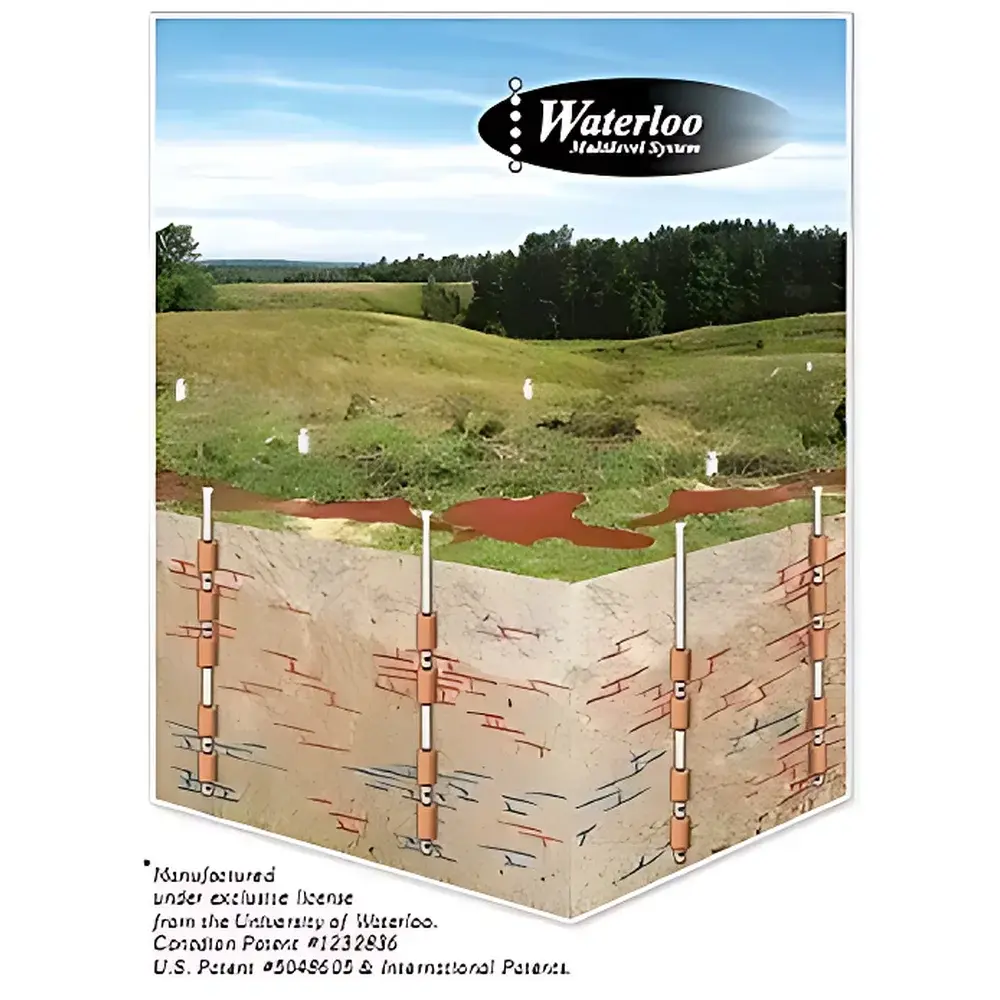
Waterloo 401 Multi-Level Groundwater Monitoring System
| Origin | Canada |
|---|---|
| Manufacturer Type | Authorized Distributor |
| Origin Category | Imported |
| Model | 401 |
| Pricing | Available Upon Request |
Overview
The Waterloo 401 Multi-Level Groundwater Monitoring System is an engineered solution for high-resolution vertical profiling of groundwater chemistry, hydraulic head, and contaminant distribution within a single borehole. Developed from the foundational research of Dr. John Cherry at the University of Waterloo’s Groundwater Research Centre in 1984, the system implements a proven Coupled Sealed-Zone Sampling and Piezometric Measurement architecture. It operates on the principle of physically isolating discrete aquifer intervals using mechanically anchored, inflatable or rigid packers (standard 915 mm sealers), enabling independent fluid sampling and pressure transduction without cross-contamination between zones. This design eliminates the need for multiple monitoring wells—reducing site footprint, installation time, and long-term maintenance while preserving stratigraphic integrity. The system complies with U.S. EPA guidance for RCRA Subtitle C post-closure monitoring and supports data collection aligned with ASTM D5092 (Standard Practice for Design and Installation of Groundwater Monitoring Wells) and ISO 5667-11 (Water quality — Sampling — Part 11: Guidance on groundwater sampling).
Key Features
- Modular, field-assemblable construction with standardized 50 mm OD PVC casing (customizable to stainless steel or PTFE-lined tubing for aggressive geochemical environments)
- Individually addressable sampling ports per monitoring zone—each routed via dedicated tubing to a surface manifold panel for sequential or simultaneous access
- Integrated hydraulic head measurement capability using calibrated pressure transducers or pneumatic piezometers per zone
- Compatible with Solinst Levelogger Edge, AquaTroll 500, or third-party digital sensors meeting SDI-12 or RS-485 protocols
- Rigid 915 mm mechanical sealers as standard; optional elastomeric packers available for variable lithology applications
- Surface connection panel designed for rapid hose coupling, leak-tight valving, and traceable port labeling per ASTM D5209
- Supports both low-flow purge-and-sample and passive diffusion sampling methodologies
Sample Compatibility & Compliance
The 401 system accommodates a broad range of groundwater matrices—including low-conductivity glacial till, fractured bedrock, and unconsolidated sand/gravel aquifers—without compromising zone isolation integrity. All wetted components meet NSF/ANSI Standard 61 for drinking water system components. When deployed with certified low-flow pumps (e.g., Solinst Dual-Valve Pump or Masterflex L/S peristaltic systems), the configuration satisfies U.S. EPA Method 500.0 and ASTM D6786 for VOC preservation. Data acquisition workflows support 21 CFR Part 11-compliant electronic records when integrated with validated software platforms. Installation procedures follow GLP-aligned documentation requirements, including borehole deviation logs, grout placement verification, and pre- and post-installation bail-down tests.
Software & Data Management
No proprietary firmware is embedded in the hardware; instead, the system interfaces seamlessly with industry-standard data loggers and telemetry gateways. Raw sensor outputs (mV, mA, or digital serial) are ingested into compliant environmental data management systems (EDMS) such as EQuIS, Geochemist’s Workbench (GWB), or AquiferTest. Field calibration certificates, port-to-depth mapping tables, and QA/QC metadata are structured in ISO 19115-compliant XML or CSV templates. Audit trails for sample event initiation, valve actuation timestamps, and sensor drift corrections are retained for regulatory review cycles and third-party verification under state-certified laboratory accreditation (e.g., NELAC/TNI standards).
Applications
- Delineation of vertical contaminant plume geometry (e.g., chlorinated solvents, PFAS, nitrate) across heterogeneous formations
- Quantification of vertical hydraulic conductivity gradients using multi-level slug test integration
- Long-term performance evaluation of in-situ remediation systems (e.g., PRBs, ISCO, thermal treatment)
- Baseline characterization prior to landfill closure or brownfield redevelopment under RCRA Part 264/265
- Research-scale investigation of agricultural leaching pathways in shallow unconfined aquifers
- Early-warning detection networks for landfill leachate migration in sensitive watershed settings
FAQ
Can the 401 system be installed in existing monitoring wells?
Yes—retrofitting is supported with custom-length sealers and adapter collars, provided annular space and casing condition meet ASTM D5092 minimum clearance requirements.
What depth ranges are typical for operational deployment?
Standard configurations span 7.3–18.3 m (24–60 ft); deeper installations up to 60 m are feasible with reinforced casing and high-strength anchoring hardware.
Is field calibration of pressure transducers required before each sampling event?
Field zeroing is recommended prior to deployment and after extended idle periods; full recalibration follows manufacturer-specified intervals (typically annually) traceable to NIST standards.
How does the system handle cross-formational flow during sampling?
The mechanical sealer design minimizes bypass flow; validation via simultaneous multi-zone head monitoring confirms hydraulic isolation prior to sampling initiation.
Are replacement parts and technical support available globally?
Yes—authorized distributors maintain regional spares inventory and provide ISO 9001-certified field service support, including installation supervision and data validation audits.
Related Products







