
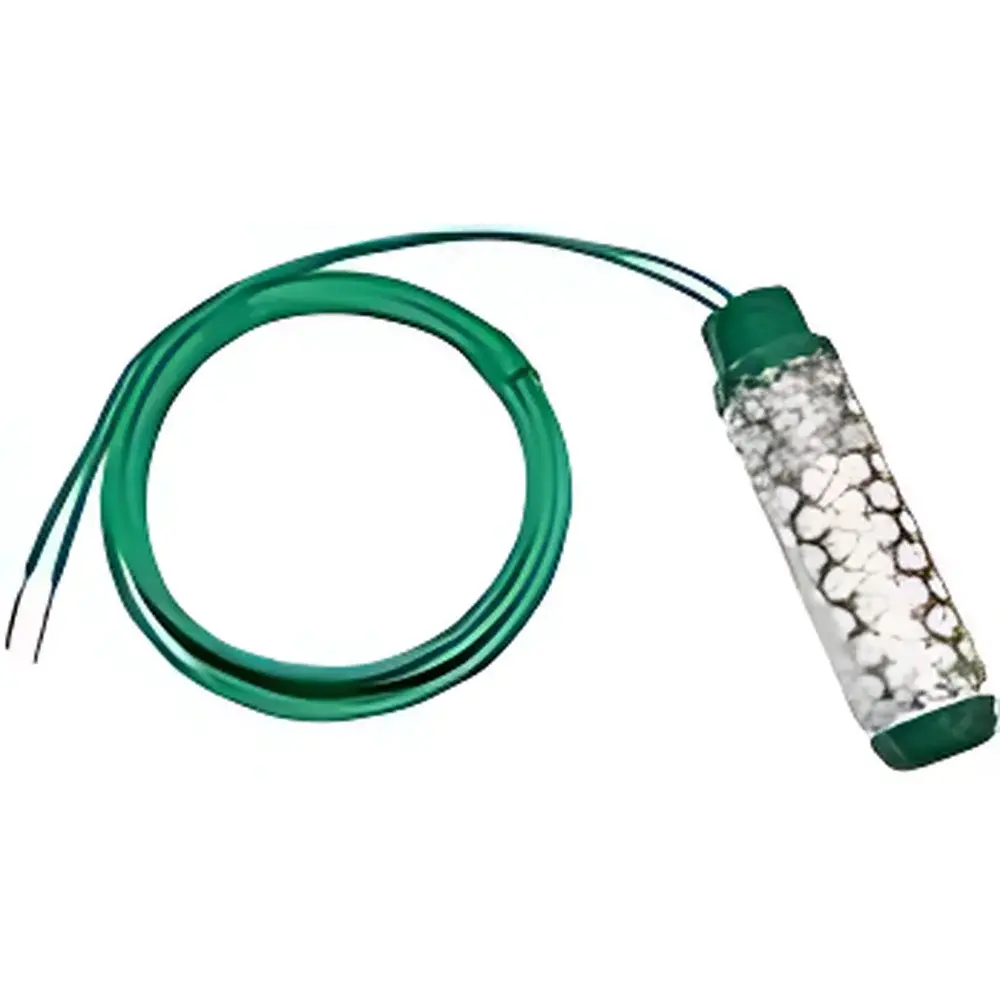
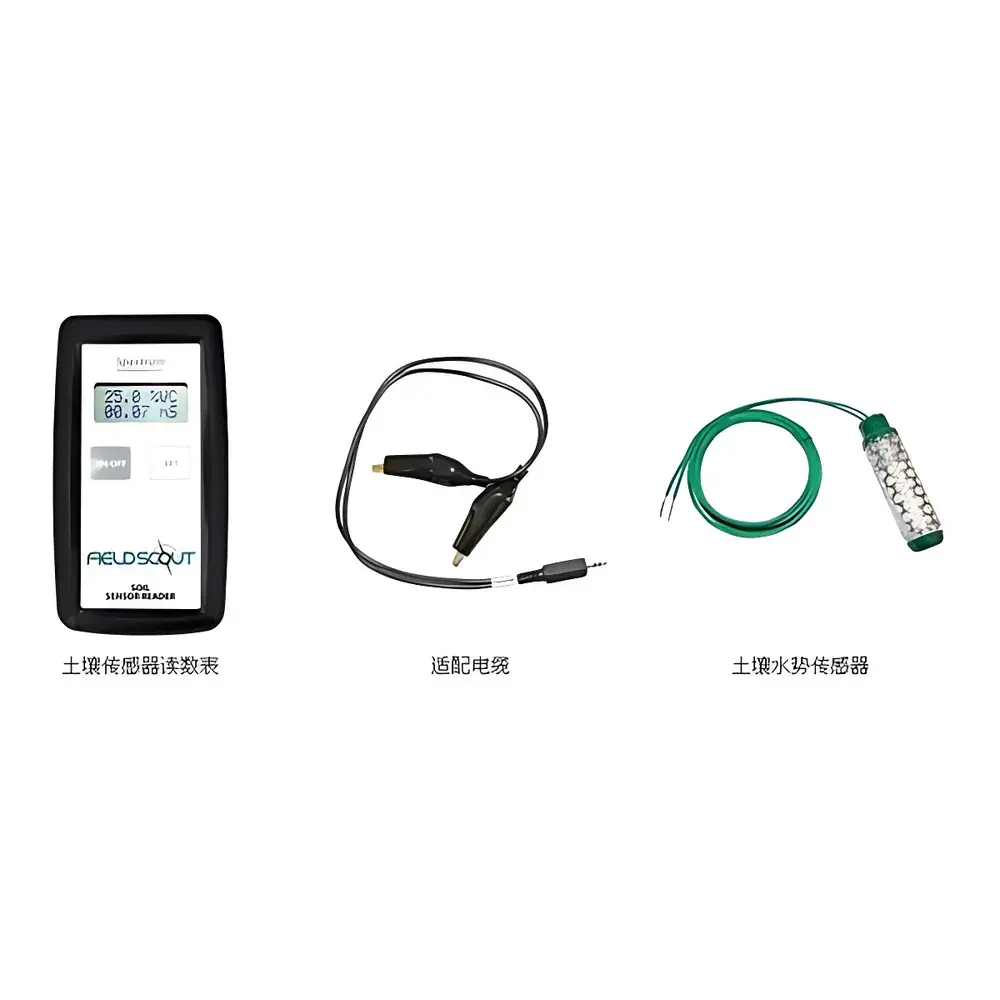
Watermark Soil Water Potential Sensor
| Origin | USA |
|---|---|
| Manufacturer Type | Distributor |
| Origin Category | Imported |
| Model | Watermark |
| Instrument Type | Soil Water Potential / Moisture Sensor |
| Measurement Range | 0–239 cb (kPa) |
| Housing Material | ABS Plastic, Stainless Steel, Hydrophilic Fiber |
| Sensor Dimensions | Ø22 mm × 83 mm |
| Cable | 2-conductor, AWG 20, 1.5 m |
Overview
The Watermark Soil Water Potential Sensor is a field-deployable, passive tensiometric sensor engineered for continuous, in-situ monitoring of soil water potential (matric potential) across agricultural, horticultural, ecological research, and landscape management applications. Unlike traditional mercury- or ceramic-tube tensiometers, the Watermark sensor operates on the principle of electrical resistance measurement across a hydrated porous matrix—functionally analogous to gypsum block sensors but with enhanced physical stability and spatial uniformity of pore structure. Its non-dissolving, inert construction ensures long-term deployment integrity in diverse soil textures (sand to clay loam), while eliminating calibration drift associated with electrolyte leaching or membrane fouling. Designed for integration with standard data loggers (e.g., Campbell Scientific CR series, HOBO, Decagon EM50), the sensor outputs an analog resistance signal (typically 0–10 kΩ) that correlates directly to soil water potential in centibars (cb), equivalent to kilopascals (kPa). It is not a volumetric water content sensor; rather, it reports the energy status of soil water—the thermodynamic driving force governing root uptake, drainage, and capillary movement—making it indispensable for irrigation scheduling, drought stress assessment, and vadose zone hydrology studies.
Key Features
- Stable, non-leaching sensor matrix composed of ABS plastic housing, stainless steel electrodes, and calibrated hydrophilic fiber—resistant to chemical degradation and biological colonization in field conditions
- Uniform pore-size distribution ensures high inter-unit reproducibility and minimal hysteresis between wetting and drying cycles
- Wide operational range: 0–239 cb (0 to −239 kPa), covering the full plant-available water range from field capacity to permanent wilting point for most crops
- Compact cylindrical form factor (Ø22 mm × 83 mm) enables minimally invasive installation using standard soil augers or direct insertion into undisturbed profiles
- Integrated 2-conductor AWG 20 cable (1.5 m standard length) with shielded termination options for noise reduction in electrically noisy environments
- No external power required—passive resistive operation reduces system complexity and extends battery life in remote telemetry networks
Sample Compatibility & Compliance
The Watermark sensor is validated for use in mineral soils ranging from coarse sands to fine-textured clays, provided the installation site is free of large voids, gravel, or organic debris that may compromise sensor–soil contact. It is unsuitable for saturated soils (where water potential exceeds 0 cb) or highly saline environments (>10 dS/m EC), as ion concentration can influence resistance readings. While not certified to ISO/IEC 17025 for metrological traceability, the sensor conforms to ASTM D4944 (Standard Test Method for Field Determination of Soil Moisture Content) in its application context for matric potential estimation. It supports Good Agricultural Practice (GAP) and FAO Irrigation and Drainage Paper No. 56–based irrigation scheduling protocols. For regulatory environmental monitoring programs, users are advised to perform site-specific calibration against laboratory-determined water retention curves (e.g., pressure plate or dew point psychrometer data).
Software & Data Management
The Watermark sensor interfaces seamlessly with industry-standard data acquisition platforms via analog voltage or resistance input channels. Resistance-to-water-potential conversion follows the manufacturer-provided empirical calibration equation (R = a × eb×Ψ, where Ψ is water potential in cb), embedded in logger firmware or post-processing scripts (e.g., Python, R, LoggerNet). Raw resistance values are stored with timestamped metadata, enabling audit-ready datasets compliant with GLP documentation requirements. When deployed in networked systems (e.g., wireless sensor nodes with cellular or LoRaWAN backhaul), data streams support real-time visualization dashboards and automated threshold alerts—facilitating responsive irrigation control per USDA NRCS Water Management Guidelines. No proprietary software license is required; however, users must validate calibration coefficients annually or after sensor replacement per QA/QC protocols.
Applications
- Precision irrigation management in orchards, vineyards, and row-crop systems to optimize water use efficiency and reduce leaching losses
- Root-zone water stress monitoring for turfgrass maintenance in golf courses, parks, and municipal landscapes
- Vadose zone process studies in hydrological modeling, including infiltration rate estimation and unsaturated hydraulic conductivity parameterization
- Long-term ecological monitoring of soil moisture dynamics in restoration projects and climate change impact assessments
- Educational field labs for teaching soil physics concepts—including matric potential, water retention, and plant–soil water relations
FAQ
How does the Watermark sensor differ from a traditional tensiometer?
Unlike vacuum-based tensiometers, the Watermark sensor measures electrical resistance across a hydrated porous medium—eliminating mechanical failure points, freezing limitations, and the need for frequent refilling or bubble removal.
Can it be used in saline soils?
Accuracy degrades above ~5 dS/m EC; for high-salinity sites, paired measurement with EC sensors and empirical correction is recommended.
What is the expected service life in field deployment?
Under typical agricultural conditions, functional lifespan exceeds 2–3 years; performance should be verified annually via bench calibration or cross-reference with adjacent sensors.
Is factory calibration traceable to NIST standards?
No—calibration is based on controlled laboratory soil–sensor equilibration; users are responsible for site-specific validation per ISO 11274 guidelines.
Does it require temperature compensation?
Yes—resistance is temperature-sensitive; integrated or co-located temperature measurement (e.g., thermistor) is essential for accurate water potential derivation.
Related Products







