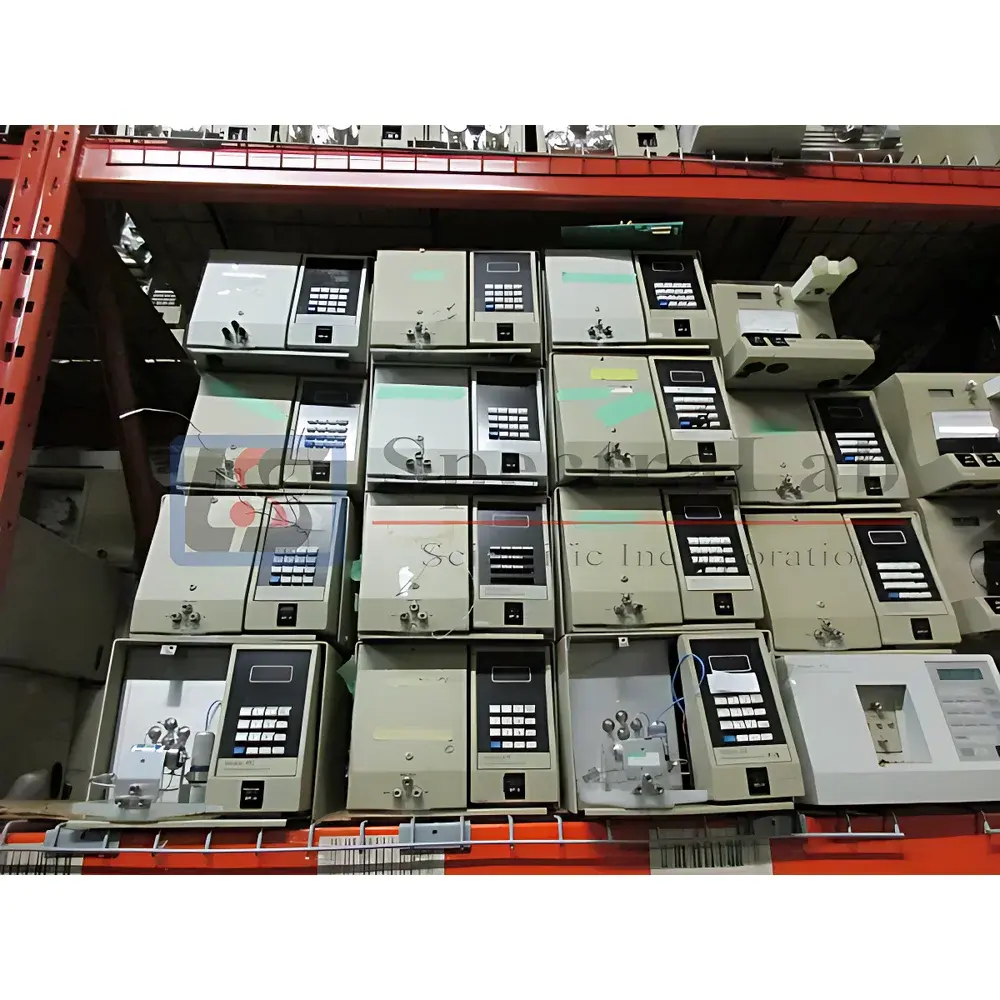
Waters 410 Differential Refractometer
| Brand | Waters |
|---|---|
| Origin | Canada |
| Model | 410 |
| Instrument Type | Differential Refractometer |
| Category | Chromatography Detector |
| Condition | Refurbished & Fully Tested |
| Operational Age | 3–4 Years |
| Warranty | Not Included |
| Regulatory Compliance | Designed for GLP/GMP-adjacent QC environments (non-21 CFR Part 11 compliant out-of-box) |
| Detection Principle | Differential Refractive Index (dRI) |
Overview
The Waters 410 Differential Refractometer is a precision optical detector engineered for universal, label-free quantification of analytes in liquid chromatography systems. Operating on the principle of differential refractive index measurement, it detects solute concentration changes by comparing the refractive index of an eluting sample stream against a matched reference solvent stream—making it particularly valuable for compounds lacking strong UV absorbance or native fluorescence (e.g., carbohydrates, polymers, lipids, and small organic molecules). As a legacy instrument originally introduced in the 1980s and widely deployed in pharmaceutical stability studies, polymer characterization labs, and food quality control workflows, the 410 delivers high baseline stability and reproducible response across broad concentration ranges. This refurbished unit has undergone full functional validation—including cell cleaning, optical alignment verification, temperature stabilization testing, and baseline noise assessment—ensuring performance consistency aligned with historical Waters specifications.
Key Features
- Optically balanced dual-beam design minimizing drift from ambient temperature fluctuations and solvent composition shifts
- Adjustable sensitivity range (typically 1–100 µRIU full-scale) supporting both high-concentration routine QC and low-level trace analysis
- Integrated thermostatted flow cell (operable at 30–55 °C) for enhanced signal-to-noise ratio and reduced viscosity-induced dispersion
- Compatible with standard 1/16″ stainless steel or PEEK capillary connections; supports flow rates from 0.1 to 5.0 mL/min
- Front-panel analog output (0–1 V or 0–5 V DC) and TTL-compatible status signals for seamless integration with legacy integrators (e.g., Waters 746, Shimadzu C-R4A) or modern DAQ systems
- Robust mechanical architecture with sealed optical path and corrosion-resistant wetted materials (316 stainless steel, sapphire windows)
Sample Compatibility & Compliance
The Waters 410 is compatible with common HPLC mobile phases including water, methanol, acetonitrile, THF, and chloroform—provided they are fully miscible and particle-free (<0.22 µm filtered). It is routinely employed in ASTM D5296 (molecular weight distribution of polymers), USP (excipient assay), and ISO 13877 (carbohydrate profiling in beverages). While the instrument itself does not natively support electronic signature or audit trail functionality required under FDA 21 CFR Part 11, it may be operated within validated chromatographic workflows when paired with compliant data systems that capture analog output via calibrated ADC modules and enforce procedural controls per GLP or internal SOPs.
Software & Data Management
The 410 operates as a standalone analog detector and does not include embedded firmware or digital communication protocols (e.g., RS-232, USB, or LAN). Data acquisition relies on external hardware: analog-to-digital converters interfaced with chromatography data systems (CDS) such as Empower (v2/v3), Chromeleon, or OpenLab CDS. SpectraLab Scientific provides documented calibration reports and baseline noise profiles (RMS ≤ 25 nRIU over 30 min at 1 mL/min, 35 °C), enabling users to establish system suitability criteria consistent with ICH Q2(R2) guidelines. All refurbished units ship with original operator manuals, maintenance logs, and a post-refurbishment test certificate.
Applications
- Quantitative analysis of sucrose, lactose, and dextrose in dairy and beverage matrices
- Molecular weight distribution determination of polyethylene glycol (PEG), polystyrene, and polyacrylamide standards via SEC/GPC
- Stability-indicating assays for non-UV-active drug substances (e.g., heparinoids, polysaccharide vaccines)
- Process monitoring of fermentation broths and enzymatic hydrolysates
- Verification of mobile phase composition consistency during method transfer
FAQ
Is this unit compatible with modern UHPLC systems?
Yes—mechanically and hydraulically—but requires appropriate low-dead-volume adapters and flow splitting if operating below 0.2 mL/min; dwell volume and dispersion must be evaluated empirically.
Does the refurbishment include replacement of the flow cell gasket and prism seals?
Yes—every unit undergoes complete wetted-path resealing using OEM-specified fluorocarbon elastomers and optical-grade epoxy bonding.
Can the 410 be used for gradient elution?
It can detect gradients, but baseline drift may occur due to refractive index shifts; isocratic or shallow-gradient methods are recommended for optimal precision.
What documentation accompanies the instrument?
Calibration report, functional test log, refurbishment checklist, electrical safety verification, and scanned copies of original Waters service bulletins relevant to the serial number range.
Is technical support available post-purchase?
SpectraLab Scientific offers remote troubleshooting, application consultation, and optional on-site startup assistance (fees apply); no long-term service contracts are included.