
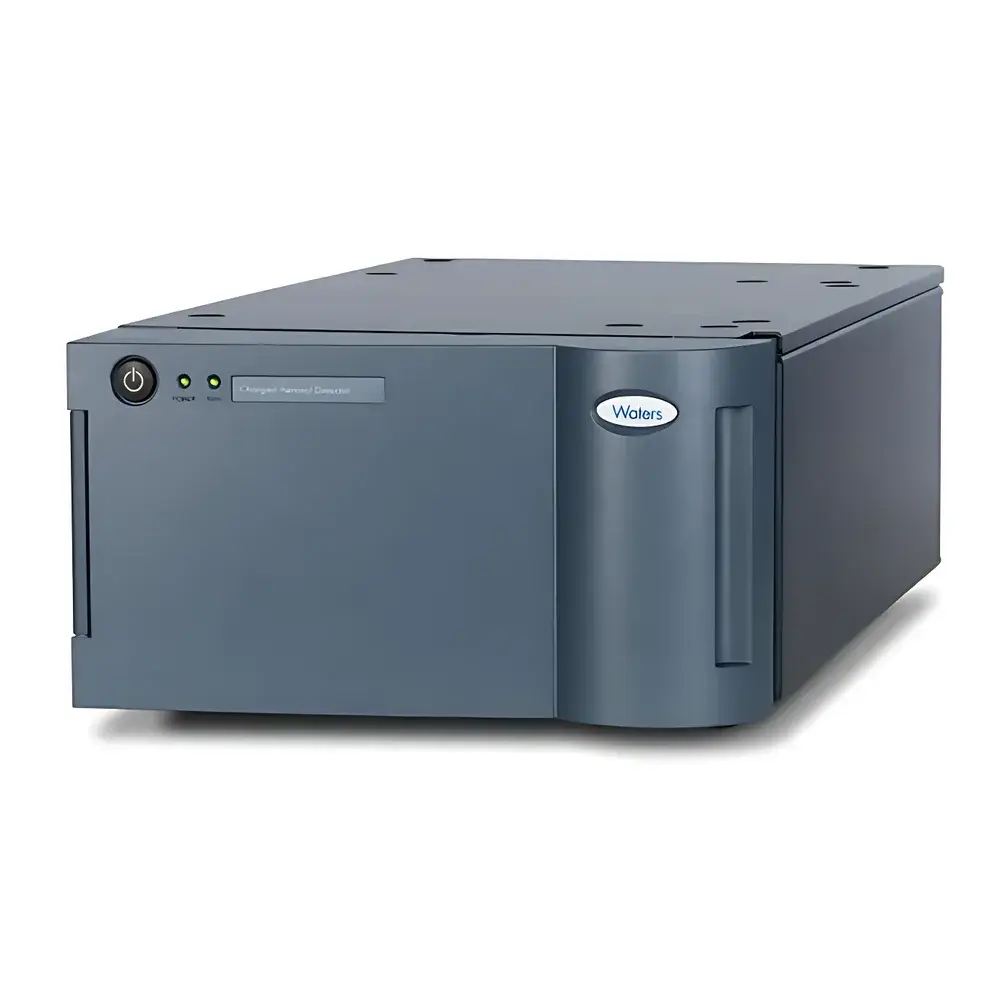
Waters Charged Aerosol Detector (CAD)
| Brand | Waters |
|---|---|
| Origin | United Kingdom |
| Manufacturer Type | Authorized Distributor |
| Origin Category | Imported |
| Model | Charged Aerosol Detector |
| Pricing | Upon Request |
Overview
The Waters Charged Aerosol Detector (CAD) is a universal, mass-sensitive detection platform engineered for high-performance liquid chromatography (HPLC), ultra-high-performance liquid chromatography (UHPLC), and ultra-performance liquid chromatography (UPLC) systems. Unlike optical detectors—such as UV/Vis or fluorescence—the CAD operates on the principle of aerosol charging and particle counting: analytes are nebulized into fine droplets, dried to form non-volatile particles, charged via corona discharge, and quantified by measuring the resulting ion current. This mechanism delivers consistent response factors across chemically diverse compounds—including non-chromophoric, semi-volatile, and low-UV-absorbing species—without requiring structural analogs or derivatization. As a result, the CAD provides robust, reproducible quantitation in both analytical and preparative chromatographic workflows where conventional detectors fall short.
Key Features
- Universal detection capability for virtually all non-volatile and semi-volatile analytes, independent of chromophore presence or UV absorbance
- Dynamic range exceeding four orders of magnitude (typically 10⁴), enabling simultaneous detection of major and trace components within a single run
- Fully integrated with Waters chromatography platforms—including Alliance HPLC, Arc Premier, Arc HPLC, ACQUITY Arc, and ACQUITY UPLC systems—via native hardware interface and firmware-level synchronization
- Native control and method execution through Waters Empower Chromatography Data System (CDS), supporting Empower 3 Feature Release 4 Service Release 3 (SR3) and later versions
- Optional operation under MassLynx software for hybrid LC-MS/CAD method development and orthogonal validation
- Engineered for regulatory compliance: supports audit trail, electronic signatures, and system suitability tracking per FDA 21 CFR Part 11 and EU Annex 11 requirements when deployed in validated Empower environments
Sample Compatibility & Compliance
The CAD accommodates a broad spectrum of sample matrices, including small-molecule pharmaceuticals, peptides, oligonucleotides, lipids, carbohydrates, surfactants, and natural product extracts. Its compatibility extends to mobile phases containing volatile buffers (e.g., ammonium formate, ammonium acetate), organic modifiers (acetonitrile, methanol), and low concentrations of non-volatile additives—provided they are compatible with standard HPLC/UPLC column chemistries and system pressure limits. The detector complies with ICH Q2(R2) guidelines for analytical method validation, particularly for linearity, range, and robustness assessment. When operated within an Empower-validated CDS environment, it meets GLP and GMP documentation standards for regulated laboratories conducting stability studies, release testing, and impurity profiling.
Software & Data Management
Data acquisition, processing, and reporting are fully embedded within the Waters Empower platform. Raw CAD signal data—including raw current output, normalized response, and post-processing baseline correction—are stored in the Empower database with full version control and time-stamped metadata. The system supports automated calibration curve generation, peak integration using industry-standard algorithms (e.g., valley-to-valley, tangent skim), and export to LIMS-compatible formats (e.g., .csv, .pdf, .xml). Audit trails record all user actions—including method edits, reprocessing events, and calibration updates—with immutable timestamps and operator identification. Integration with Empower’s System Suitability module enables automatic pass/fail evaluation against pre-defined criteria (e.g., RSD ≤ 2% for replicate injections), facilitating routine QC workflows.
Applications
- Quantitative analysis of APIs and excipients in formulation development without reference standards
- Impurity profiling and degradation product quantification in forced degradation studies
- Characterization of biopolymer distributions (e.g., polysaccharides, synthetic polymers) via SEC/GPC
- Method transfer and harmonization between HPLC, UPLC, and preparative LC systems
- Supporting orthogonal detection strategies in multi-detector LC configurations (e.g., CAD + UV + MS)
- Stability-indicating assays compliant with ICH Q5C and Q5D guidance
FAQ
Is the CAD compatible with non-Waters LC systems?
Yes—while optimized for Waters platforms, the CAD can be interfaced with third-party HPLC/UPLC systems via analog voltage output (0–1 V) or digital communication protocols (e.g., RS-232, Ethernet), subject to hardware configuration and driver support.
Does the CAD require daily calibration with reference standards?
No—unlike refractive index or conductivity detectors, the CAD does not rely on external calibration curves for relative quantitation; however, response factor calibration is recommended for absolute quantitation in regulated environments.
Can CAD data be reprocessed after acquisition?
Yes—raw signal files retain full resolution and are fully reprocessable in Empower using updated integration parameters, baselines, or peak detection settings without loss of fidelity.
What maintenance intervals are recommended for the CAD?
Routine maintenance includes weekly nebulizer cleaning, monthly corona needle inspection, and quarterly desolvation chamber purge—procedures documented in the Waters CAD Maintenance Guide (Document No. 715000692).
Is the CAD suitable for GMP-regulated manufacturing environments?
Yes—when deployed with validated Empower CDS, IQ/OQ/PQ documentation packages, and appropriate SOPs, the CAD meets the technical and procedural requirements for use in pharmaceutical release testing and stability programs.
Related Products





