
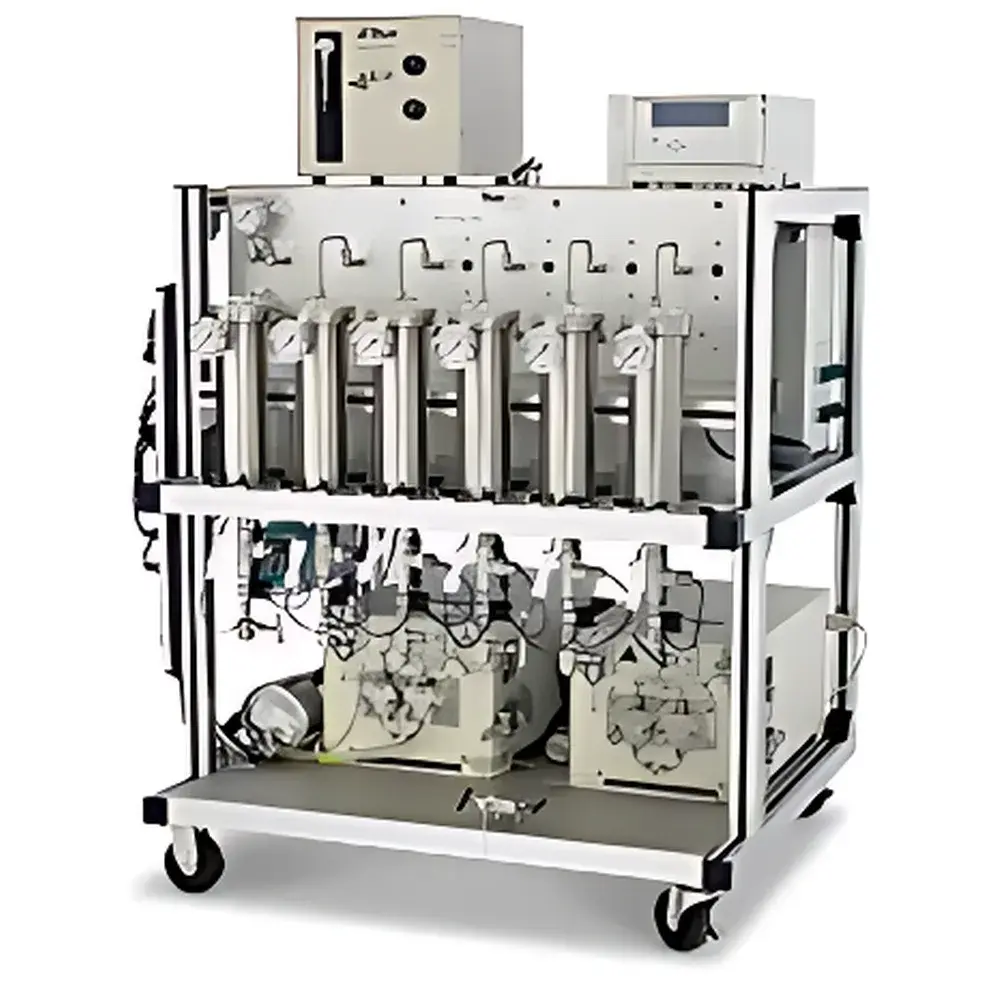
Waters Prep SFC Purification System (80/200/350 Series)
| Brand | Waters |
|---|---|
| Origin | USA |
| Instrument Type | Preparative Supercritical Fluid Chromatography (SFC) System |
| Model Variants | 80, 200, 350 |
| Application Level | Laboratory-Scale Purification |
| Regulatory Context | Designed for GLP-compliant workflows and compatible with FDA 21 CFR Part 11–enabled software environments |
| Compliance Framework | Supports ASTM D7894–21 (Standard Guide for SFC Method Development), ISO 17025–2017 (Testing Laboratory Competence), and USP <621> Chromatography guidelines |
| Software Platform | SuperChrom v3.x (with audit trail, electronic signatures, and method versioning) |
| Detection | UV-Vis absorbance detection (dual-wavelength capability) |
| Fraction Collection | Automated, timed or peak-triggered, with solvent compatibility up to 100% CO₂-expanded liquids and polar modifiers (e.g., methanol, ethanol, isopropanol) |
| Back Pressure Control | Active Automatic Back Pressure Regulator (ABPR) with ±0.2 bar pressure stability |
| Solvent Delivery | Dual-pump architecture — primary CO₂ pump (supercritical phase delivery) and auxiliary modifier pump (liquid-phase co-solvent gradient) |
| System Architecture | Modular, rack-mounted configuration with integrated safety interlocks, CO₂ phase monitoring, and real-time density compensation |
Overview
The Waters Prep SFC Purification System (80/200/350 Series) is a modular, laboratory-scale preparative supercritical fluid chromatography platform engineered for high-throughput, environmentally sustainable purification of chiral and achiral compounds. Unlike conventional high-performance liquid chromatography (HPLC), this system leverages supercritical carbon dioxide (scCO₂) as the primary mobile phase—offering lower viscosity, higher diffusivity, and rapid mass transfer kinetics. The core separation mechanism relies on tunable solvent strength via dynamic pressure- and temperature-dependent CO₂ density modulation, combined with precise gradient elution of organic modifiers (e.g., methanol, ethanol, or isopropanol). This enables efficient resolution of structurally similar analytes—including enantiomers, synthetic intermediates, natural product isolates, and pharmaceutical impurities—without requiring derivatization or extensive method development. The system operates across three scalable configurations (80, 200, and 350 bar maximum operating pressure), each optimized for distinct throughput and loading capacity requirements while maintaining consistent thermodynamic control over the supercritical phase.
Key Features
- Dual-pump architecture: Independent high-pressure CO₂ pump and precision modifier pump enable reproducible gradient formation with ≤0.5% RSD in modifier composition across multi-hour runs.
- Automated Back Pressure Regulation (ABPR): Real-time pressure feedback loop maintains setpoint stability within ±0.2 bar—critical for preserving scCO₂ density and retention time reproducibility.
- UV-Vis detector with dual-wavelength acquisition: Supports simultaneous monitoring at two user-defined wavelengths (190–400 nm range), facilitating selective detection of UV-active fractions without post-run re-analysis.
- Intelligent fraction collection: Triggered by peak apex, threshold absorbance, or fixed time intervals; accommodates vial racks, microtiter plates, and custom containers with solvent-resistant sealing.
- Modular feed module: Integrates sample loop injection, pre-column heating, and inline degassing to minimize band broadening and ensure robust introduction of viscous or particulate-laden samples.
- CO₂ phase integrity monitoring: Integrated temperature/pressure sensors coupled with real-time density calculation algorithms provide continuous verification of supercritical state compliance per ISO 20783:2019.
Sample Compatibility & Compliance
The Waters Prep SFC systems accommodate a broad spectrum of sample matrices—including racemic mixtures, peptide fragments, organometallic catalysts, botanical extracts, and polymer additives—provided they exhibit sufficient solubility in CO₂-modifier blends. Column compatibility spans standard 10–50 mm ID preparative columns packed with silica, polysaccharide-based chiral stationary phases (e.g., AD-H, OD-H, AS-H), and hybrid organic-inorganic materials. All hardware components comply with ASME B31.3 Process Piping standards for high-pressure gas service. The platform supports full traceability under GLP and GMP frameworks: SuperChrom software logs all instrument parameters, method versions, operator IDs, and calibration events with immutable audit trails compliant with FDA 21 CFR Part 11 Annex 11 requirements.
Software & Data Management
SuperChrom v3.x serves as the unified control and data handling environment. It provides method editor tools for defining modifier gradients, ABPR profiles, and collection logic; real-time chromatogram visualization with baseline correction and peak integration; and automated report generation in PDF/CSV formats. Raw data files are stored in vendor-neutral .wiff format, enabling third-party processing via open-source chromatography libraries (e.g., PyChromatography). Electronic signature enforcement, role-based access control, and automatic backup to network-attached storage (NAS) ensure regulatory readiness. Data archiving follows ISO/IEC 27001–2022 information security protocols.
Applications
- Chiral purification of active pharmaceutical ingredients (APIs) under ICH Q5A and Q5B guidelines.
- Isolation of minor alkaloid constituents from plant extracts for structure–activity relationship (SAR) studies.
- Removal of residual palladium catalysts from cross-coupling reaction mixtures.
- Preparative separation of diastereomeric oligonucleotide synthesis by-products.
- Recovery of thermally labile natural products (e.g., terpenes, carotenoids) where HPLC-induced degradation occurs.
- Method scouting for analytical-to-preparative SFC scale-up per USP Section 7.3 recommendations.
FAQ
What distinguishes Prep SFC from preparative HPLC in terms of green chemistry metrics?
SFC reduces organic solvent consumption by 70–90% compared to reversed-phase HPLC, with CO₂ serving as the primary mobile phase—recoverable, non-toxic, and non-flammable.
Can the system operate with non-standard modifiers such as acetone or THF?
Yes—provided compatibility is verified with column manufacturer specifications and system wetted materials (e.g., Hastelloy C-276 seals); modifier delivery lines support miscible solvents with vapor pressure <100 kPa at 40°C.
Is method transfer between analytical and preparative SFC platforms supported?
SuperChrom includes built-in scaling calculators aligned with van Deemter and Knox equations, enabling linear velocity–based transfer from 4.6 mm ID analytical columns to 10–30 mm ID prep columns.
How is CO₂ supply managed during extended unattended runs?
Systems integrate with bulk CO₂ dewars or high-pressure cylinder manifolds equipped with automatic switchover valves and low-pressure alarms compliant with NFPA 55.
Does Waters provide validation documentation for IQ/OQ/PQ protocols?
Yes—factory-verified installation and operational qualification packages are available upon request, including test scripts, acceptance criteria, and raw data templates aligned with ASTM E2500–13.




