
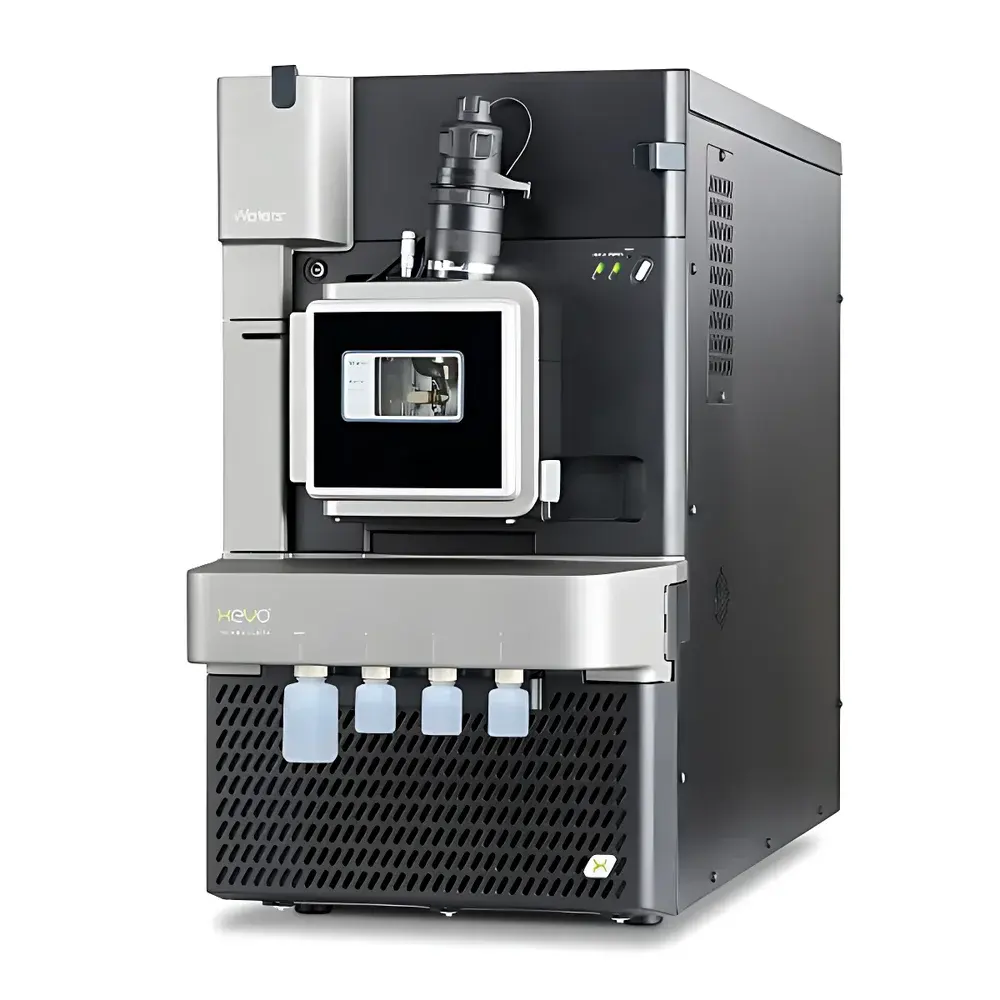
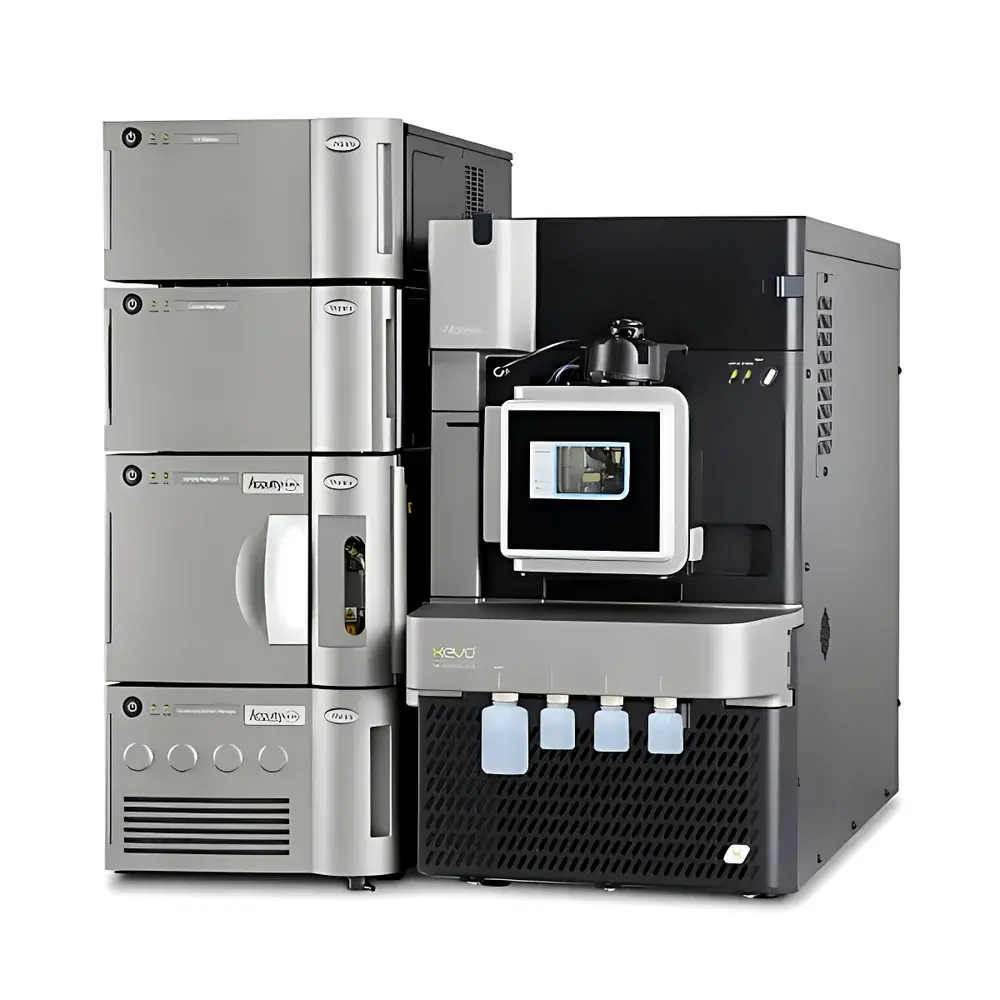
Waters Xevo TQ Absolute Triple Quadrupole Mass Spectrometer
| Brand | Waters |
|---|---|
| Origin | United Kingdom |
| Model | Xevo TQ Absolute |
| Instrument Type | Triple Quadrupole (TQ) |
| Application Scope | Universal LC-MS/MS Quantitation |
| Mass Range | Not specified by manufacturer in public datasheets |
| Sensitivity | Up to 15× higher for challenging negative-ion-mode analytes vs. prior-generation TQ systems |
| Resolution | Unit mass resolution standard for SRM/MRM transitions |
| Mass Accuracy | Not specified (typical for QqQ: ±0.1–0.2 Da under routine conditions) |
| Operating Pressure Range | Vacuum system maintained at <1×10⁻⁶ mbar in analyzer region |
Overview
The Waters Xevo TQ Absolute is a high-performance, compact triple quadrupole (QqQ) mass spectrometer engineered for robust, reproducible quantitative analysis in liquid chromatography–tandem mass spectrometry (LC-MS/MS) workflows. It operates on the principle of selected reaction monitoring (SRM) or multiple reaction monitoring (MRM), where the first quadrupole (Q1) isolates a precursor ion, the second quadrupole (q2) acts as a collision cell for controlled fragmentation, and the third quadrupole (Q3) selects a characteristic product ion for detection. This architecture delivers exceptional specificity, dynamic range (>5 orders), and low-picogram-level quantitation capability—particularly for analytes exhibiting poor ionization efficiency in negative electrospray ionization (ESI−) mode. Designed for regulatory-compliant laboratories, the system meets foundational requirements for method validation per ICH M10, USP , and FDA Bioanalytical Method Validation Guidance, with hardware and software architectures supporting audit trails, electronic signatures, and data integrity principles aligned with 21 CFR Part 11.
Key Features
- Enhanced negative-ion sensitivity: Delivers up to 15× improved signal-to-noise ratio for structurally challenging, low-proton-affinity compounds (e.g., acidic pharmaceuticals, nucleotides, certain pesticides) compared to previous-generation Xevo TQ platforms.
- Energy-efficient design: Reduces power consumption, nitrogen gas usage, and thermal load by approximately 50% relative to conventional high-throughput TQ systems—lowering HVAC demand and operational costs without compromising analytical performance.
- Compact footprint: Optimized mechanical layout minimizes bench space requirements while maintaining full vacuum integrity and ion transmission efficiency—enabling higher instrument density per laboratory square foot.
- Source architecture with extended uptime: Features an advanced source shroud that mitigates matrix-induced contamination and salt deposition; coupled with an intuitive probe positioning guide to ensure repeatable source alignment and minimal downtime between runs.
- Robust vacuum system: Dual-stage turbomolecular pumping maintains stable high-vacuum conditions (<1×10⁻⁶ mbar) across extended acquisition periods, ensuring consistent sensitivity and mass stability over multi-day sequences.
Sample Compatibility & Compliance
The Xevo TQ Absolute supports broad sample compatibility across biological matrices (plasma, serum, tissue homogenates), environmental extracts (water, soil), food safety applications (mycotoxins, veterinary drug residues), and small-molecule pharmaceutical development (PK/PD, impurity profiling). Its ESI and APCI ion sources accommodate polar, thermally labile, and moderately volatile compounds. From a compliance perspective, the platform is engineered to support GLP and GMP environments: hardware logs system status, temperature, pressure, and voltage parameters continuously; software modules enforce role-based access control, version-controlled method storage, and immutable audit trails. It aligns with ISO/IEC 17025:2017 requirements for testing laboratories and provides traceability for calibration standards, QC samples, and instrument qualification records.
Software & Data Management
Two primary software ecosystems are supported: Waters Connect and MassLynx. Waters Connect is a modern, web-enabled informatics platform featuring Exception-focused Review (XfR), which applies intelligent filtering to flag outliers, integration anomalies, or calibration drift—reducing manual data review time by up to 50%. All raw and processed data are stored in a secure, relational SQL database with built-in backup scheduling and encryption-at-rest. MassLynx offers deep method scripting, customizable report templates, and backward compatibility with legacy methods—ideal for labs transitioning from earlier Waters platforms. Both environments comply with 21 CFR Part 11 through electronic signature workflows, audit trail generation, and user privilege management. Data export formats include .raw (Waters native), .mzML (open standard), and CSV for third-party statistical tools.
Applications
- Regulatory bioanalysis: Quantitation of small-molecule drugs and metabolites in human plasma per FDA and EMA guidelines.
- Environmental monitoring: Detection of per- and polyfluoroalkyl substances (PFAS), endocrine disruptors, and legacy pesticides at sub-part-per-quadrillion levels.
- Food safety: Multi-residue screening of veterinary drugs, mycotoxins, and adulterants in complex food matrices.
- Clinical toxicology: High-throughput confirmation and quantification of opioids, benzodiazepines, and novel psychoactive substances.
- Pharmaceutical quality control: Impurity identification and quantitation in active pharmaceutical ingredients (APIs) and finished dosage forms.
FAQ
What ionization modes does the Xevo TQ Absolute support?
Electrospray Ionization (ESI) in both positive and negative modes, and Atmospheric Pressure Chemical Ionization (APCI) — with optimized sensitivity for negative-ion analysis of acidic and electron-capturing compounds.
Is the system compatible with UPLC and HPLC separations?
Yes — fully integrated with Waters ACQUITY UPLC and Alliance HPLC systems, and interoperable with third-party LC platforms via analog/digital I/O and standard API protocols.
Does the instrument meet 21 CFR Part 11 requirements out-of-the-box?
When deployed with Waters Connect or MassLynx v4.2+ and configured per documented validation procedures, it supports electronic signatures, audit trails, and data integrity controls required for regulated submissions.
What maintenance intervals are recommended for the ion source and vacuum system?
Source cleaning is typically required every 2–4 weeks depending on sample complexity; turbomolecular pump oil replacement is scheduled annually, and roughing pump oil every 6 months — all tracked automatically within instrument diagnostics.
Can the Xevo TQ Absolute be upgraded to support high-resolution capabilities?
No — as a dedicated triple quadrupole platform, it does not incorporate time-of-flight (TOF) or Orbitrap mass analyzers; high-resolution applications require separate instrumentation such as the Waters SELECT SERIES Cyclic IMS or Xevo G3 QTof.





