
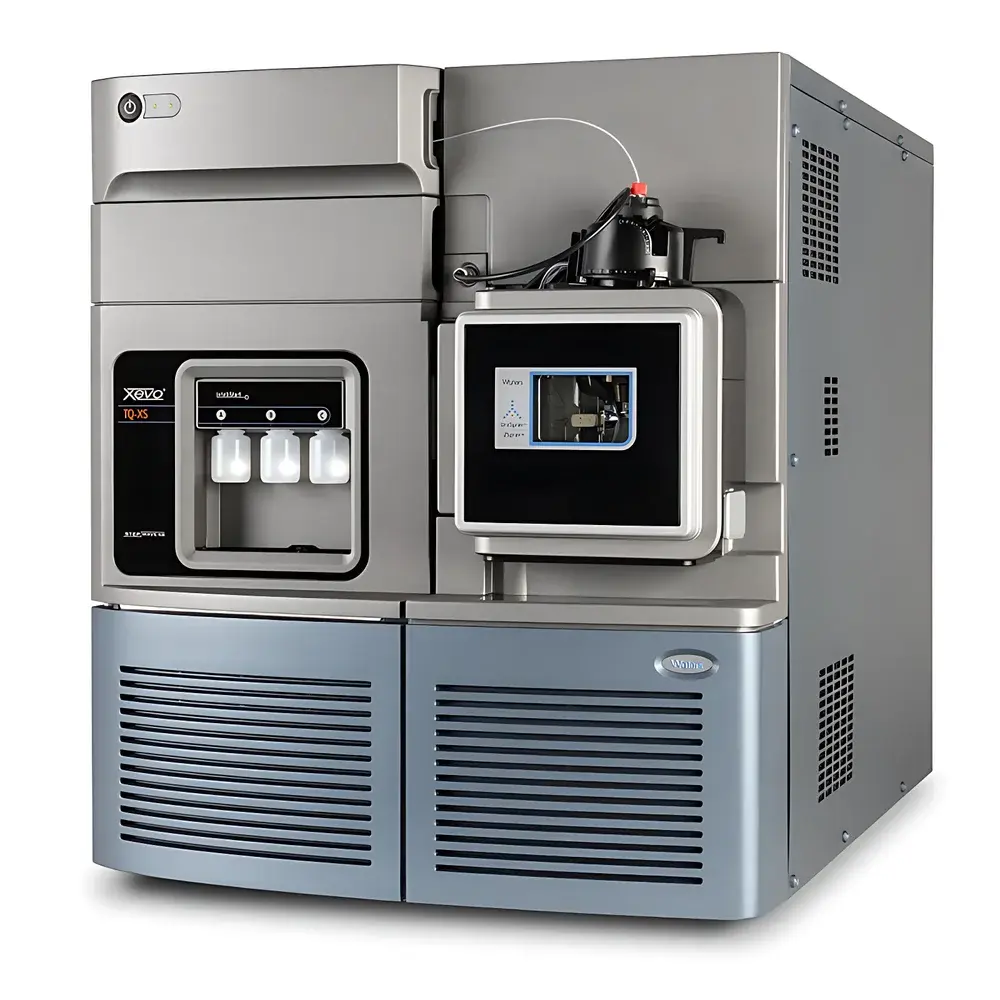
Waters Xevo TQ-XS Triple Quadrupole Mass Spectrometer
| Brand | Waters |
|---|---|
| Origin | United Kingdom |
| Model | Xevo TQ-XS |
| Instrument Type | Tandem Quadrupole (Triple Quad) |
| Ionization Source Compatibility | UniSpray™, Electrospray Ionization (ESI), Atmospheric Pressure Chemical Ionization (APCI) |
| Detection Principle | Selected Reaction Monitoring (SRM) / Multiple Reaction Monitoring (MRM) |
| Dynamic Range | 6 orders of magnitude (Xtended Dynamic Range, XDR™) |
| Ion Transmission Technology | StepWave XS™ off-axis ion optics |
| Probe Design | Tool-free atmospheric pressure ionization (API) source |
| Software Platform | MassLynx™ NX, TargetLynx XS™, Intellistart™, QUANPEDIA™ |
| Regulatory Compliance Support | 21 CFR Part 11, GLP/GMP audit trails, electronic signatures |
Overview
The Waters Xevo TQ-XS is a high-performance triple quadrupole mass spectrometer engineered for robust, reproducible quantitative analysis in regulated and research laboratories. It operates on the fundamental principle of tandem mass spectrometry (MS/MS) using selected reaction monitoring (SRM) or multiple reaction monitoring (MRM), where precursor ions are isolated in Q1, fragmented in the collision cell (Q2), and specific product ions are detected in Q3. This architecture delivers exceptional selectivity and sensitivity for trace-level quantitation across complex matrices—particularly critical in pharmaceutical bioanalysis, environmental monitoring, food safety testing, and clinical toxicology. The system integrates seamlessly with ultra-high-performance liquid chromatography (UHPLC) platforms such as the ACQUITY UPLC® family, enabling rapid method development and high-throughput workflows without compromising data integrity.
Key Features
- StepWave XS™ Ion Optics: An off-axis, multi-stage ion guide that separates ion transmission from neutral species and gas load. This design reduces in-source fragmentation and improves ion transmission efficiency—especially for labile, low-abundance, or highly matrix-suppressed analytes.
- Xtended Dynamic Range (XDR™) Detector: Provides linear response over six decades (10⁶), eliminating the need for sample dilution or multiple injections when quantifying analytes spanning wide concentration ranges within a single run.
- Tool-Free API Source: Enables rapid, repeatable probe exchange—including capillary, cone, and desolvation gas components—without wrenches or calibration re-alignment. Ensures consistent performance across operators and shifts.
- UniSpray™ Ionization Technology: A dual-mode electrospray-compatible source offering broader compound coverage than conventional ESI or APCI alone—particularly effective for polar, non-polar, and thermally labile molecules without hardware modification.
- Intellistart™ Smart Setup: Guides users through instrument initialization, tuning, and method validation via intuitive, context-sensitive prompts—reducing training time and minimizing operator-dependent variability.
Sample Compatibility & Compliance
The Xevo TQ-XS supports diverse sample types—from small-molecule pharmaceuticals and metabolites to peptides, oligonucleotides, and small proteins—across biological fluids (plasma, serum, urine), tissue homogenates, environmental extracts, and food matrices. Its robust ion source design mitigates ion suppression effects commonly observed in protein-precipitated plasma samples; validation studies demonstrate ≤3% RSD across 2000 consecutive injections of sulfadimethoxine in plasma—even under aggressive conditions (5 ms dwell time). The platform meets stringent regulatory requirements for data integrity: full 21 CFR Part 11 compliance is enabled through MassLynx NX software, including role-based access control, electronic signatures, audit trails, and secure archiving. All analytical methods and raw data adhere to GLP and GMP documentation standards required for FDA, EMA, and PMDA submissions.
Software & Data Management
Data acquisition, processing, and reporting are unified under the MassLynx NX software suite. TargetLynx XS™ automates quantitative review—including standard addition workflows—with configurable QC acceptance criteria, outlier detection, and statistical summaries (e.g., %CV, accuracy, precision). QUANPEDIA™ serves as a searchable, vendor-curated database of optimized MRM transitions, collision energies, and retention times—accelerating method transfer and cross-laboratory harmonization. TrendPlot visualizes longitudinal QC performance across batches, flagging drift or deviation before it impacts reportable results. All data files are stored in open, vendor-neutral formats (e.g., .raw with embedded metadata), supporting third-party integration with LIMS and ELN systems.
Applications
The Xevo TQ-XS is routinely deployed in applications demanding high specificity and low detection limits: pharmacokinetic (PK) and toxicokinetic (TK) studies; residue analysis of pesticides and veterinary drugs in food; endogenous biomarker quantification (e.g., steroids, eicosanoids); impurity profiling per ICH Q3 guidelines; and forensic toxicology screening. Its ability to sustain reproducibility under extended runtime—validated over >2000 injections—makes it suitable for large-scale clinical trial sample analysis where throughput and data consistency are non-negotiable.
FAQ
Is the Xevo TQ-XS compatible with non-Waters LC systems?
Yes—it accepts analog and digital signals from third-party UHPLC/HPLC systems via standard TTL or Ethernet interfaces, enabling synchronized gradient control and peak-based triggering.
Does the system support retrospective data reprocessing?
Yes—raw data files retain all acquisition parameters, allowing full re-extraction, peak integration, and calibration curve recalculation without re-injection.
Can the StepWave XS technology be retrofitted to older Xevo models?
No—StepWave XS is an integrated mechanical and electrical architecture unique to the TQ-XS platform and not available as an upgrade kit.
What level of technical support is provided for method development?
Waters offers application-specific consulting services, including assay optimization, matrix effect assessment, and regulatory documentation support—available globally through certified Application Scientists.
How does the tool-free probe impact routine maintenance scheduling?
It eliminates scheduled downtime for probe realignment; typical preventive maintenance intervals remain at 6–12 months depending on usage intensity and sample cleanliness—verified by automated performance checks during startup.




