
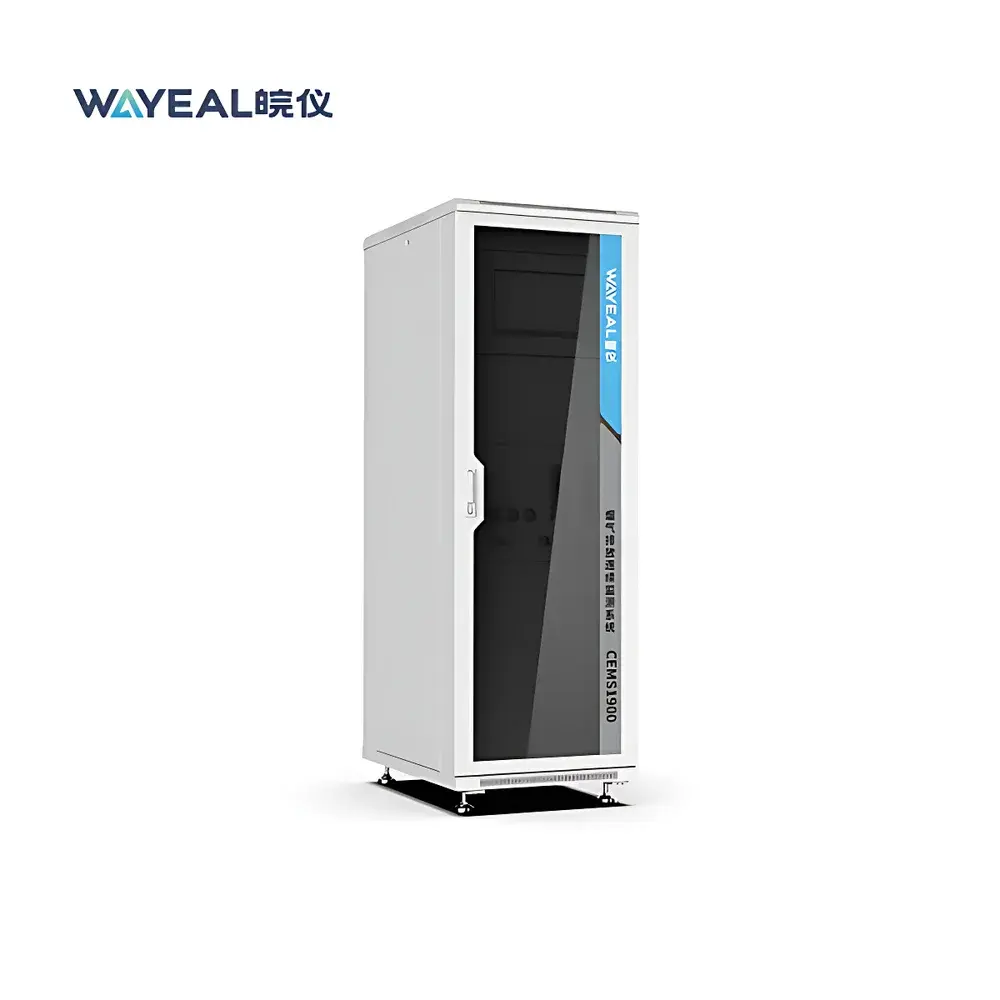
WAYEAL CEMS1900 Continuous Emission Monitoring System (FTIR-based)
| Brand | WAYEAL |
|---|---|
| Origin | Anhui, China |
| Manufacturer Type | Direct Manufacturer |
| Product Origin | Domestic (China) |
| Model | CEMS1900 |
| Instrument Type | Continuous Emission Monitoring System (CEMS) |
| Measurement Principle | Fourier Transform Infrared (FTIR) Spectroscopy |
| Accuracy | ≤ ±2% of Full Scale (F.S.) |
| Response Time | ≤ 200 s (typical gases) |
| Thermal Stability | Full-path high-temperature conditioning at 180 °C |
| Measured Gases | SO₂, NO, NO₂, NOₓ, NH₃, HCl, HF, O₂, CO, CO₂, CH₄, H₂O (wet/dry basis & normalized concentrations) |
Overview
The WAYEAL CEMS1900 is a fully integrated, stack-mounted Continuous Emission Monitoring System engineered for regulatory-grade, real-time quantification of gaseous pollutants and greenhouse gases in industrial flue gas streams. It employs Fourier Transform Infrared (FTIR) spectroscopy — a reference-grade, multi-component analytical technique based on molecular vibrational absorption signatures — to deliver simultaneous, non-destructive measurement of up to 12 target analytes without chemical conversion or catalytic interference. The system complies with the fundamental physical principles outlined in ISO 14956:2002 (air quality — performance criteria for automated measuring systems) and supports alignment with EN 15267-3 (performance certification of CEMS) and EPA Methods 320 and PS-15 for FTIR-based stack gas analysis. Designed for continuous operation under harsh industrial conditions, the CEMS1900 integrates high-temperature sampling, robust optical architecture, and traceable calibration protocols to ensure long-term data integrity required for environmental compliance reporting.
Key Features
- Full-path 180 °C heated sampling train — including SS316L probe, 50 m insulated heated line, and heated gas cell — eliminates condensation, prevents acid deposition (e.g., HCl, HF, H₂SO₄), and preserves true wet-basis concentration profiles.
- Gold-coated, temperature-stabilized multipass gas cell (operable up to 200 °C) with high-reflectivity optics optimized for corrosive gas environments; minimizes spectral drift and surface degradation.
- Interferometer with dynamic alignment compensation — mechanically decoupled from external vibration and thermal gradients — ensures stable fringe generation and high signal-to-noise ratio (>10,000:1) over extended duty cycles.
- Jet pump-based sampling (no moving parts) with closed-loop pressure regulation of instrument air supply — maintains constant volumetric flow rate independent of stack backpressure fluctuations.
- Integrated CO₂ scrubber and desiccant dryer for zero-gas generation; enables automated zero-point verification using purified instrument air as both purge and baseline reference.
- Multi-wavelength spectral deconvolution algorithm with water vapor interference correction — selectively isolates overlapping absorption bands (e.g., NH₃ vs. H₂O, NO₂ vs. HCl) using least-squares fitting against high-fidelity reference libraries.
Sample Compatibility & Compliance
The CEMS1900 is validated for use across heterogeneous flue gas matrices generated by waste-to-energy incineration (municipal solid waste, hazardous waste, medical waste), coal-fired power plants, cement kilns, coke ovens, sintering belts, and syngas production units. It accommodates inlet temperatures up to 300 °C (probe-rated), particulate loading ≤ 500 mg/Nm³ (with cyclonic pre-separation), and dew points up to 150 °C. All hardware components meet CE marking requirements per Directive 2014/30/EU (EMC) and 2014/35/EU (LVD). Data acquisition firmware supports audit-trail logging compliant with ISO/IEC 17025:2017 and facilitates integration into plant-level DCS/SCADA architectures via Modbus TCP and OPC UA. Calibration records, maintenance logs, and raw interferograms are retained with time-stamped digital signatures for GLP/GMP-aligned QA/QC workflows.
Software & Data Management
The embedded CEMS Control Suite provides ISO/IEC 17025-compliant data handling: automatic calculation of dry- and wet-basis concentrations, O₂-dilution correction (per EN 14181), volumetric flow normalization (to 11% O₂ or user-defined reference), and mass emission rate derivation using real-time stack velocity, temperature, and static pressure inputs. All spectra are archived in standard JCAMP-DX format; processed results comply with EU MRV (Monitoring, Reporting, Verification) and China’s HJ 75-2017 / HJ 76-2017 technical specifications for CEMS. Remote diagnostics, firmware updates, and spectral library expansion are supported via TLS-secured web interface. Audit trails include operator ID, timestamp, action type, and pre-/post-event spectral snapshots — satisfying FDA 21 CFR Part 11 electronic record requirements when deployed in regulated pharmaceutical or biotech co-incineration facilities.
Applications
- Regulatory compliance monitoring for national and provincial emission standards (e.g., China’s GB 18485-2014, EU IED Annex II, US EPA 40 CFR Part 60 Subpart Ea).
- Co-monitoring of criteria pollutants (SO₂, NOₓ, HCl, HF) and greenhouse gases (CO₂, CH₄, N₂O) in carbon accounting frameworks.
- Process optimization support in fluidized bed combustors and selective non-catalytic reduction (SNCR) systems via real-time NH₃ slip tracking.
- Stack testing validation and method comparison studies against reference methods (e.g., EPA Method 6C, 7E, 10, 25A).
- Long-term trend analysis of combustion efficiency indicators (CO/O₂ ratio, CO₂ conversion yield) in thermal treatment facilities.
FAQ
Does the CEMS1900 require periodic span calibration with certified gas standards?
Yes — per EN 14181 QAL2 requirements, initial calibration verification and semi-annual re-validation using traceable multi-component gas standards (NIST or equivalent) are mandatory for compliance-grade operation.
Can the system operate unattended for extended periods in remote stack locations?
Yes — the jet pump design, self-diagnostic firmware, and dual-redundant power input (24 VDC + 220 VAC) enable >30-day unattended operation; remote health monitoring is supported via SNMP or MQTT.
Is spectral library customization available for non-standard analytes?
Yes — customers may commission custom spectral acquisition and partial least squares (PLS) model development for emerging compounds (e.g., dioxin precursors, VOCs) under NDA-protected collaboration with WAYEAL’s application lab.
How is moisture interference managed during high-humidity sampling?
The system applies real-time multivariate water vapor subtraction using empirically derived H₂O absorption cross-sections and leverages the 180 °C hot-wet measurement approach to avoid condensation-induced bias.
What cybersecurity measures are implemented in the data acquisition unit?
The embedded controller runs a hardened Linux OS with disabled unused ports, TLS 1.2+ encryption for all remote interfaces, role-based access control (RBAC), and automatic log rotation with SHA-256 integrity hashing.







