
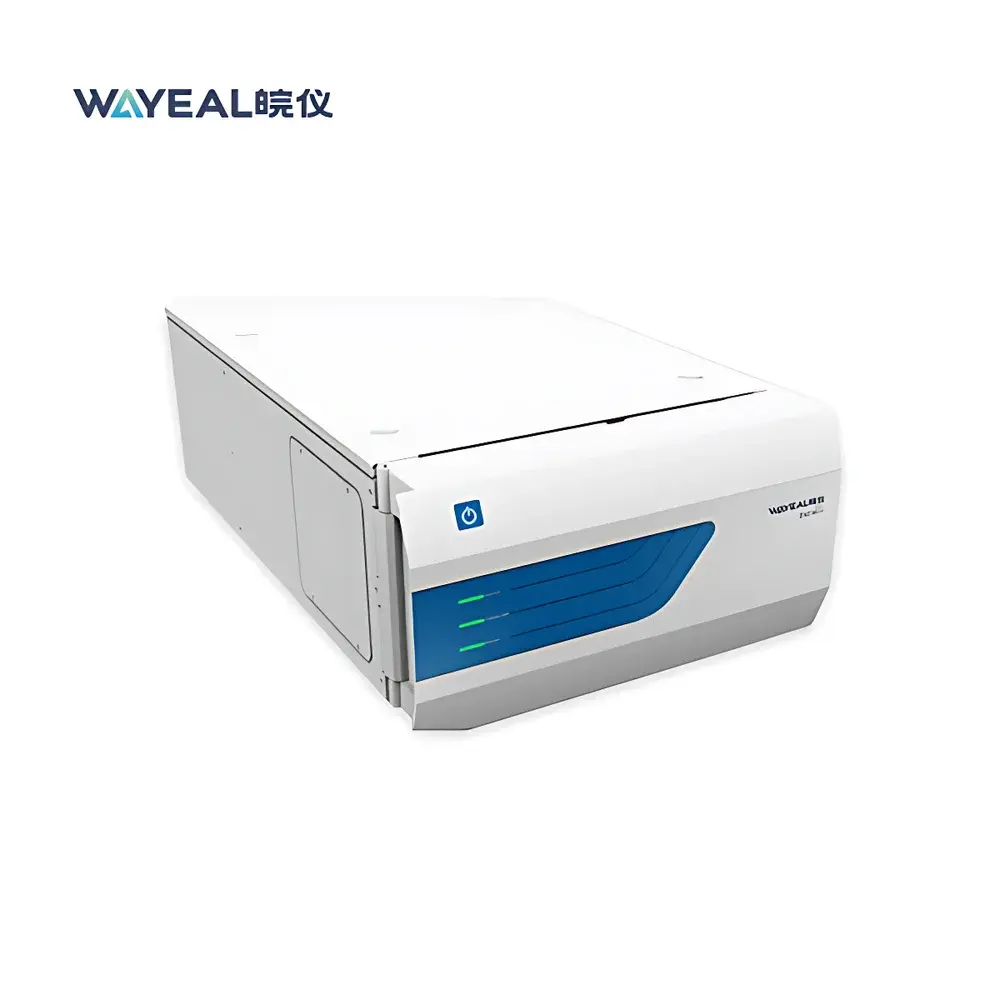
WAYEAL DAD-1000 Diode Array Detector for HPLC
| Brand | WAYEAL |
|---|---|
| Origin | Anhui, China |
| Manufacturer Type | Direct Manufacturer |
| Instrument Type | Diode Array Detector (DAD) |
| Wavelength Range | 190–800 nm |
| Baseline Drift | ≤ 3 × 10⁻⁵ AU/h |
| Wavelength Accuracy & Reproducibility | ≤ ±0.1 nm |
Overview
The WAYEAL DAD-1000 Diode Array Detector is a high-performance, optically integrated detection module engineered for compatibility with standard high-performance liquid chromatography (HPLC) systems. It operates on the principle of simultaneous multi-wavelength absorbance detection using a fixed grating spectrometer and a 1024-element silicon photodiode array. Unlike single-wavelength UV-Vis detectors, the DAD-1000 captures full UV-Vis spectra (190–800 nm) across every data point in real time—enabling true spectral fidelity during chromatographic elution. This capability supports not only quantitative analysis at user-defined wavelengths but also qualitative assessment via spectral deconvolution, peak purity evaluation, and library-based compound identification. The detector’s optical architecture minimizes path-length variability and thermal drift, contributing to long-term baseline stability and measurement reproducibility required in regulated laboratory environments.
Key Features
- Real-time acquisition of full UV-Vis spectra (190–800 nm) at up to 100 Hz sampling rate, preserving chromatographic resolution without spectral averaging.
- Optimized optical design with thermally stabilized grating and low-noise diode array sensor, achieving baseline drift of ≤ 3 × 10⁻⁵ AU/h over 1-hour operation.
- Wavelength calibration traceable to NIST-traceable holmium oxide and didymium filters; accuracy and reproducibility maintained at ≤ ±0.1 nm across the operational range.
- Integrated spectral processing engine supporting on-the-fly generation of maximum absorption chromatograms, contour plots, 3D surface renderings, and spectral overlays.
- Rugged mechanical housing with passive thermal management, designed for continuous operation in ambient laboratory conditions (15–30 °C, <80% RH non-condensing).
- Standard RS-232 and USB 2.0 interfaces for bidirectional communication with third-party HPLC control software or vendor-neutral chromatography data systems (CDS).
Sample Compatibility & Compliance
The DAD-1000 is compatible with standard stainless-steel or PEEK capillary flow cells (10 mm path length, 1 µL volume) and supports mobile phases commonly used in reversed-phase, normal-phase, and HILIC separations—including aqueous buffers, acetonitrile, methanol, and tetrahydrofuran. It complies with ISO/IEC 17025 general requirements for competence of testing and calibration laboratories, and its firmware architecture supports audit trail functionality aligned with FDA 21 CFR Part 11 requirements when deployed with compliant CDS platforms. Spectral data files adhere to ANDI/NetCDF format conventions, ensuring interoperability with open-source and commercial chemometric tools. The detector meets electromagnetic compatibility (EMC) standards per IEC 61326-1 and safety requirements under IEC 61010-1 for laboratory electrical equipment.
Software & Data Management
The DAD-1000 operates with WAYEAL’s proprietary ChromoView DAD Suite (v3.2+), which provides native support for spectral library creation, spectral subtraction, peak purity algorithms (e.g., threshold-based and correlation coefficient methods), and spectral match scoring against internal or user-loaded libraries (including NIST, Wiley, and custom reference sets). All raw spectral datasets are stored in HDF5 format with embedded metadata (acquisition time, lamp status, cell temperature, wavelength calibration coefficients). The software supports GLP-compliant electronic signatures, user role-based access control, and automated report generation conforming to ISO 17025 reporting guidelines. Export options include CSV (peak table + spectra), PNG/SVG (rendered chromatograms and overlays), and mzML-compatible spectral exports for integration into metabolomics or proteomics workflows.
Applications
- Method development and validation in pharmaceutical QC labs, including forced degradation studies and impurity profiling per ICH Q2(R2) guidelines.
- Identification and confirmation of co-eluting compounds in natural product extracts, food adulterants, or environmental water samples.
- Stability-indicating assay development where spectral consistency across retention time is critical for demonstrating method specificity.
- Photodiode array–driven peak tracking in preparative HPLC fraction collection, enabling wavelength-optimized triggering based on real-time spectral maxima.
- Supporting regulatory submissions requiring spectral evidence—such as FDA IND/NDA filings or EMA scientific advice requests—where spectral overlays and purity assessments are mandatory documentation elements.
FAQ
What is the minimum detectable absorbance change (noise level) for the DAD-1000?
The RMS noise level is specified at ≤ ±1.5 × 10⁻⁵ AU (measured at 254 nm, 1 s response time, water blank, 1 mL/min flow rate).
Can the DAD-1000 be retrofitted to legacy HPLC systems from other vendors?
Yes—provided the system offers analog output (0–1 V or 0–5 V) or digital interface (RS-232/USB) and supports external trigger synchronization; detailed integration protocols are included in the Technical Integration Manual.
Is spectral calibration performed automatically during startup?
No—calibration is semi-automated: users initiate wavelength verification using supplied reference filters; the system then adjusts internal lookup tables and logs calibration events with timestamps and operator ID.
Does the detector support variable path-length flow cells?
It is optimized for standard 10-mm-path-length cells; optional 6-mm and 1-mm microflow cells are available with recalibrated sensitivity profiles and updated spectral correction matrices.
How is data integrity ensured during extended unattended runs?
Raw spectral frames are written to non-volatile storage with cyclic redundancy checksums; the software enforces write-verification before advancing to the next scan, and all acquisition parameters are embedded in each dataset header.
Related Products





