
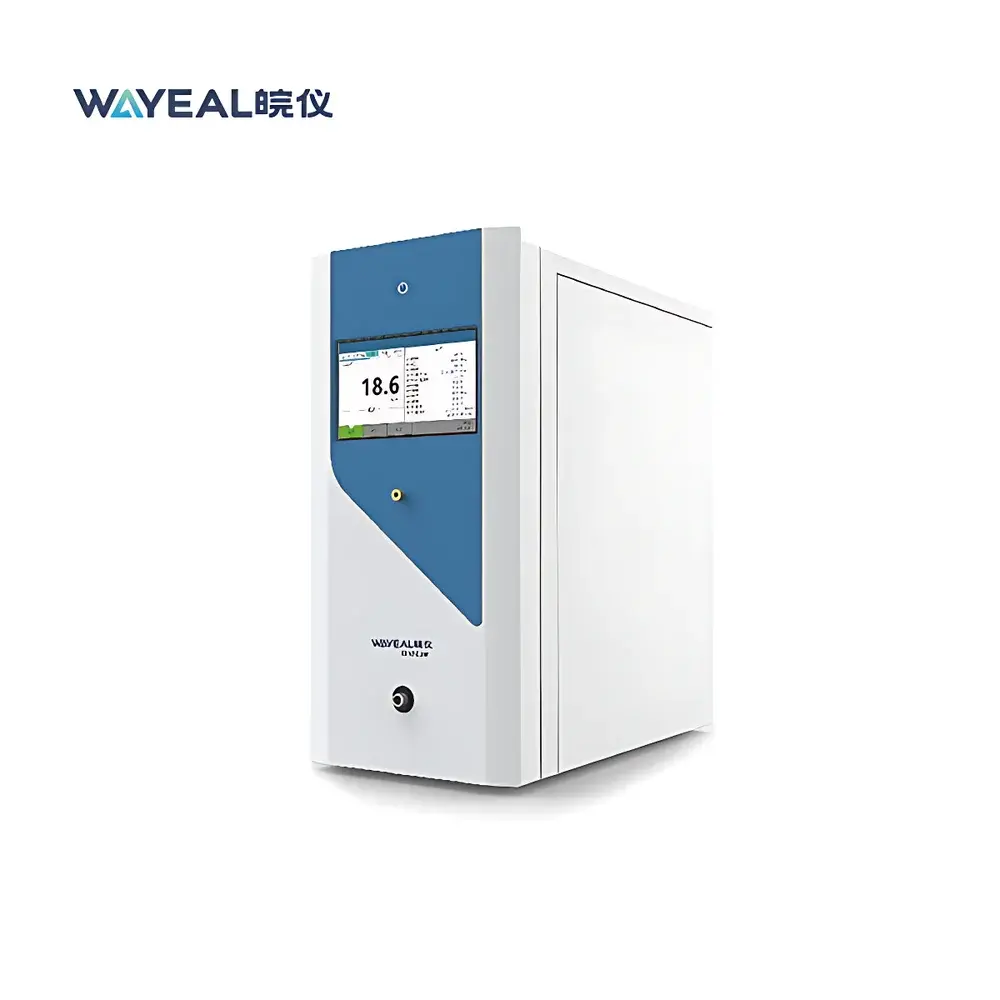
WAYEAL ELSD Series Evaporative Light Scattering Detector
| Brand | WAYEAL |
|---|---|
| Origin | Anhui, China |
| Manufacturer Type | Direct Manufacturer |
| Product Category | Domestic |
| Model | ELSD |
| Compatible Instrument | Liquid Chromatography (HPLC/UHPLC) |
| Detector Type | Evaporative Light Scattering Detector (ELSD) |
| Wavelength Range | Visible Light (400–700 nm) |
| Detection Principle | Light Scattering of Nebulized Analyte Particles |
| Light Source | High-Stability LED |
| Nebulization/Evaporation/Detection Gas Flow | Independently Controlled Triple-Gas System |
| Display | 7-inch Capacitive Touchscreen LCD |
| Operating Temperature Range | Ambient to 120 °C (Evaporator), Adjustable in 1 °C Increments |
| Sensitivity | Sub-nanogram Level for Non-Volatile and Semi-Volatile Compounds |
| Compliance | Designed to Support GLP/GMP Environments with Audit-Trail-Capable Software Integration |
Overview
The WAYEAL ELSD Series Evaporative Light Scattering Detector is a dedicated, high-performance detection module engineered for integration with liquid chromatography systems—including HPLC and UHPLC platforms. It operates on the well-established principle of evaporative light scattering: analytes eluting from the column are first nebulized into fine droplets using a controlled gas stream; volatile mobile-phase components are then removed via gentle, temperature-regulated evaporation; and the remaining non-volatile or semi-volatile analyte particles are illuminated by a stable visible-light LED source. The intensity of scattered light—proportional to particle mass—is captured by a high-gain photomultiplier tube (PMT), enabling universal, gradient-compatible, and mass-sensitive detection independent of chromophore presence. Unlike UV-Vis detectors, the ELSD provides consistent response across diverse compound classes—including lipids, carbohydrates, polymers, surfactants, and natural products—making it indispensable for method development in pharmaceutical, nutraceutical, and food quality control laboratories.
Key Features
- Low-Temperature Evaporation Architecture: Optimized evaporator design enables precise thermal control from ambient up to 120 °C in 1 °C increments, preserving thermally labile compounds such as glycosides, peptides, and certain vitamins without degradation.
- Triple-Independent Gas Flow Regulation: Separate mass-flow-controlled streams govern nebulization (N₂ or compressed air), evaporation (dry gas), and optical detection chamber purge—ensuring reproducible aerosol formation, complete solvent removal, and minimal background noise.
- LED-Based Illumination System: A high-stability, narrow-spectrum visible-light LED (centered at ~530 nm) delivers long-term intensity consistency (>20,000 hours MTBF), eliminating lamp replacement cycles and spectral drift associated with halogen or xenon sources.
- High-Sensitivity Photomultiplier Detection: Coupled with low-noise signal conditioning electronics, the PMT achieves sub-nanogram detection limits for sucrose, cholesterol, and polyethylene glycol standards under standardized HPLC-ELSD conditions.
- Intuitive 7-Inch Capacitive Touch Interface: Fully localized GUI supports real-time parameter adjustment (evaporator temp, gas flow rates, gain), method storage, and status diagnostics—no external PC required for routine operation.
Sample Compatibility & Compliance
The WAYEAL ELSD accommodates a broad range of sample types commonly encountered in regulated analytical workflows: non-UV-absorbing carbohydrates (e.g., fructose, maltodextrins), phospholipids, saponins, synthetic polymers, and excipients used in parenteral formulations. Its response is largely independent of chemical structure, offering near-uniform calibration slopes for homologous series—critical for relative quantitation in QC release testing. The detector’s hardware architecture and firmware support 21 CFR Part 11-compliant software integration when paired with validated chromatography data systems (CDS). It meets essential design criteria for GLP and GMP environments, including electronic signature capability, audit-trail logging of all parameter changes, and secure user access levels (operator, supervisor, administrator). While not certified to ISO/IEC 17025 out-of-the-box, its performance characteristics align with ASTM D7217–18 (Standard Practice for ELSD Use in Polymer Analysis) and USP guidelines for alternative detection strategies in chromatographic assays.
Software & Data Management
The ELSD communicates via standard USB 2.0 and RS-232 interfaces, ensuring seamless compatibility with major CDS platforms—including Thermo Chromeleon, Waters Empower, Agilent OpenLab, and Shimadzu LabSolutions. Native driver support enables full remote control of temperature, gas flows, and PMT gain directly from acquisition software. All operational parameters, detector status logs, and alarm events are timestamped and embedded within raw data files (.arw, .cdf), facilitating traceability during regulatory inspections. Optional firmware upgrade paths include enhanced peak integration algorithms for baseline-resolved ELSD chromatograms and automated system suitability reporting per ICH Q2(R2) expectations.
Applications
- Pharmaceutical Development: Quantification of API impurities lacking UV chromophores; assay of lipid-based nanocarriers (liposomes, LNPs); residual solvent analysis in lyophilized formulations.
- Food & Beverage QA/QC: Sucrose/fructose profiling in fruit juices; detection of starch hydrolysates and prebiotic oligosaccharides; adulteration screening in honey and maple syrup.
- Natural Products Research: Fingerprinting of triterpenoid saponins from herbal extracts; molecular weight distribution assessment of polysaccharide fractions.
- Polymer Characterization: SEC-MALS-ELSD hyphenated workflows for absolute molar mass determination of non-UV-active polymers (e.g., PEG, PVP, cellulose derivatives).
- Biopharmaceutical Process Monitoring: In-line detection of host cell proteins (HCPs) and process-related impurities during purification steps where UV absorbance is confounded by buffer components.
FAQ
Does the WAYEAL ELSD require a specific carrier gas?
Yes—nitrogen is recommended for optimal sensitivity and baseline stability; however, oil-free compressed air may be used for cost-sensitive applications with minor trade-offs in noise floor.
Can the ELSD be used with gradient elution methods?
Yes—its universal detection mechanism eliminates refractive index artifacts common in RID, making it fully compatible with reversed-phase and HILIC gradients containing acetonitrile, methanol, or aqueous buffers.
What maintenance intervals are recommended for routine operation?
Nebulizer capillary cleaning every 500 injections; evaporator chamber inspection and wipe-down every 2,000 injections; PMT gain calibration annually or after major environmental shifts.
Is the detector compatible with UHPLC systems operating above 1,000 bar?
Yes—the flow-cell design and pressure-rated fittings support inlet pressures up to 1,300 bar, and the fast-response electronics accommodate dwell-time-corrected gradient delivery typical of modern UHPLC platforms.
How does ELSD response compare to CAD (Charged Aerosol Detection)?
ELSD offers superior ruggedness and lower operational cost but exhibits slightly lower mass sensitivity and broader dynamic range compression compared to CAD; method transfer between the two requires re-optimization of gas flows and temperature profiles.





