
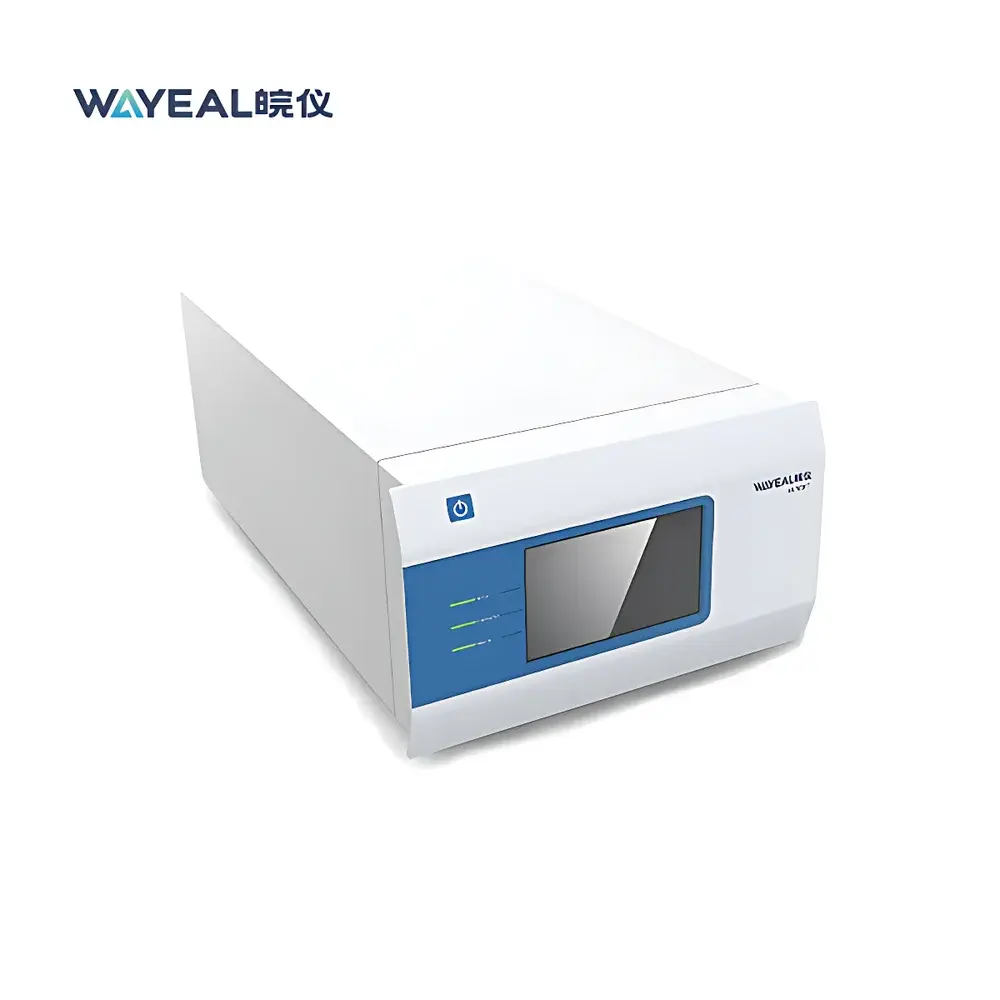
WAYEAL FLD Fluorescence Detector for HPLC Systems
| Brand | WAYEAL |
|---|---|
| Origin | Anhui, China |
| Manufacturer Type | Original Equipment Manufacturer (OEM) |
| Product Category | Domestic |
| Model | FLD |
| Instrument Type | Fluorescence Detector (FD) |
| Wavelength Range | 200–650 nm |
| Detection Mode | Fluorescence |
| Light Source | Mercury-Xenon Lamp |
| Display Interface | Touchscreen LCD |
| Data Output | Dual Analog Channels |
| Communication Interfaces | RS232, Ethernet |
| Compatible System | High-Performance Liquid Chromatography (HPLC) |
Overview
The WAYEAL FLD Fluorescence Detector is a high-sensitivity, dual-monochromator fluorescence detection system engineered for integration with high-performance liquid chromatography (HPLC) platforms. It operates on the principle of photoluminescence detection: analytes eluting from the HPLC column are excited by monochromatic light at a user-selectable excitation wavelength, and the resulting fluorescence emission—typically redshifted—is isolated via a second monochromator and quantified by a low-noise photomultiplier tube (PMT). This orthogonal optical architecture minimizes stray light interference and enables precise spectral resolution critical for selective detection in complex matrices. Designed for routine QC laboratories and research environments requiring trace-level quantification of native or derivatized fluorophores, the FLD delivers high reproducibility across extended run times and supports method transfer between instruments without recalibration.
Key Features
- Dual-grating monochromator design with independently adjustable excitation and emission wavelengths (200–650 nm), enabling spectral scanning and optimal signal-to-noise ratio optimization per analyte.
- Stable mercury-xenon arc lamp providing broad UV-Vis spectral output with consistent intensity over >2,000 hours of operation; lamp power and dwell time are software-controlled to extend service life.
- Integrated 7-inch capacitive touchscreen LCD for standalone instrument control—supports real-time chromatogram display, wavelength parameterization, gain adjustment, and baseline diagnostics without external PC dependency.
- Dual analog voltage outputs (0–1 V and 0–10 V, configurable polarity) compliant with legacy data acquisition systems and third-party integrators.
- Standard RS232 serial interface and optional 10/100 Mbps Ethernet port supporting TCP/IP-based remote monitoring, firmware updates, and bidirectional command execution per ASTM E1319 and ISO/IEC 17025-compliant workflows.
- Modular flow cell with 8 µL pathlength and fused silica windows optimized for low dispersion and minimal carryover; compatible with standard 1/16″ stainless steel or PEEK capillary connections.
Sample Compatibility & Compliance
The FLD detector demonstrates validated sensitivity for native fluorescent compounds—including polycyclic aromatic hydrocarbons (PAHs), aflatoxins (B1, B2, G1, G2), vitamins (B2, K1), amino acids (tryptophan, tyrosine), and pharmaceutical metabolites—without chemical derivatization. For non-fluorescent analytes, post-column derivatization modules (e.g., o-phthalaldehyde, ninhydrin) can be coupled via auxiliary ports. All optical and electronic subsystems comply with IEC 61010-1 safety standards for laboratory equipment. Firmware supports audit trail logging and user-access controls aligned with FDA 21 CFR Part 11 requirements when operated within validated chromatography data systems (CDS). Calibration verification protocols follow USP and EP 2.2.46 guidelines for fluorescence detector performance qualification.
Software & Data Management
The detector is fully interoperable with major third-party HPLC data systems (e.g., Waters Empower, Thermo Chromeleon, Agilent OpenLab CDS) via standard ASCII or binary data streaming protocols. Native WAYEAL Chromatography Workstation software provides method editor, real-time peak integration, spectral library matching, and batch report generation with PDF/CSV export. Raw detector signals are timestamped with microsecond precision and stored in vendor-neutral .CDF (NetCDF-based) format, ensuring long-term archival integrity and cross-platform readability. All configuration changes—including wavelength pairs, PMT voltage, and analog scaling—are recorded with operator ID, timestamp, and reason-for-change metadata to satisfy GLP/GMP documentation requirements.
Applications
- Quantitative analysis of mycotoxins in cereal and feed samples per AOAC 2005.05 and EU Regulation No. 1881/2006.
- Residue monitoring of PAHs in environmental water and soil extracts following EPA Method 8310.
- Stability-indicating assays for fluorescent APIs (e.g., quinolones, tetracyclines) under ICH Q2(R2) validation frameworks.
- Quality control of vitamin-fortified food products per AOAC 999.11 and ISO 11292.
- Metabolite profiling in preclinical pharmacokinetic studies using LC-FLD hyphenation.
FAQ
What is the minimum detectable concentration for aflatoxin B1 under typical HPLC-FLD conditions?
Detection limits depend on column efficiency, mobile phase composition, and injection volume; typical LODs range from 10–50 pg on-column using reversed-phase C18 separation and gradient elution.
Can the FLD be used with UHPLC systems operating above 600 bar?
Yes—the flow cell is rated to 700 bar and features zero-dead-volume fittings compatible with sub-2 µm particle columns.
Is spectral calibration traceable to NIST standards?
Wavelength accuracy is verified using holmium oxide and didymium glass filters certified to NIST SRM 2034 and SRM 2035 during factory acceptance testing.
Does the detector support synchronous scanning or three-dimensional excitation-emission matrix (EEM) acquisition?
No—this model implements fixed-wavelength or sequential wavelength scanning only; EEM functionality requires dedicated spectrofluorometric hardware.
How often does the mercury-xenon lamp require replacement?
Under normal usage (8 h/day, 5 days/week), lamp lifetime exceeds 2,000 hours; integrated lamp hour counter triggers maintenance alerts at 90% end-of-life threshold.





