
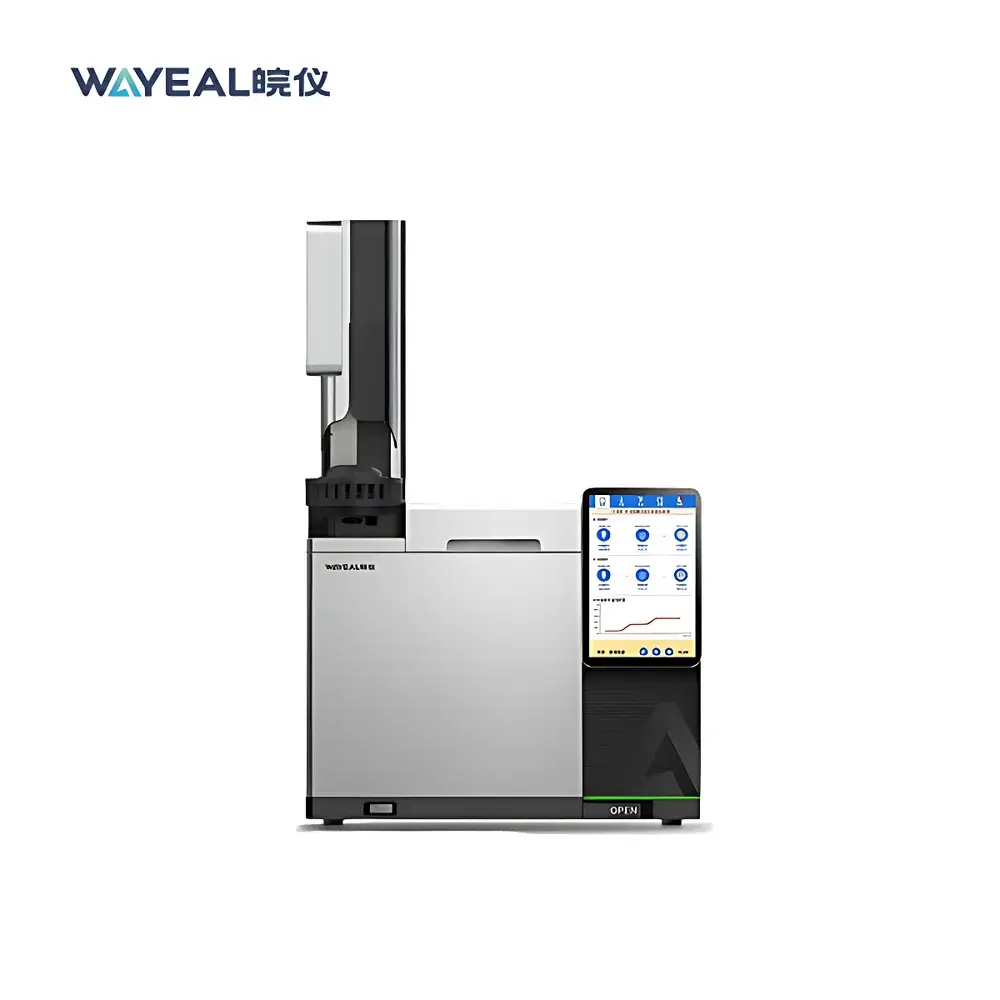
WAYEAL GC6100 Laboratory Gas Chromatograph
| Brand | WAYEAL |
|---|---|
| Origin | Anhui, China |
| Manufacturer Type | Direct Manufacturer |
| Instrument Type | Laboratory Gas Chromatograph |
| Model | GC6100 |
| Application Scope | General-Purpose |
| Control Architecture | Dual-Core Mainboard (Quad-Core Application Processor + Dual-Core Co-Processor) |
| Temperature Control | PID with Auto-Tuning & Environmental Compensation |
| EPC System | High-Stability Electronic Pressure Control |
| Detectors Supported | FID (1000 Hz Sampling Rate, 0.5 ms Minimum Peak Width), ECD (Low-Radiation Microcell), MS (Integrated with WAYEAL Mass Spectrometer) |
| Software Platform | SmartLab CDS Workstation with H.B.C-ApexFinder & SmartPeak Algorithms |
| Connectivity | Web-Based UI, Touchscreen (10.1" Capacitive), Remote Access via Browser |
| Compliance Features | Audit Trail, User Permission Levels, Electronic Signatures (FDA 21 CFR Part 11 Ready), GLP/GMP Data Integrity Support |
Overview
The WAYEAL GC6100 is a laboratory-grade gas chromatograph engineered for precision, reproducibility, and operational resilience in regulated and research-intensive environments. It operates on the fundamental principle of separating volatile and semi-volatile compounds based on differential partitioning between a mobile phase (carrier gas) and a stationary phase (capillary column), with detection achieved via flame ionization (FID), electron capture (ECD), or coupled mass spectrometry (MS). Designed as a modular, future-ready platform, the GC6100 integrates advanced thermal management, digital electronic pressure control (EPC), and embedded real-time diagnostics to ensure retention time stability, peak area repeatability, and minimal baseline drift across multi-day sequences. Its dual-core control architecture—comprising a quad-core application processor and dedicated dual-core co-processor—enables concurrent execution of instrument control, self-diagnosis, environmental compensation, and data acquisition without latency or resource contention.
Key Features
- High-fidelity temperature control system featuring auto-tuning PID algorithms with integrated temperature and pressure compensation, ensuring intra- and inter-day retention consistency under variable ambient conditions.
- Digital EPC delivering ±0.01 psi pressure resolution and <0.05% RSD flow stability across 0–100 mL/min range, supporting complex gradient methods and multi-detector configurations.
- FID detector with 1000 Hz sampling rate and digital amplification circuitry—capable of resolving peaks as narrow as 0.5 ms full width at half maximum (FWHM) and offering a linear dynamic range exceeding 10⁷.
- ECD detector incorporating low-radiation, miniaturized microcell design with enhanced surface passivation, achieving sub-femtogram sensitivity for halogenated compounds while maintaining operator safety and long-term baseline stability.
- Native MS compatibility via synchronized timing interface and unified SmartLab CDS software control—eliminating third-party middleware and enabling single-point method development for GC-MS workflows.
- 7 independent temperature-controlled zones—including oven, inlet(s), detector(s), and valve manifold—supporting rapid ramp rates (up to 120 °C/min) and simultaneous multi-detector operation.
- 10.1-inch capacitive touchscreen with intuitive graphical interface, complemented by browser-based remote access (Chrome, Edge, Safari) for instrument monitoring and method initiation from any networked device.
Sample Compatibility & Compliance
The GC6100 accommodates liquid, gaseous, and headspace samples through configurable inlets including split/splitless, PTV, and cooled injection systems. Optional integration with autosamplers (liquid, headspace, purge-and-trap) enables unattended high-throughput analysis of environmental, pharmaceutical, food safety, and petrochemical matrices. All fluidic pathways undergo rigorous inertization (siliconized fused silica, deactivated stainless steel) and microfluidic plate-based routing to minimize adsorption, carryover, and catalytic degradation. The system meets essential regulatory requirements for analytical instrumentation: data integrity features include role-based user authentication, immutable audit trails, electronic signatures, and secure archive export—all aligned with FDA 21 CFR Part 11, ISO/IEC 17025, and GLP/GMP documentation standards. Hardware validation protocols support IQ/OQ/PQ execution per ASTM D3612, USP , and EP 2.2.46.
Software & Data Management
SmartLab CDS is a validated chromatography data system built on a client-server architecture with local or network-deployable database options (Microsoft SQL Server or embedded SQLite). It implements H.B.C-ApexFinder—a retention-time-aware peak detection algorithm that dynamically adjusts integration parameters based on signal-to-noise ratio, peak asymmetry, and neighboring elution profiles. SmartPeak employs second-derivative thresholding to resolve co-eluting shoulders and low-amplitude components without manual reprocessing. All processing methods are version-controlled and exportable as XML templates. Raw data files (.wdf) are stored with embedded metadata (instrument configuration, calibration history, user ID, timestamp), and reports comply with customizable templates adhering to LIMS integration standards (ASTM E1467, HL7). Data backups, encryption-at-rest, and automatic log rotation are configurable per organizational IT policy.
Applications
The GC6100 serves as a primary analytical tool across multiple regulated domains: residual solvent quantification in APIs (ICH Q3C), pesticide residue screening in agricultural commodities (AOAC 2017.16), hydrocarbon speciation in fuels (ASTM D6730), volatile organic compound (VOC) profiling in indoor air (EPA TO-17), and fatty acid methyl ester (FAME) analysis in biodiesel (EN 14103). Its modularity supports method transfer from legacy GC platforms, while its MS-coupling capability extends utility into structural elucidation, metabolomics, and impurity identification workflows. Routine QC labs benefit from automated calibration verification, scheduled maintenance alerts, and predictive diagnostics that reduce unplanned downtime by up to 40% compared to conventional single-processor architectures.
FAQ
Does the GC6100 support FDA 21 CFR Part 11 compliance?
Yes—SmartLab CDS includes electronic signature workflows, audit trail logging with tamper-evident hashing, and configurable user roles with privilege escalation controls.
Can I run GC and GC-MS methods within the same software environment?
Yes—the SmartLab platform natively controls both standalone GC and GC-MS configurations using shared method templates and unified report generation.
What is the minimum detectable peak width the FID can resolve?
The FID supports sampling at 1000 Hz, enabling reliable detection of peaks with full-width at half-maximum (FWHM) as narrow as 0.5 milliseconds under optimized flow and column conditions.
Is remote instrument monitoring supported without additional hardware?
Yes—browser-based remote access is built-in; no external gateway or VPN appliance is required beyond standard network infrastructure.
How does the system handle carrier gas conservation during idle periods?
The GC6100 features programmable carrier gas save mode and deep-sleep/wake-on-command functionality, reducing helium or hydrogen consumption by up to 70% during non-analysis intervals.





