
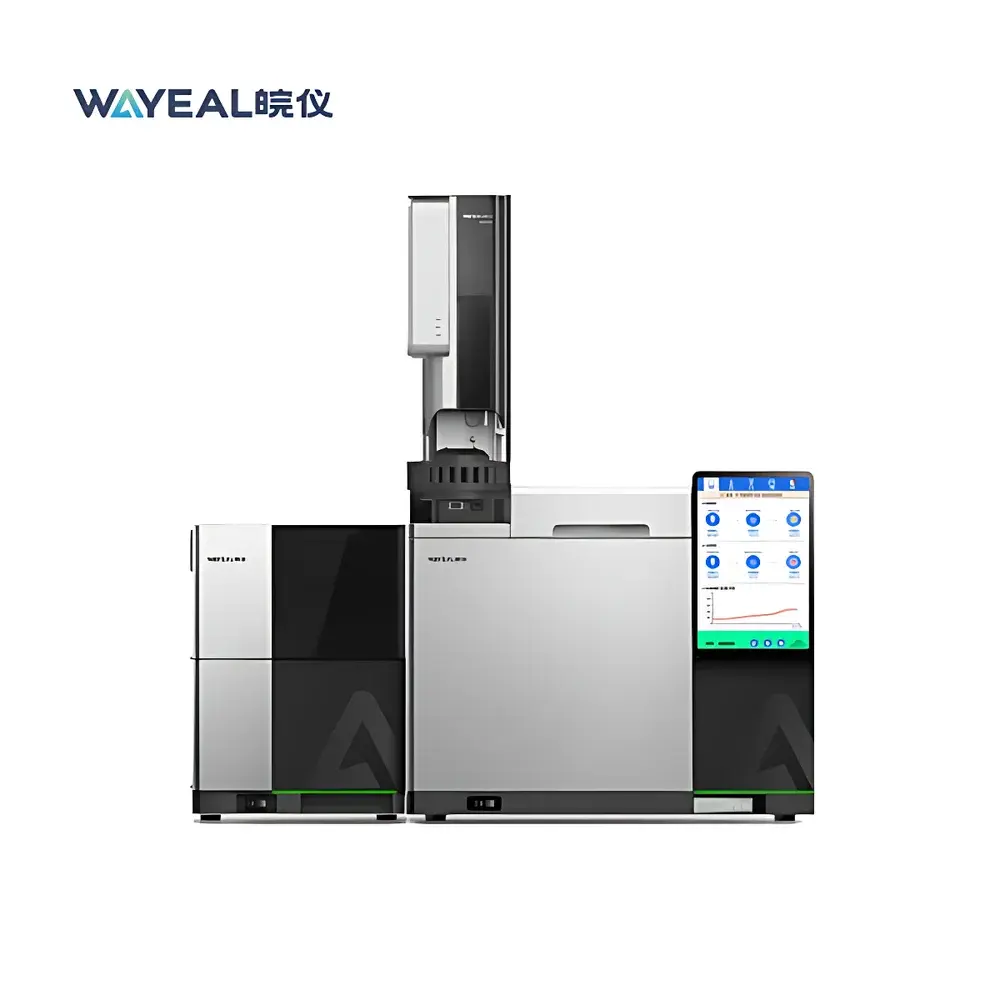
WAYEAL GM6100 Gas Chromatography-Mass Spectrometry (GC-MS) System
| Brand | WAYEAL |
|---|---|
| Origin | Anhui, China |
| Manufacturer | WAYEAL Scientific Instrument Co., Ltd. |
| Instrument Type | Single Quadrupole Mass Spectrometer |
| GC Configuration | Conventional Capillary Gas Chromatograph |
| System Architecture | Integrated GC-MS Platform |
| Control Software | Unified GUI for Acquisition, Processing & Reporting |
| Compliance Framework | Designed to support GLP/GMP workflows and 21 CFR Part 11–ready audit trail functionality (configuration-dependent) |
Overview
The WAYEAL GM6100 Gas Chromatography-Mass Spectrometry (GC-MS) System is an integrated analytical platform engineered for routine and research-grade organic compound identification, quantification, and method development in environmental, pharmaceutical, food safety, and forensic laboratories. It combines the GC6100 capillary gas chromatograph—featuring precision temperature-programmable oven control, split/splitless injection capability, and low thermal mass transfer lines—with the MSD7000 single quadrupole mass spectrometer, which employs electron ionization (EI) and optional chemical ionization (CI) sources. The system operates on a robust vacuum architecture with turbomolecular pumping, enabling stable ion transmission and high signal-to-noise ratio across m/z 10–1000. Data acquisition follows NIST-compatible spectral acquisition standards, supporting library search compatibility with NIST, Wiley, and user-defined spectral libraries. The GM6100 is designed for reproducible retention time alignment, consistent peak shape fidelity, and long-term baseline stability—critical for validated quantitative workflows.
Key Features
- Integrated hardware architecture: Synchronized GC oven, injector, and MS interface ensure precise timing control between separation and ion detection.
- MSD7000 mass analyzer: Temperature-stabilized quadrupole rod set with digital RF/DC power supply for improved mass accuracy (< ±0.1 Da) and resolution (unit mass resolution at 10% valley definition).
- Electron Ionization (EI) source: Standard 70 eV filament operation with dual-filament redundancy; heated transfer line (up to 350 °C) minimizes condensation and carryover.
- GC6100 chromatograph: Programmable oven range from 4 °C above ambient to 450 °C, with ramp rates up to 120 °C/min and isothermal hold precision of ±0.1 °C.
- Autosampler compatibility: Supports 108-position liquid autosamplers with programmable syringe wash, needle purge, and injection volume calibration.
- Real-time system diagnostics: Embedded sensor network monitors vacuum status, detector gain, filament emission current, and column head pressure—logging all parameters with timestamps.
Sample Compatibility & Compliance
The GM6100 accommodates volatile and semi-volatile organic compounds (VOCs/SVOCs) with boiling points up to ~350 °C and molecular weights below 800 Da. Compatible sample introduction modes include split/splitless injection, cold on-column, and programmable temperature vaporization (PTV). The system supports derivatized analytes (e.g., silylated pesticides, fatty acid methyl esters) and complies with core regulatory requirements for analytical instrumentation: ASTM D5845 (petroleum hydrocarbons), EPA Method 8270 (SVOCs), USP (chromatographic system suitability), and ISO/IEC 17025–aligned instrument qualification protocols. When configured with secure user authentication, electronic signatures, and audit trail logging, the GM6100 meets functional prerequisites for FDA 21 CFR Part 11 compliance in regulated environments.
Software & Data Management
The GM6100 is operated via WAYEAL GCMS Navigator—a Windows-based application built on a modular architecture supporting method creation, sequence definition, real-time monitoring, and post-run processing. Raw data files conform to ANDI/NetCDF format for cross-platform interoperability. Quantitative analysis includes internal standard, external standard, and standard addition calibration models with automatic peak integration using adaptive baseline algorithms. Batch processing enables parallel review of multiple samples, with customizable report templates exportable to PDF, CSV, or Excel. All user actions—including method edits, data reprocessing, and report generation—are recorded in a tamper-evident audit trail compliant with ALCOA+ principles (Attributable, Legible, Contemporaneous, Original, Accurate, Complete, Consistent, Enduring, Available).
Applications
- Environmental testing: Detection and quantification of PAHs, PCBs, organochlorine pesticides, and phthalate esters in soil, water, and air matrices.
- Pharmaceutical impurity profiling: Identification of genotoxic impurities per ICH M7 guidelines using retention index matching and spectral deconvolution.
- Food authenticity and adulteration screening: Fatty acid profile analysis, flavor compound fingerprinting, and pesticide residue multi-residue methods (MRMs).
- Forensic toxicology: Targeted screening of drugs of abuse (e.g., amphetamines, benzodiazepines) in biological fluids using selected ion monitoring (SIM) and retention time locking.
- Materials science: Volatile organic emissions (VOC) testing from polymers, adhesives, and coatings per ISO 16000-9.
FAQ
What ionization modes does the MSD7000 support?
The MSD7000 provides standard electron ionization (EI) and optional chemical ionization (CI) with methane or isobutane reagent gas.
Is the GM6100 compatible with third-party GC columns?
Yes—it accepts standard 0.1–0.53 mm ID fused silica capillary columns with universal ferrule-based inlet connections.
Can the system perform quantitative analysis without internal standards?
Yes, though internal standardization is recommended for highest precision in complex matrices; external calibration and standard addition are also supported.
Does the software support automated spectral deconvolution for co-eluting peaks?
Yes—GCMS Navigator includes AMDIS (Automated Mass Spectral Deconvolution and Identification System) integration for resolving overlapping components.
What vacuum pump configuration is used?
A dual-stage turbomolecular pump backed by a dry scroll forepump ensures rapid pump-down (< 15 min to operational vacuum) and low base pressure (< 5 × 10⁻⁶ Torr).




